
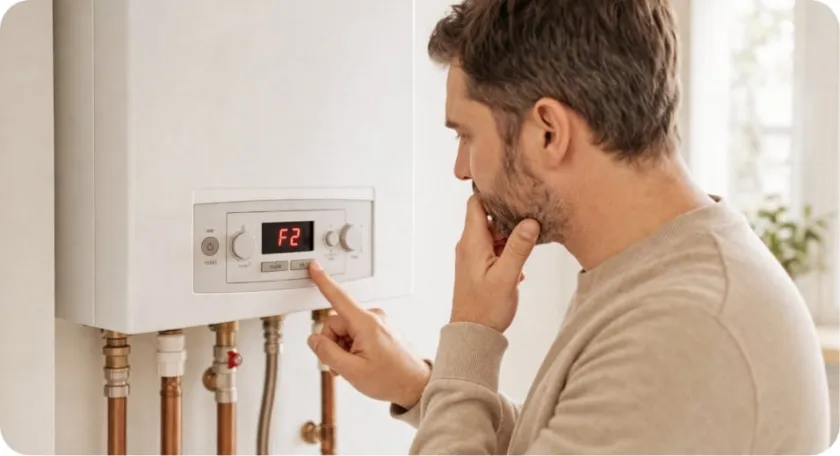
| An F2 fault code means your boiler has attempted to ignite and failed to detect a stable flame. On its own, this is not immediately dangerous. The boiler locks out as a safety response, shutting down rather than allowing unburned gas to build up. However, the underlying cause matters. Some causes are harmless and fixable in minutes. Others, particularly flue faults or gas supply issues, need a qualified engineer before you restart the boiler. |
Seeing an error code on your boiler display is never a welcome sight, especially when the heating is off and you have no idea what the code actually means. An f2 boiler fault refers specifically to a flame failure, meaning the boiler tried to light and could not confirm that ignition actually happened. It is one of the more common fault codes across Ideal and several other boiler brands.
This article explains exactly what is happening inside your boiler when that code appears, which causes are safe to investigate yourself, which ones require a professional, and what to do in the right order so you do not make things worse or miss a genuine safety concern.
What Does an F2 Fault Code Actually Mean?
When a boiler fires up, it opens the gas valve, sparks the ignition electrode, and then checks for a flame using a sensor called a thermocouple or flame detection probe. If that sensor does not confirm a stable flame within a few seconds, the boiler shuts down and logs a fault.
That shutdown is a deliberate safety feature, not a malfunction. The boiler is behaving exactly as designed. Allowing repeated ignition attempts without flame confirmation would allow gas to accumulate, which is genuinely dangerous. The lockout prevents that.
So the F2 boiler error code is more accurately described as a safety response than a fault. The fault is whatever prevented the flame from establishing in the first place.
Common Causes of Flame Failure on a Boiler
1.Gas Supply Interruption
Start with the simplest possibility. Check whether your other gas appliances are working. Put a hob ring on for 30 seconds. If that works normally, your gas supply is fine and the issue is inside the boiler. No gas to the hob means either a supply outage in your area or a problem at your meter, neither of which requires touching the boiler.
Contact your gas supplier to check for outages before assuming anything is wrong with the boiler itself.
2. Dirty or Faulty Ignition Electrode
The ignition electrode is a small ceramic-tipped component that produces the spark to light the gas. Over time, it builds up carbon deposits from normal combustion. When it gets dirty enough, the spark either does not form properly or cannot bridge the gap reliably.
A competent homeowner who is comfortable with basic appliance maintenance can sometimes clean the tip carefully with fine sandpaper or an abrasive pad. However, if the electrode is cracked, corroded at the connections, or positioned incorrectly, it needs replacing by an engineer.
3. Faulty Flame Sensor or Thermocouple
Even when ignition happens successfully, a faulty flame sensor can fail to detect it. The boiler reads no flame confirmation and shuts down, even though a flame was present. This is a component replacement job and not something you can test or fix without the right equipment.
A Gas Safe registered engineer can measure the sensor’s output with a multimeter to confirm whether it is functioning correctly.
4. Blocked or Damaged Flue
Your boiler’s flue removes combustion gases from the property. A partial blockage, bird nesting material being a surprisingly common cause in spring and early summer, can disrupt the air-to-gas ratio enough to prevent stable combustion. Some modern boilers will also detect flue issues directly and use the flame failure code as a secondary indicator.
Do not attempt to restart a boiler you suspect has a flue problem. This is an engineer job and it is not something to delay.
5. Faulty Gas Valve
The gas valve controls the flow of gas into the burner. A valve that is sticking, failing electrically, or not opening fully will starve the burner and cause repeated ignition failures. This is a component-level repair that only a Gas Safe engineer should handle.
6. PCB Fault
The printed circuit board is the boiler’s control system. It manages the timing and sequencing of ignition. A PCB that is sending incorrect signals, losing power intermittently, or has a failed relay can cause flame failure codes even when every other component is working correctly. Diagnosing a PCB fault requires specialist knowledge and equipment.
F2 Fault Causes at a Glance
| Possible Cause | Fix Yourself? | Engineer Needed? |
| Gas supply interrupted | Check other appliances | If supply confirmed, yes |
| Dirty or corroded ignition electrode | Clean carefully (competent DIY) | Yes, if unsure |
| Faulty flame sensor / thermocouple | No | Yes |
| Blocked or damaged flue | No | Yes, urgently |
| Faulty gas valve | No | Yes |
| PCB fault | No | Yes |
| Low gas pressure at meter | Contact gas supplier | Yes if persists |
Is the F2 Fault Dangerous?
In most cases, no. The boiler has locked out, gas flow has stopped, and there is no active risk to your household. You are sitting with a cold boiler rather than a hazardous one.
There are two situations where the F2 fault does carry a risk worth taking seriously. First, if the fault is being caused by a flue problem, attempting to restart and run the boiler without fixing that issue first could lead to incomplete combustion and carbon monoxide production. Second, if you can smell gas after the boiler has locked out, do not reset the boiler. Leave the property, leave doors open as you go, and call the National Gas Emergency line on 0800 111 999.
For most homeowners, though, an F2 fault means a boiler that will not start rather than one that poses an active danger.
What to Do When Your Boiler Shows an F2 Code
Step 1: Check for a Gas Supply
Test a gas hob or another appliance. Confirm your gas supply is live before assuming the boiler is the problem.
Step 2: Check for Any Gas Smell
Stand near the boiler for a moment. A smell of gas means you stop here. Do not reset, do not try anything else. Open windows, leave the property, and call the emergency gas line immediately.
Step 3: Reset the Boiler Once
If there is no gas smell and your supply is confirmed, try one reset using the button or menu on the boiler display. Observe whether the boiler fires up and holds a flame for at least a few minutes.
A single successful restart after which the boiler runs normally for the rest of the day might indicate a one-off ignition hiccup. One that immediately faults again or that keeps failing over the following days needs professional attention.
Step 4: Do Not Reset Repeatedly
Repeatedly resetting a boiler that keeps locking out does not fix the problem and can mask important diagnostic information. Most boilers log fault history, and an engineer reading that log can identify patterns. Constant resets can make that harder.
Step 5: Call a Gas Safe Engineer
Any F2 fault that does not clear after a single reset, or that keeps coming back, needs a qualified engineer to diagnose. Attempting to access internal gas components without Gas Safe registration is illegal in the UK and potentially dangerous regardless of your DIY confidence.
Can You Reset an F2 Fault Yourself?
Yes, a single reset attempt is reasonable and safe in most situations where there is no gas smell and the supply is confirmed. Hold the reset button on your boiler for the duration specified in the manual, usually between three and ten seconds, and release.
What you should not do is reset the boiler multiple times hoping the problem will go away, or bypass any lockout mechanism. Lockouts exist for a reason.
How Long Does an F2 Boiler Repair Take?
That depends entirely on the cause. A dirty ignition electrode that just needs cleaning might take an engineer 20 minutes. A faulty gas valve or PCB replacement could take a couple of hours, plus any time needed to source the part if it is not on the van.
Most common F2 fault causes are resolved within a single visit when diagnosed by an experienced engineer. The cost will vary depending on the component and the call-out rate, but getting a professional assessment first means you are not paying for parts that do not need replacing.
Preventing F2 Faults: Annual Servicing
Most F2 faults are preventable with regular boiler servicing. During an annual service, an engineer cleans the ignition electrode, checks the flame sensor output, inspects the flue for obstructions, and tests gas pressure at the burner. Components showing early signs of wear get flagged before they cause a lockout.
Boilers that are serviced annually also tend to run more efficiently, which reduces energy bills over time. Gas Safe engineers can spot the kind of slow deterioration that does not trigger a fault code but does affect combustion quality.
Frequently Asked Questions
Q: Is an F2 fault on a boiler an emergency?
Not usually. An F2 fault means the boiler has locked out safely rather than continuing to attempt ignition. The exception is if you can smell gas after the lockout, in which case you should leave the property and call the National Gas Emergency line on 0800 111 999 without attempting any reset.
Q: Why does my Ideal boiler keep showing F2?
Repeated F2 faults on an Ideal boiler are most commonly caused by a worn ignition electrode, a failing flame sensor, or a gas valve that is not opening consistently. An engineer reading the boiler’s fault log can usually pinpoint the cause quickly.
Q: Can I fix an F2 boiler fault myself?
You can check your gas supply and attempt a single reset safely. Cleaning a visibly sooty ignition electrode is something some homeowners tackle carefully. Beyond that, any repair involving gas components must be carried out by a Gas Safe registered engineer.
Q: How much does it cost to fix an F2 fault?
Costs vary depending on the cause and your location. A simple electrode clean during a service call might add little to a standard call-out fee. A gas valve or PCB replacement will cost more, typically between £150 and £400 including parts and labour. Always get a diagnosis before agreeing to parts.
Q: My boiler reset and worked for a day, then showed F2 again. What does that mean?
An intermittent F2 fault that clears temporarily and then returns usually points to a component that is failing rather than completely failed. A flame sensor, electrode, or gas valve that is borderline will sometimes work and sometimes not. This needs professional diagnosis before it becomes a complete breakdown.
Q: Does an F2 fault mean carbon monoxide risk?
An F2 lockout itself does not produce carbon monoxide because the boiler has shut down. The risk arises if the cause of the fault is a flue blockage and someone attempts to run the boiler in that condition. If your carbon monoxide detector is sounding, treat that as a separate emergency regardless of any boiler fault code.
Q: Will my boiler warranty cover an F2 fault repair?
That depends on your warranty terms and the cause of the fault. Component failure within a warranty period is often covered. Faults caused by lack of servicing or external factors like gas supply problems may not be. Check your documentation and contact the manufacturer or installer before paying for repairs that might be covered.
Q: How do I know if my F2 fault is a gas valve or an electrode problem?
You cannot reliably tell without testing equipment. An engineer can check electrode spark quality visually and with inspection tools, and can test gas valve operation by measuring pressure and flow at the burner. Guessing and replacing parts without testing is an expensive way to approach the problem.
Final Thoughts
An F2 fault is your boiler doing its job. It detected a problem with ignition, shut itself down safely, and waited for human intervention. That is the system working correctly.
Your job as a homeowner is to respond sensibly. Check the gas supply, check for any smell of gas, try one reset if everything seems normal, and call a professional if it does not clear or keeps returning.
0800 Homefix offers Gas Safe boiler diagnostics and repairs, with engineers experienced across Ideal and other major boiler brands. Whether your F2 fault turns out to be a quick electrode clean or a component replacement, getting a proper diagnosis from someone qualified means you are not guessing, overpaying, or leaving a safety concern unresolved.