
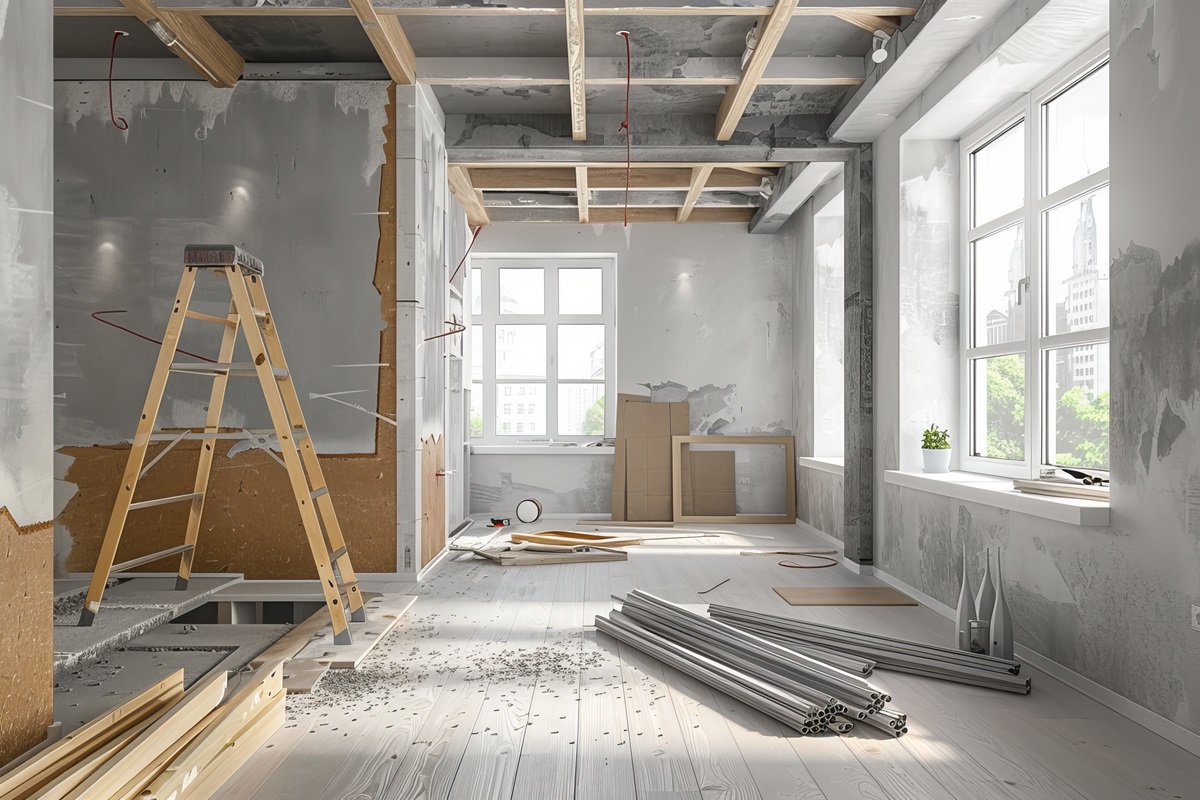
Over the past several years, a noticeable shift has taken place in how American homeowners approach residential improvement projects. The model that once dominated — renovate fast, sell quickly, move on — is giving way to something more deliberate. Homeowners are staying in their properties longer, thinking more carefully about material choices, and asking harder questions about what a renovation actually delivers over time. This is not a trend driven by aesthetics or design culture. It is driven by financial reality, structural experience, and a growing understanding of what it means to invest in a home rather than simply update it.
The distinction between a renovation done for longevity and one done for speed is not always visible at first glance. But it becomes apparent over years of use, in the performance of systems, in the durability of materials, and in the costs that either appear or do not appear over time. Understanding this difference is increasingly important for homeowners who are making decisions about significant financial commitments.
What Quality Home Renovation Actually Means in Practice
The phrase ”quality home renovation” gets used loosely, but in practice it refers to a specific set of decisions made throughout a project — decisions about material selection, contractor standards, sequencing of work, and the degree to which underlying systems are addressed alongside visible surfaces. When a renovation is built for longevity, every phase of the work is treated as load-bearing in some sense, meaning that shortcuts in early stages compound into problems in later ones. A commitment to quality home renovation means that the work done inside walls, under floors, and behind fixtures is held to the same standard as what ends up visible when the project is complete.
Homeowners who have experienced both approaches tend to describe the difference not in terms of appearance but in terms of how the home behaves. Systems that were properly integrated do not develop leaks, gaps, or failures at the points where trades connected. Surfaces that were installed with care over properly prepared substrates do not buckle, crack, or separate.
This is the operational reality of quality work, and it is what separates a renovation that holds its value from one that begins to deteriorate within a few years of completion.
The Role of Contractor Selection in Long-Term Outcomes
One of the most consequential decisions a homeowner makes during any renovation project is who performs the work. This is not simply a matter of licensing or insurance, though those are baseline requirements. It is about whether the contractor treats each phase of the project as part of a coherent whole or as a series of disconnected tasks. Contractors who are accustomed to fast-turnaround work often develop habits around speed that are not compatible with durable outcomes. They may install correctly but rush sequencing, or they may cut preparation time to meet a schedule that was set before the full scope of work was understood.
Homeowners choosing to build for longevity need to evaluate contractors differently — not just on price and availability, but on how they talk about the work, how they handle complications, and whether they have experience with projects where durability was an explicit goal. References from past clients, photographs of completed work, and direct questions about material choices are all reasonable tools for making this assessment.
Structural and Systems Work Beneath the Surface
Many of the most important decisions in a renovation happen in areas that will be covered up before the project is complete. Electrical systems, plumbing rough-ins, insulation, moisture barriers, framing corrections — these are not the parts of a renovation that appear in photographs, but they are the parts that determine whether the finished product holds up. In quick-turnaround projects, these elements are often treated as pass-through items: addressed to code minimum, then covered and forgotten. In a renovation built for longevity, they are treated as the foundation of everything else.
Homeowners who have purchased properties that were previously renovated for resale often encounter this reality directly. They find that while surfaces look updated, the systems beneath them were not upgraded or were installed in ways that created new problems. Correcting these issues after the fact is almost always more expensive than addressing them during the original renovation.
The Economics of Quick Flips and Why They Often Fail the Long-Term Owner
The quick-flip renovation model is built around a straightforward economic logic: spend the minimum necessary to make a property visually competitive, sell it before underlying issues surface, and move on. This logic works for the seller in many market conditions, but it consistently transfers costs to the buyer. The buyer, often unaware of what was done or not done beneath updated surfaces, discovers these costs over months or years — through maintenance needs, system failures, or the realization that work will need to be redone.
According to the US Census Bureau’s housing data, homeowners are staying in their properties for longer periods than at any point in recent decades. This shift in ownership duration changes the economics of renovation significantly. When a homeowner plans to remain in a property for ten or fifteen years, the cost of redoing work that was done poorly the first time is not theoretical
— it is nearly certain. The cost savings achieved by choosing cheaper materials or less experienced labor rarely survive contact with actual use over time.
Hidden Costs That Accumulate in Low-Quality Renovations
The costs associated with a renovation built around speed rather than durability do not all arrive at once. They tend to accumulate gradually, which makes them easy to rationalize as ordinary maintenance rather than consequences of the original work. Grout that begins to fail, paint that peels at seams, cabinetry that shifts out of alignment, fixtures that develop leaks at improperly sealed connections — each of these individually seems minor. Together, across the lifespan of a home, they represent a significant ongoing expense.
Homeowners who have tracked these costs over time often find that the gap between what they paid for a budget renovation and what a quality renovation would have cost narrows considerably once repair and replacement costs are factored in. This is particularly true in high-use areas like kitchens and bathrooms, where the frequency and intensity of use accelerates the rate at which poor-quality work becomes visible.
Why US Homeowners Are Reprioritizing Durability
Several factors have converged to make durability a more explicit priority for American homeowners. Housing costs have increased substantially in most markets, making the financial consequences of a failed renovation more severe. Interest rates have shifted the calculus around buying and selling, leading more homeowners to invest in their current properties rather than move. And a broader cultural shift toward more intentional consumption has made the “buy cheap, replace often” model less appealing across many categories, including home improvement.
There is also a generational component to this trend. Homeowners who purchased during previous periods of rapid price appreciation often found that the quality of their homes’ renovations was irrelevant to resale value in a rising market. That assumption no longer holds uniformly. Buyers in many markets have become more discerning, and properties with demonstrably well-executed renovations command more reliable pricing than those with cosmetic updates over questionable fundamentals.
The Influence of Material Availability and Supply Chain Experience
The supply chain disruptions that affected construction materials over recent years had an unexpected effect on how some homeowners think about renovation quality. When specific materials became difficult to source or significantly more expensive, projects that had been designed around cheaper substitutes became more complicated. Homeowners and contractors who had planned for quality materials from the outset were often better positioned to adapt without compromising the integrity of the work.
This experience reinforced for many homeowners that the decision to invest in durable materials is not just about performance — it is also about reducing the complexity of future work. Replacing a component that was installed correctly the first time with the right material is a straightforward task. Replacing something that was installed with a substitute, on top of preparation that assumed a different product, often involves correcting multiple layers of prior decisions.
How to Evaluate a Renovation Project Through the Lens of Longevity
Evaluating a renovation project for long-term durability requires asking different questions than evaluating it for immediate cost or visual appeal. The relevant questions are about what will happen to the work under sustained use, how each element connects to the systems around it, and what the maintenance requirements will be over time. These are not questions that require technical expertise, but they do require a willingness to move past surface-level assessments. Homeowners benefit from requesting detailed documentation of what was done in areas that will be closed up — photographs of framing, insulation, rough plumbing, and electrical work before they are covered. They benefit from understanding what warranties apply to materials and labor, and what conditions those warranties require to remain valid. And they benefit from working with contractors who are willing to explain their decisions rather than simply present a finished product.
Long-Term Value Versus Short-Term Appearance
The distinction between a renovation that looks good and one that performs well over time is real, and it matters more as the ownership period extends. Cosmetic renovations can transform the appearance of a space in ways that photograph well and feel immediately satisfying. But appearance and performance are not the same thing, and homeowners who conflate them often find themselves revisiting finished spaces within a few years to address problems that were not visible at completion.
Long-term value in a renovation comes from the integration of systems, the quality of underlying work, and the durability of materials in their specific application context. These are the elements that determine whether a renovation holds its value or becomes a source of ongoing cost and disruption.
Closing Perspective
The movement among US homeowners toward renovation built for durability rather than speed reflects a mature understanding of what home ownership actually involves over time. A home is not a static asset that can be updated once and left alone. It is a functioning system of interconnected materials and infrastructure that requires intelligent investment to maintain its integrity and its value.
The comparison between quality-focused renovation and quick-flip work is not about aesthetics or ambition. It is about whether the work done today will hold up under the conditions of actual use, or whether it will begin to unravel and require correction before the decade is out. Homeowners who approach their properties with a long-term perspective, who ask hard questions about what is happening beneath the surfaces being updated, and who select contractors and materials accordingly, are not overspending. They are reducing risk, limiting future costs, and making decisions that align with the actual duration of their ownership. That is a straightforward and defensible approach to one of the most significant financial decisions most people make.