
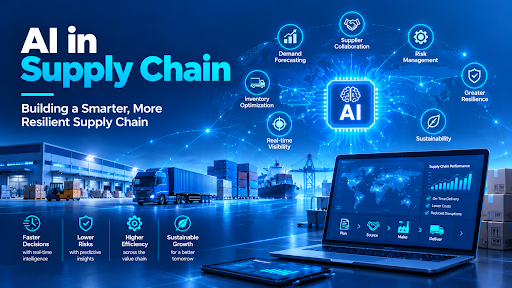
Supply chains are becoming increasingly complex, with changing customer demand, supplier risks, rising costs, and frequent disruptions putting pressure on organizations to respond faster. AI can help businesses turn fragmented data into actionable insights, improve decision-making, automate repetitive processes, and build more agile and resilient supply networks.
How AI Is Changing Supply Chain Operations
AI enables organizations to move beyond reactive supply chain management by using data to predict demand, identify risks, optimize resources, and support faster decisions. By integrating AI in supply chain operations, organizations can improve visibility across processes, respond proactively to changing business conditions, and make more informed decisions.
Improving Demand Forecasting
AI can analyze historical demand, customer behavior, market conditions, seasonality, and external factors to generate more accurate forecasts. Better forecasting helps organizations align inventory and production with expected demand, reduce stockouts and excess inventory, and make faster adjustments when market conditions change.
Optimizing Inventory Management
AI can continuously evaluate inventory levels, demand patterns, lead times, and replenishment requirements. These insights help organizations determine where inventory should be positioned and when replenishment is needed, reducing working capital requirements while maintaining appropriate product availability and service levels.
AI Across Supply Chain Functions
AI can support multiple supply chain functions, including planning, procurement, logistics, manufacturing, inventory, and supplier management. Connecting intelligence across these areas allows organizations to coordinate decisions, identify dependencies, and create greater visibility instead of optimizing individual processes in isolation.
Strengthening Procurement and Supplier Management
AI can analyze supplier performance, spending patterns, contracts, market signals, and risk indicators to support procurement decisions. Organizations can identify savings opportunities, monitor supplier risks, and anticipate potential disruptions while improving sourcing decisions and strengthening relationships with strategically important suppliers.
Optimizing Logistics and Transportation
AI-powered solutions can evaluate routes, shipment schedules, transportation capacity, delivery requirements, and operational constraints. By identifying optimization opportunities, organizations can improve transportation efficiency, reduce costs, increase delivery reliability, and respond faster when unexpected disruptions affect logistics networks.
Improving Warehouse Operations
AI can support warehouse planning by analyzing inventory placement, picking patterns, labor requirements, order volumes, and operational bottlenecks. Intelligent recommendations can help organizations improve warehouse productivity, optimize workforce allocation, reduce unnecessary movement, and create more responsive distribution operations.
Building an AI-Enabled Supply Chain Strategy
A successful supply chain strategy should define where AI can create measurable business value and how intelligent capabilities will be implemented at scale. Organizations should prioritize use cases according to business impact, data readiness, technical feasibility, risk, investment requirements, and expected outcomes.
Connecting the Supply Chain System
An integrated supply chain system provides a foundation for connecting planning, sourcing, inventory, logistics, and execution data. AI can enhance this environment by identifying patterns, generating recommendations, and helping teams make faster decisions without manually consolidating information from multiple disconnected sources.
Creating Scalable Supply Chain Solutions
Modern supply chain solutions can combine predictive analytics, machine learning, automation, optimization, and generative AI. Selecting the right capabilities requires organizations to evaluate existing technology, data quality, integration requirements, security, scalability, and the specific operational challenges they need to solve.
Improving Supply Chain Performance With AI
AI can help organizations improve supply chain performance by identifying inefficiencies, predicting potential disruptions, and continuously monitoring operational conditions. When performance data is combined with intelligent recommendations, leaders can move from simply measuring results to proactively identifying actions that can improve cost, service, and resilience.
Using Supply Chain Benchmarks
Supply chain benchmarks provide valuable context for evaluating costs, productivity, service levels, cycle times, and other operational measures. Combining benchmark insights with AI can help organizations identify performance gaps, prioritize improvement opportunities, establish realistic targets, and focus investments on areas with the greatest potential value.
Enhancing Supply Chain Services
AI can strengthen supply chain services by supporting planning, analytics, exception management, customer interactions, and operational decision-making. Automating repetitive activities allows specialists to spend more time addressing complex issues, managing critical relationships, and pursuing initiatives that improve overall supply chain effectiveness.
Accelerating AI Adoption Across the Supply Chain
Successful AI adoption requires more than implementing new technology. Organizations need reliable data, capable teams, effective governance, process redesign, and change management. A structured adoption approach helps businesses introduce AI responsibly while ensuring employees understand how intelligent capabilities support their roles and business objectives.
Managing AI Transformation
AI transformation involves redesigning processes around intelligent capabilities rather than simply adding AI to existing workflows. Organizations can identify where AI can change how decisions are made, work is performed, and resources are allocated, creating more responsive operating models and stronger long-term supply chain capabilities.
Measuring AI Performance
AI performance should be evaluated using both technology and business metrics. Organizations can monitor forecast accuracy, productivity, automation rates, cost reduction, service levels, exception rates, and adoption to determine whether AI initiatives are delivering measurable improvements and identify opportunities for continuous optimization.
Accelerate Supply Chain Transformation With AI
Moving from AI experimentation to enterprise-scale value requires a clear roadmap, strong business alignment, and the ability to translate technology into measurable operational outcomes. Organizations need to prioritize high-value use cases, establish governance, integrate AI with existing systems, and build capabilities that can scale across the supply chain.
Partner With AI Consultants
AI consultants can help organizations assess readiness, identify high-impact opportunities, prioritize use cases, and establish practical implementation roadmaps. Their expertise can connect supply chain priorities with technology capabilities, helping leaders make informed investment decisions while reducing the complexity associated with enterprise AI initiatives.
Access AI Consulting Services
AI consulting services can support organizations across the AI lifecycle, from opportunity assessment and strategy development to implementation, integration, governance, and performance measurement. A structured consulting approach helps organizations focus investment on AI initiatives that align with supply chain priorities and deliver measurable business value.
Accelerate AI Development
AI development should focus on solving specific supply chain challenges while ensuring scalability, integration, security, and usability. Organizations can develop intelligent applications that work with existing enterprise systems, enabling supply chain teams to access relevant insights and automate decisions within their everyday workflows.
Build a Smarter Supply Chain With The Hackett Group®
AI can become a strategic capability for organizations looking to improve supply chain agility, efficiency, and resilience. The Hackett Group® helps businesses identify high-value AI opportunities, evaluate supply chain performance, develop transformation roadmaps, and align technology investments with strategic business priorities.
From demand forecasting and inventory optimization to procurement, logistics, supplier management, and warehouse operations, AI can help organizations make faster and more informed decisions. A structured approach enables businesses to move beyond isolated AI experiments and develop scalable capabilities that continuously improve supply chain performance.
Ready to accelerate your AI transformation? Partner with experienced specialists to identify the right opportunities, prioritize investments, and build an intelligent supply chain designed for stronger performance, greater resilience, and sustainable business value