
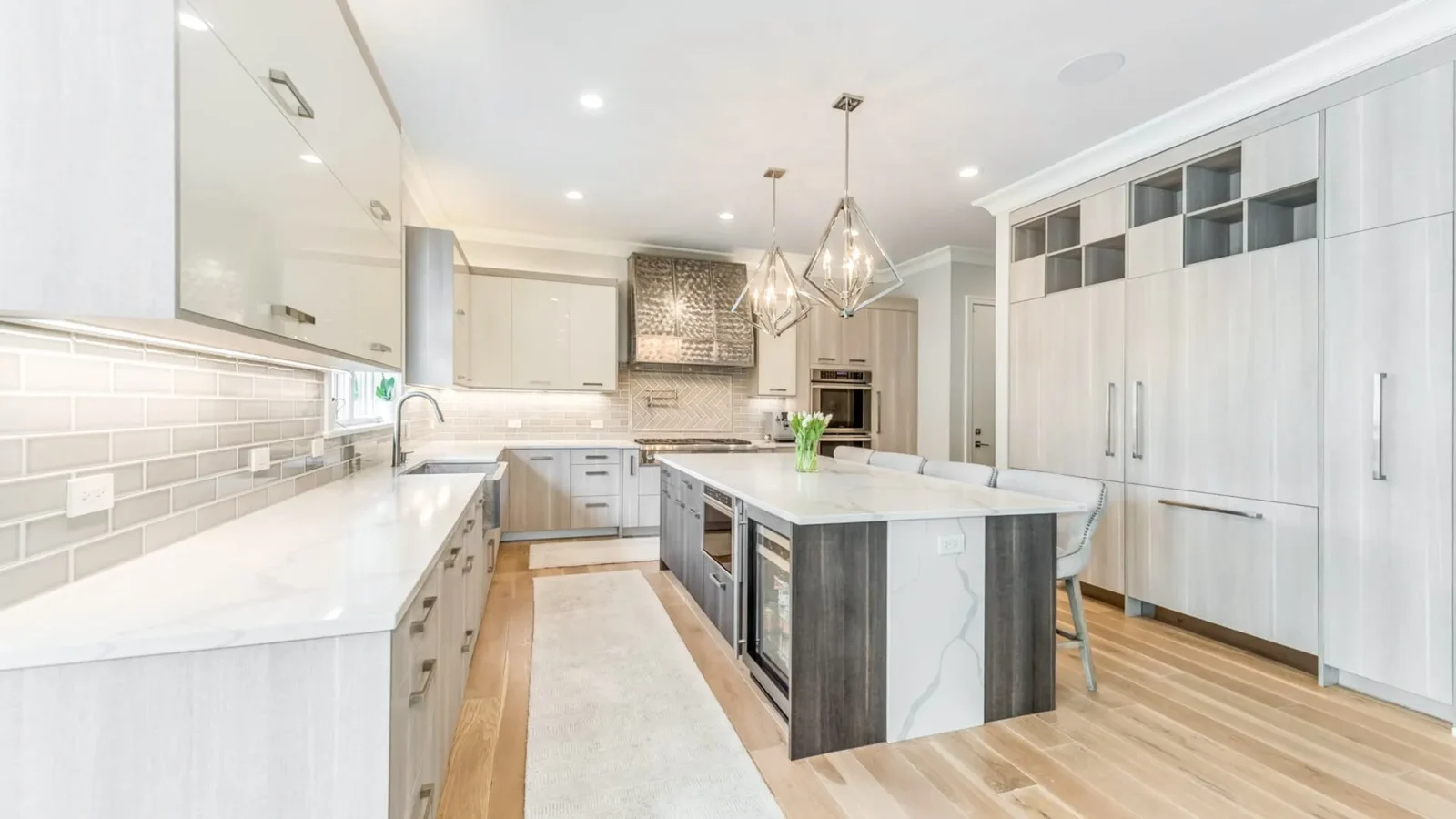
Most renovation projects that go over budget or miss the mark on quality do so not because of poor taste, but because of poor specification. When a homeowner or design professional selects cabinetry without a structured approach to finish selection, the result is often a mismatch between expectation and outcome. The finish arrives, and it reads differently in context than it did on a sample card. The color shifts under different light sources. The sheen level looks flat against polished hardware. The texture doesn’t hold up in a high-moisture environment. These are not rare problems. They are predictable outcomes of an underspecified process. Finish specification is not a style decision made at the end of a project. It is a technical and contextual decision made early, informed by the physical conditions of the space, the durability requirements of the room, and the relationship between cabinetry and every other surface it will interact with. Interior designers who work at a high level understand this, which is why their projects tend to land correctly even when the details are complex. The process is learnable, and understanding it changes how you approach every cabinetry decision from the start.
What Finish Specification Actually Involves
When designers talk about specifying high-end custom finishes for kitchen and bath cabinetry, they are referring to a layered decision-making process that includes substrate compatibility, application method, sheen level, color accuracy, environmental performance, and long-term maintenance behavior. These factors are not independent. Each one affects the others, and a decision made in one area without considering its downstream impact will produce inconsistency in the final installation.
Understanding high-end custom finishes for kitchen and bath cabinetry at a professional level means recognizing that a finish is not just a color applied to wood. It is a system — a combination of preparation, primer, topcoat, and protective layer that performs differently depending on the wood species, the room conditions, and the application technique used. When any part of that system is substituted without adjustment, the result may look acceptable in the short term but will show wear or inconsistency over time.
The Role of Substrate in Finish Outcomes
The material beneath the finish determines how the finish behaves. Natural wood with open grain absorbs finish differently than MDF, which has a sealed, uniform surface. Plywood panels can respond unevenly to paint if not properly primed, particularly at edge banding transitions. A designer who specifies a deep, lacquered finish on a door with prominent wood grain without accounting for grain fill will receive a surface that shows texture through the paint. That is not a finishing error — it is a specification error made before the finishing process began. High-end custom cabinetry work often involves matching existing elements, integrating new cabinetry with older millwork, or creating a seamless look across different cabinet configurations. In these cases, substrate selection and preparation are as important as color selection. The finish system must be built to accommodate the substrate’s natural behavior, including expansion, contraction, and porosity variation.
Understanding Sheen and Its Spatial Impact
Sheen level is one of the most frequently underspecified aspects of cabinetry finishes. A matte finish reads as quiet and recessive. A semi-gloss or high-gloss finish reflects light and draws attention to both the quality of the surface and any imperfections within it. In kitchens with strong directional lighting, a high-gloss cabinet door will show brushstroke marks, dust, and fingerprints that a satin finish would absorb visually.
Designers typically specify sheen not just based on aesthetic preference, but based on the actual lighting conditions in the finished space, the proximity of the cabinetry to work surfaces, and the maintenance expectations of the client. A bathroom vanity in a primary suite may warrant a different sheen than a utility bathroom. A kitchen island that serves as a social gathering surface may benefit from a different treatment than perimeter cabinetry in the same room. Sheen is a performance specification as much as a visual one.
Color Development and Matching in Custom Finish Work
Custom color development is where many projects encounter their first serious specification challenge. A color selected on a paint chip or digital swatch will read differently once applied to a three-dimensional object at full scale in a specific room. The relationship between the finish color and the room’s natural light, artificial light temperature, flooring tone, and countertop material all alter how the eye perceives the cabinet color in context.
Professional designers manage this by working from full-scale mock-ups or door samples applied in the actual space whenever possible. When that is not feasible, they account for known variables such as the color temperature of the installed lighting and the reflective quality of adjacent surfaces. This is standard practice, not an exceptional step. It is simply how accurate color specification works at a high level.
Metamerism and Light Source Dependency
One of the less discussed technical issues in finish specification is metamerism — the phenomenon where two colors that appear identical under one light source appear different under another. This is well-documented in color science and is particularly relevant when cabinetry finishes are selected under showroom lighting and then installed in spaces with different light source types. A warm white that reads cleanly in a room with incandescent lighting may take on a greenish or yellow cast under cool LED fixtures.
According to the explanation of metamerism in color theory, this occurs because different light sources emit different wavelength distributions, which interact differently with the pigments in a finish. Designers who understand this specify finishes by testing them under the actual or intended light source of the finished space, not under general showroom conditions. This one step alone prevents a significant number of finish complaints after installation.
Coordinating Finish Color Across Mixed Materials
Many high-end kitchen and bath projects involve cabinetry finished in multiple tones or combined with contrasting islands, floating shelves, or open millwork elements. Coordinating these finishes requires an understanding of undertone relationships. Two whites that appear similar in isolation may read as competing when placed in the same room — one warm, one cool, without enough contrast to read as intentional. The same applies to gray-toned finishes, which can shift dramatically depending on the warm or cool undertones present in the surrounding materials. The professional approach is to build the finish palette from the room’s fixed elements outward — starting with the flooring and countertop materials, then selecting cabinetry finishes that either harmonize or contrast in a controlled and deliberate way. Allowing cabinet finish decisions to happen in isolation from the broader material palette is one of the most common sources of disconnect in residential projects.
Durability Considerations for High-Traffic Environments
Kitchens and bathrooms impose specific physical demands on cabinetry finishes that living room millwork or bedroom furniture does not. Steam, moisture, cleaning agents, cooking residue, and daily physical contact all degrade finish systems over time at rates that vary significantly depending on the finish type and application quality. Specifying the right finish for the environment is a durability decision, not just an aesthetic one.
High-end custom finishes for kitchen and bath cabinetry that perform over time typically involve topcoat systems with established resistance to moisture, chemical exposure, and UV degradation. Lacquers, catalyzed conversion varnishes, and polyurethane-based systems each have different performance profiles. Understanding which system is appropriate for which environment — and which substrate — is part of what separates professional specification from general consumer selection.
The Maintenance Profile of Different Finish Systems
Every finish system has a maintenance profile that clients should understand before selection is finalized. A high-gloss lacquer finish may look exceptional when new but will require careful cleaning to avoid micro-scratching over time. A wire-brushed or textured finish may hide daily wear more effectively but can accumulate residue in its surface texture in a kitchen environment. A painted finish on cabinetry near cooking surfaces will need periodic touch-up unless the topcoat system has sufficient hardness and adhesion to resist impact and abrasion.
Designers present this information to clients as part of the selection conversation, not after the fact. When a client understands the trade-off between a visually compelling finish and its maintenance requirements, they can make an informed decision. When they are not given that context, dissatisfaction typically follows within the first year of use.
The Specification Document and Communication with Fabricators
A finish specification is only useful if it is communicated clearly to the cabinet fabricator and finishing shop. Verbal descriptions are insufficient. The professional standard involves written documentation that includes the finish system, substrate preparation requirements, sheen level, color reference, topcoat product or equivalent, and any performance requirements specific to the environment. Without this documentation, fabricators work from interpretation rather than instruction, and interpretation introduces variation.
This is particularly important when the same finish needs to be replicated across multiple phases of a project, or when future repairs or additions may require a matching finish application. A well-documented finish specification allows a skilled finisher to reproduce the result with accuracy years after the original installation. An undocumented finish exists only in the memory of whoever applied it the first time.
Managing Approvals and Samples Before Production
The sample approval process is a formal checkpoint, not a formality. Before full production begins, designers request finished samples on the actual substrate and species being used in the project. These samples are reviewed under the lighting conditions of the finished space wherever possible, and approval is documented in writing. Any deviation discovered after full production is complete is significantly more costly — in time, material, and schedule — than a variation caught at the sample stage.
This process protects the client, the designer, and the fabricator equally. It removes ambiguity from a decision that is inherently subjective and gives everyone involved a shared reference point for what the finished product is expected to look like.
Closing Thoughts on Finish Specification as a Professional Practice
Selecting high-end custom finishes for kitchen and bath cabinetry with confidence requires moving away from purely visual decision-making and toward a more structured, contextual approach. The decisions that matter most — substrate compatibility, finish system selection, sheen appropriateness, color accuracy under real lighting, and durability against daily use — are all technical in nature, even if their outcomes are experienced aesthetically.
The reason experienced designers consistently produce results that hold up over time is not because they have better taste. It is because they treat finish specification as a disciplined process with defined checkpoints, documented decisions, and clear communication across every party involved. That process is available to anyone willing to understand what it involves and apply it consistently from the earliest stages of a project forward.
When the specification process is handled with this level of care, the result is cabinetry that performs exactly as intended — visually cohesive, durable in context, and consistent with the broader material language of the space. That is the standard worth holding to.