
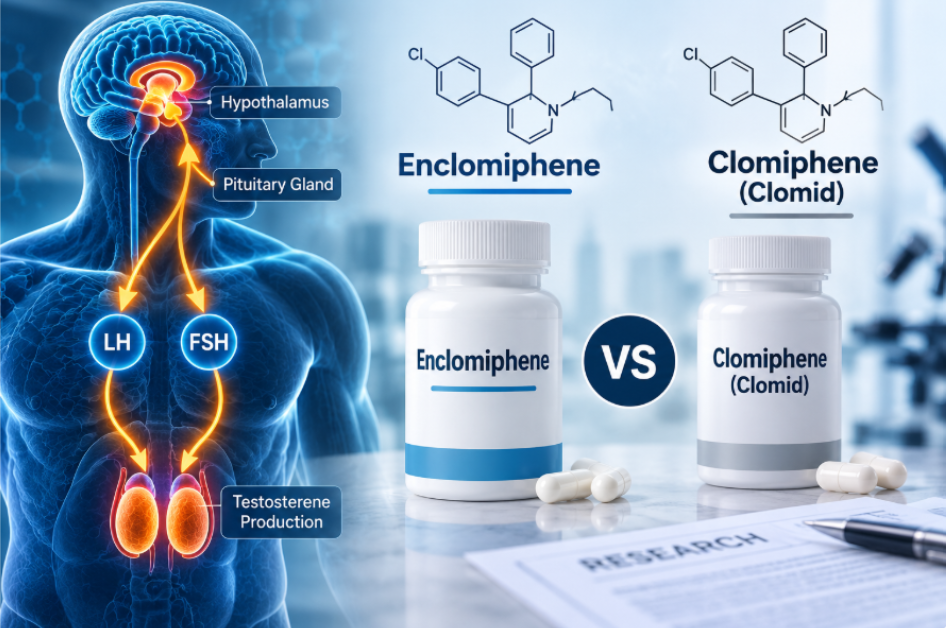
Enclomiphene and Clomid are closely related compounds, but they are not the same thing. Although both have been studied for their effects on male hormone signalling, an important difference lies in their chemical composition.
Clomid, the commonly used brand name for clomiphene citrate, contains two different isomers: enclomiphene and zuclomiphene. Enclomiphene, by comparison, refers specifically to the trans-isomer of clomiphene.
This distinction has made enclomiphene an increasingly interesting subject of research in its own right.
What Is Enclomiphene?
Enclomiphene is a selective oestrogen receptor modulator (SERM) and one of the two principal isomers found in clomiphene citrate.
Research involving men with secondary hypogonadism has investigated enclomiphene’s effects on the hypothalamic-pituitary-gonadal (HPG) axis and hormones including luteinising hormone (LH), follicle-stimulating hormone (FSH) and testosterone.
For those looking to explore the compound and its research background further, additional information on Enclomiphene is available from Affordable Nutrition.
What Is Clomid?
Clomid is a well-known trade name for clomiphene citrate. Rather than consisting solely of enclomiphene, clomiphene contains both enclomiphene and a second isomer called zuclomiphene.
This is one of the most important distinctions when comparing Clomid with enclomiphene.
While the two compounds are closely related, taking clomiphene exposes the body to both isomers rather than enclomiphene alone.
Enclomiphene vs Zuclomiphene
Enclomiphene and zuclomiphene have different pharmacological characteristics despite being components of the same parent compound.
Research has demonstrated that zuclomiphene can persist considerably longer than enclomiphene. In one study examining men receiving long-term clomiphene citrate, researchers found substantially higher circulating concentrations of zuclomiphene than enclomiphene.
This difference in pharmacokinetics is one reason researchers have investigated isolated enclomiphene separately from conventional clomiphene citrate.
How Does Enclomiphene Affect Hormonal Signalling?
Enclomiphene has been investigated for its ability to influence the body’s own hormonal signalling rather than supplying testosterone externally.
By interacting with oestrogen receptors involved in hormonal feedback, enclomiphene can affect signalling through the HPG axis.
Clinical research in men with secondary hypogonadism has reported increases in LH and testosterone during enclomiphene treatment. Other research has also examined FSH and sperm concentration, making fertility-related hormonal signalling an important area of scientific interest.
Enclomiphene vs Clomid: Why Does the Difference Matter?
The key distinction can be summarised relatively simply:
Clomid (clomiphene citrate) contains both enclomiphene and zuclomiphene. Enclomiphene contains the trans-isomer without the accompanying zuclomiphene component of conventional clomiphene.
That compositional difference may influence pharmacokinetics and biological effects.
It therefore isn’t necessarily accurate to assume that research involving clomiphene can be applied directly and identically to enclomiphene. Researchers increasingly consider the individual characteristics of the two isomers when interpreting results.
What Has Research Found?
Clinical studies have investigated enclomiphene in men with secondary hypogonadism.
Research has reported increases in testosterone alongside increases in LH and FSH. Studies comparing enclomiphene with testosterone gel have also investigated differences in sperm production, with enclomiphene maintaining sperm concentrations in the studied populations while exogenous testosterone suppressed them.
These findings have contributed to continuing scientific interest in enclomiphene and its potential differences from conventional clomiphene.
Enclomiphene and Clomid Are Related — But Not Identical
It is easy to understand why the names are sometimes used interchangeably, but chemically this isn’t correct.
Clomiphene is a mixture containing both enclomiphene and zuclomiphene, whereas enclomiphene isolates one of those components.
Understanding that distinction is fundamental when reading research involving either compound and helps explain why enclomiphene continues to be investigated separately.
For a more detailed discussion of the research surrounding the two compounds, see Enclomiphene vs Clomid from Affordable Nutrition.
This article is provided for general educational and research information only and should not be interpreted as medical advice.