
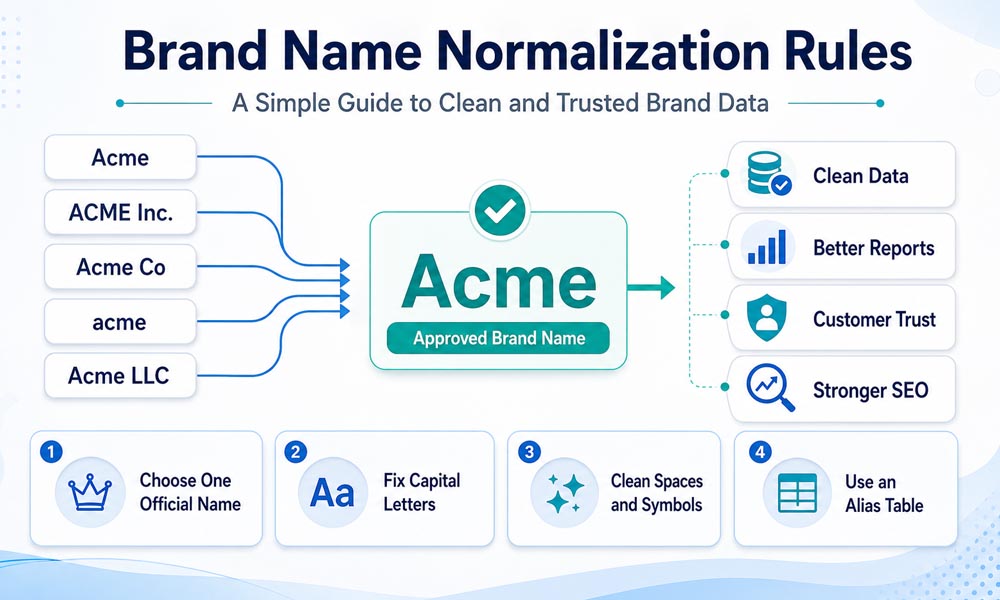
Imagine you are checking your business data one morning. You search for one brand in your CRM, but you find it written in five different ways. One record says “Acme.” Another says “ACME Inc.” Another says “Acme Co.” One more says “acme,” and another says “Acme LLC.” At first, this may look like a small problem. But in real business, this small problem can turn into a big mess.
This is where Brand Name Normalization Rules become very important. These rules help a business choose one clear and approved version of a brand name. They also help teams use that same name across websites, customer records, product lists, ad reports, invoices, and data tools. When every system uses the same name, the data becomes easier to trust.
In this article, we will talk about Brand Name Normalization Rules in a very simple way. We will explain what they mean, why they matter in 2026, how messy brand names can hurt your business, and which basic rules help keep brand data clean. We will also look at examples so everything feels easy to understand.
What Are Brand Name Normalization Rules?
Brand Name Normalization Rules are simple rules that help turn different versions of a brand name into one correct version. This correct version is often called the main or approved name. Some people also call it the “canonical brand name.” That may sound like a big term, but it simply means the official version that your business wants to use everywhere.
For example, a brand name may appear as “Nike Inc.,” “NIKE,” “nike,” or “Nike®” in different systems. But for normal marketing, reporting, and customer-facing use, the clean version may be just “Nike.” So, all the other versions can be mapped back to “Nike.” This makes the data cleaner and easier to manage.
Think of it like organizing a messy contact list. If the same person is saved as “Ali,” “Ali Khan,” “Mr. Ali,” and “ALI K,” your phone may treat them as different people. Brand data works in a similar way. Without Brand Name Normalization Rules, your systems may treat one brand as many separate brands.
These rules are used in many places. They are useful in CRMs, product catalogs, sales reports, ad platforms, SEO tools, billing systems, and customer databases. When the brand name stays the same everywhere, teams can find the right data faster and make better choices.
Why Brand Name Normalization Rules Matter
In 2026, businesses depend on data more than ever. Sales teams use data to find leads. Marketing teams use data to study campaigns. Finance teams use data for billing and reports. SEO teams use data to build online trust. If the brand names inside these systems are not clean, the whole business can suffer.
This is why Brand Name Normalization Rules matter so much. They help keep brand data clear, trusted, and easy to use. If one brand is written in many ways, reports may show wrong results. A team may think there are many brands when there is only one. This can lead to wrong decisions and wasted time.
For example, a marketing team may run a report to see how many customers bought from “BrightPath.” But if some records say “Bright Path,” “BrightPath Inc.,” and “BRIGHTPATH,” the report may not show the full picture. The team may think sales are lower than they really are. This is not a marketing problem. It is a data problem.
Clean brand names also help customers trust a business. When customers see the same brand name on a website, invoice, email, social page, and product listing, the brand feels more professional. But when the name changes from place to place, it can feel careless. People may wonder if they are dealing with the same business or not.
How Messy Brand Names Hurt Your Business
Messy brand names can create problems that are not always easy to see at first. A single spelling mistake may not feel serious. But when a company has thousands of records, those small mistakes can grow quickly. Over time, your data becomes harder to search, harder to trust, and harder to use.
One big problem is broken reporting. If your system sees “Coca-Cola,” “Coca Cola,” and “COCA-COLA” as three different brands, your reports may split the numbers. Your sales report may show three small groups instead of one clear total. This can confuse managers and slow down decisions.
Another problem is duplicate outreach. Imagine two salespeople contacting the same company because the CRM has two versions of the brand name. One sees “Acme Inc.” and the other sees “Acme.” Both think they are working with different accounts. The customer may receive repeated emails or calls. This can feel unprofessional and annoying.
Messy brand names can also waste marketing money. If ad reports and customer records do not match, the team may not know which campaign really worked. They may spend more money on the wrong channel. They may also miss good chances because the data does not tell the full story.
There is also a trust problem. A brand should look steady and clear everywhere. If customers see one name on your website and another name on your invoice, they may feel unsure. A clean brand name builds confidence. A messy one creates doubt.
Brand Name Normalization Rules for Clean Data
The main goal of Brand Name Normalization Rules is to keep data clean and useful. Clean data means the same brand is written the same way in all the right places. It also means that old, wrong, or messy versions are connected to the approved name.
The first basic rule is to choose one main brand name. This is the version your business will use most of the time. It should match how the brand is known to customers. If your business is called “NorthPeak,” then that should be the approved name. You should not let some systems use “North Peak,” “NORTHPEAK,” or “NorthPeak Inc.” unless there is a clear reason.
The second rule is to clean simple errors. This means removing extra spaces, fixing random capital letters, and handling marks like commas, periods, hyphens, and symbols. For example, “ Apple Inc ” has extra spaces. A clean version may become “Apple Inc.” or just “Apple,” based on your rule.
The third rule is to decide what to do with legal words. Words like “Inc.,” “LLC,” “Ltd.,” “Corp.,” and “PLC” may be needed in legal papers, but they are often not needed in marketing reports or product catalogs. Brand Name Normalization Rules should explain when to keep them and when to remove them.
These rules may sound simple, but they can save a lot of time. When everyone follows the same format, there is less confusion. Teams do not have to guess which version is correct. Systems can match records more easily. Reports become cleaner and more useful.
Choose One Official Brand Name
Every business needs one official brand name for general use. This name should be the version that appears on the website, social media pages, product pages, email templates, and public content. It should be the name customers know and remember.
For example, most people say “Apple,” not “Apple Inc.” They say “Nike,” not “Nike, Inc.” They say “Microsoft,” not “Microsoft Corporation.” The legal name still matters, but it is not always the best name for normal brand use. This is why Brand Name Normalization Rules should separate the public brand name from the legal company name.
A good rule may look like this. The customer-facing name is “BrightPath.” The legal name is “BrightPath, Inc.” The website and blog use “BrightPath.” Contracts and legal papers use “BrightPath, Inc.” This keeps things simple while still respecting legal needs.
Choosing one official name also helps teams move faster. Writers know what to use in articles. Designers know what to put in banners. Sales teams know what to write in decks. Data teams know what to store in dashboards. Everyone works from the same answer.
This is especially helpful when a company has older names, short names, or merged brands. Without one approved version, people may use whatever version they remember. That is how brand data becomes messy again.
Brand Name Normalization Rules for Capital Letters
Capital letters matter more than many people think. A brand name is not just a word. It is part of the brand’s identity. Some names use special capital letters to look unique and easy to recognize. Think about names like “YouTube,” “PayPal,” “iPhone,” and “LinkedIn.” If a system changes these names to “Youtube,” “Paypal,” “Iphone,” or “Linkedin,” the brand no longer looks right.
That is why Brand Name Normalization Rules should clearly explain capitalization. A business should decide how each brand name should appear. Once that decision is made, all teams and systems should follow it.
For normal brand names, title case may work well. For example, “Nike,” “Samsung,” and “Walmart” look clean and simple. But for short names or acronyms, uppercase may be correct. For example, “IBM,” “BMW,” and “HBO” are usually written in capital letters. The rule should explain these cases so people do not guess.
Capitalization also matters in databases. Some systems may treat “Apple,” “APPLE,” and “apple” as different values. This can create duplicate records. A clear capitalization rule helps prevent this problem before it starts.
It is also important not to let tools change brand names without review. Some spreadsheets and systems may automatically change letter case. This can damage brand names that use special styling. A good rulebook should tell teams to protect official capitalization.
Brand Name Normalization Rules for Spaces and Symbols
Spaces and symbols can create some of the most common brand name problems. A name may look almost the same to a person, but very different to a computer. For example, “H&M,” “H & M,” and “H and M” may all point to the same brand. But a system may read them as separate names unless rules are in place.
This is why Brand Name Normalization Rules must cover spaces, dots, commas, hyphens, apostrophes, ampersands, and other marks. The rule should explain which marks should stay and which ones should be removed. It should also explain when a symbol is part of the real brand name.
For example, the ampersand in “H&M” is part of the official brand name, so it should usually stay. The apostrophe in “McDonald’s” also matters. Removing it may make the brand look wrong. But extra dots, random commas, or double spaces may not add meaning. These can often be cleaned.
Spacing is another simple but important area. A record like “ Apple Inc. ” has extra spaces before, inside, and after the name. These spaces may not be visible in reports, but they can break matching in databases. A basic rule should remove leading and trailing spaces and turn many spaces into one space.
Still, businesses must be careful not to over-clean. If a rule removes all symbols without checking, it may harm names like “7-Eleven,” “H&M,” “AT&T,” or “McDonald’s.” Good normalization keeps the brand clean without destroying its real identity.
How to Handle Inc., LLC, Ltd., and Other Legal Words
Legal words are common in company names. You may see names with “Inc.,” “LLC,” “Ltd.,” “Corp.,” “PLC,” “GmbH,” or “Co.” These words are important in legal and business records. But they are not always useful in normal brand data.
For example, customers usually know the brand as “Nike,” not “Nike, Inc.” They know “Microsoft,” not “Microsoft Corporation.” In marketing content, SEO pages, product listings, and dashboards, the short brand name is often cleaner and easier to read.
This does not mean legal names should be deleted everywhere. They still matter in contracts, tax records, invoices, vendor files, legal papers, and compliance systems. The key is to use the right version in the right place.
Good Brand Name Normalization Rules should make this clear. They may say that the canonical marketing name is “BrightPath,” while the legal name is “BrightPath, Inc.” Both are correct, but they are used in different contexts. This avoids confusion between brand identity and legal identity.
This rule is very helpful for large companies, global businesses, and B2B teams. Many systems pull names from legal records, payment tools, or partner data. If legal suffixes are not handled carefully, the same brand may appear in many forms. Clear rules help bring those forms together without losing important legal details.
Why Every Business Needs an Alias Table
An alias table is one of the most useful parts of Brand Name Normalization Rules. It is a simple list that connects all wrong, short, old, or different versions of a brand name to the correct version. In simple words, it tells your system, “When you see this name, treat it as that approved name.”
For example, your alias table may say that “Wal-Mart,” “WALMART,” and “Wal-Mart Stores Inc.” should all become “Walmart.” It may also say that “Samsung Electronics Co.,” “Samsung electronics,” and “SAMSUNG ELECTRONICS” should all become “Samsung.” This makes data much easier to clean and search.
An alias table is helpful because real data is never perfect. People type names in different ways. Vendors send product feeds in different formats. Customers fill forms with spelling errors. Old records may use old brand names. Without an alias table, your team has to fix the same problem again and again.
A good alias table should include the variant name, the correct name, the reason for the change, and the date it was added. This makes the table easier to trust. It also helps new team members understand why one name is being changed into another.
Brand Name Normalization Rules for SEO
Brand Name Normalization Rules can also help with SEO. This does not mean that clean brand names will magically put your site at number one. But they can help search engines understand your brand more clearly. When your name appears the same way across your website, social pages, product pages, business listings, and schema, your brand signals become cleaner.
Think about it like this. If your brand appears as “BrightPath,” “Bright Path,” “BrightPath Inc,” and “BRIGHTPATH” across the web, search engines may still understand some of it. But the signals are not as clean as they could be. A single clear brand name makes your online identity easier to follow.
This is very important in 2026 because many businesses depend on search, AI tools, local listings, shopping feeds, and review sites. If your brand data is messy, your online presence can also feel messy. Clean names help your website, Google Business Profile, product pages, and directory listings look more connected.
SEO teams should use the canonical brand name in title tags, meta descriptions, schema markup, internal links, author bios, product feeds, and local citations. This helps create a steady pattern. When people and search engines see the same name again and again, the brand feels stronger and easier to trust.
How to Apply Brand Name Normalization Rules Step by Step
The best way to start is with a full data audit. This means checking every place where your brand names are stored. Look at your CRM, website, product catalog, invoices, ad reports, analytics tools, partner files, email templates, and old documents. Write down every version of the brand name you find.
Next, choose one canonical brand name. This should be the main version that customers know and trust. For example, if your public brand name is “NovaGrid,” do not use “Nova Grid,” “NOVAGRID,” or “NovaGrid Inc.” as the main version unless there is a strong reason.
After that, create your alias table. Add every wrong, old, or different version you found during the audit. Then map each one to the approved name. This table becomes your guide for cleaning old records and stopping new errors.
Now write your rulebook. Keep it simple. Explain how to handle capital letters, spaces, symbols, legal words, short forms, old names, regional names, and trademark symbols. Add clear examples of correct and incorrect names. People follow rules better when they can see real examples.
Once the rules are ready, apply them at the point of entry. This means fixing brand names before they enter your systems. Add checks to web forms, CRM fields, CSV uploads, API imports, and product feeds. This is much better than cleaning the data after it becomes messy.
Finally, test the rules before using them everywhere. Take a small sample of data and apply your rules. Check if the results look right. If the system changes “H&M” into “HM” or removes the apostrophe from “McDonald’s,” you know the rules need more work. Testing helps you catch mistakes early.
Best Tools for Brand Name Normalization Rules
Small businesses can start with simple tools. A spreadsheet can work well in the beginning. You can list all brand name versions in one column and the correct name in another column. This is not fancy, but it is a good first step.
As the business grows, manual cleanup becomes harder. If you have thousands or millions of records, you need automation. CRM cleanup tools can help clean names inside platforms like Salesforce or HubSpot. Data quality tools can help find duplicates and fix repeated errors.
Developers can also use libraries and scripts to clean brand names. Tools like FuzzyWuzzy and Cleanco can help find close matches and remove common legal suffixes. These tools are useful when your team wants to build its own process.
Large companies may need stronger systems. Enterprise data tools like Talend or Informatica can help with master data management. Cloud tools like AWS Glue and Google Cloud Dataflow can help apply rules at a large scale. These are useful when data comes from many platforms at high speed.
AI and language tools can also help in 2026. They can spot patterns, suggest possible matches, and find names that look similar. But AI should not work alone. Human review is still needed for unclear cases, legal names, regional spellings, mergers, and rebrands.
Common Mistakes in Brand Name Normalization Rules
One common mistake is not writing the rules down. If the rules only live in someone’s head, different teams will make different choices. Marketing may use one version. Sales may use another. Finance may use the legal name everywhere. Soon, the same brand appears in many forms again.
Another mistake is treating cleanup as a one-time task. Some businesses clean their data once and then forget about it. But new data enters every day. New forms, vendors, tools, customers, and campaigns can bring new errors. Brand Name Normalization Rules should be part of daily systems, not a one-day project.
A third mistake is removing too much. Some teams try to clean everything by removing all punctuation, spaces, and symbols. This can damage real brand names. Names like “H&M,” “AT&T,” “7-Eleven,” and “McDonald’s” need special care. Good normalization does not destroy meaning.
Another big mistake is mixing brand names and legal names. A brand name is what customers see. A legal name is what appears in official business records. Both matter, but they should not always be used in the same way. Your rules should explain the difference clearly.
Many businesses also rely too much on manual cleanup. Manual work is slow and easy to get wrong. It may work for a small list, but it will not work well for large data. The better method is to automate easy matches and send unclear cases for human review.
Another mistake is delaying deduplication. Cleaning names is helpful, but duplicate records still need to be merged or linked. If “Acme Inc.” and “Acme LLC” are changed to “Acme,” the system must also know whether they are the same account or different legal entities. Normalization and deduplication should work together.
The last mistake is not measuring results. If you do not track progress, you cannot know if your rules are working. You need simple numbers to show improvement. This makes it easier to prove the value of clean brand data.
How to Measure Clean and Trusted Brand Data
You can measure brand data quality in simple ways. Start by checking how many duplicate records existed before and after cleanup. If your duplicate rate drops, your rules are working. This is one of the clearest signs of success.
You can also measure how much time teams save. Before normalization, sales or data teams may spend hours fixing names by hand. After strong Brand Name Normalization Rules, that time should go down. Even saving a few hours each week can matter a lot over a full year.
Another useful metric is the manual review rate. This means how many records still need a person to check them. At first, this number may be high. But as your alias table grows and your rules improve, the number should become lower.
You should also check cross-system consistency. This means comparing the same brand across different systems. Does your CRM show the same brand name as your invoice tool? Does your product catalog match your website? Do your ad reports match your analytics dashboard? If the answer is yes, your data is becoming more trusted.
SEO teams can also measure progress. They can check if business listings, product pages, schema markup, and citations use the same brand name. They can also watch branded search clicks and impressions. Clean brand signals can help support a stronger online presence over time.
Regular audits are important too. A business should review its brand name data every month or quarter. This helps catch new errors before they spread. It also keeps the rulebook fresh as the business changes.
Conclusion
Brand names may look like small details, but they can affect a lot of important work. They affect reports, sales activity, customer trust, SEO, product data, legal records, and team decisions. When names are messy, business data becomes harder to trust.
This is why Brand Name Normalization Rules are so useful. They give every team a clear way to write, store, clean, and manage brand names. They help businesses choose one approved name, connect all variants to that name, and stop the same mistakes from coming back again.
The best rules are simple. They explain the canonical name, legal name, capital letters, spaces, symbols, suffixes, aliases, and special cases. They also explain where each version should be used. This makes life easier for marketing, sales, legal, SEO, data, and finance teams.
In 2026, clean data is no longer optional. Businesses use AI, automation, analytics, and digital tools every day. These tools work better when the data is clear. If brand names are inconsistent, even the best tools can give poor results.
So, if your brand appears in many forms across your systems, now is the right time to fix it. Start with a simple audit. Choose one official name. Build an alias table. Write clear rules. Use automation where possible. Review tricky cases by hand. Then keep checking your data over time.
Clean brand names create clean reports. Clean reports create better choices. Better choices create stronger trust. That is the real power of Brand Name Normalization Rules.
(FAQs)
What Are Brand Name Normalization Rules?
Brand Name Normalization Rules are clear rules that help a business write and store brand names in one approved way. These rules turn different versions like “Nike Inc.,” “NIKE,” “Nike®,” and “nike” into one clean name, such as “Nike.” This helps teams keep data clean across CRMs, websites, reports, product lists, invoices, and marketing tools.
Why Are Brand Name Normalization Rules Important?
Brand Name Normalization Rules are important because messy brand names can break reports, create duplicate records, and confuse teams. If one brand is saved in five different ways, your system may treat it as five different brands. This can lead to wrong data, wasted marketing money, repeated customer outreach, and weak brand trust.
What Is a Canonical Brand Name?
A canonical brand name is the main approved version of a brand name. It is the version your business wants to use most of the time. For example, “Apple” may be the canonical brand name, while “Apple Inc.,” “APPLE,” and “Apple®” are other versions that can be mapped back to it.
How Do Brand Name Normalization Rules Help Clean Data?
Brand Name Normalization Rules help clean data by removing extra spaces, fixing capital letters, cleaning symbols, handling legal suffixes, and connecting name variants to one approved name. This makes the data easier to search, compare, and trust. It also helps teams make better choices because reports show one clear version of each brand.
Should Inc., LLC, or Ltd. Be Removed From Brand Names?
In most marketing, SEO, analytics, and customer-facing data, legal words like Inc., LLC, Ltd., Corp., and PLC are usually removed. For example, “Nike, Inc.” becomes “Nike.” But these legal words should still be used in contracts, invoices, tax records, and legal documents. Good rules explain when to keep them and when to remove them.
How Do Brand Name Normalization Rules Help SEO?
Brand Name Normalization Rules help SEO by keeping the brand name the same across title tags, schema, citations, product pages, local listings, and business profiles. When search engines see one clear brand name again and again, they can understand the brand better. This can support stronger brand signals and better online trust.
What Is an Alias Table in Brand Name Normalization?
An alias table is a list that connects different versions of a brand name to the correct name. For example, “Wal-Mart,” “WALMART,” and “Wal-Mart Stores Inc.” may all point to “Walmart.” This table helps systems clean records faster and stops teams from fixing the same name errors again and again.
Can AI Help With Brand Name Normalization Rules?
Yes, AI can help find spelling changes, close matches, duplicate records, and new brand name variants. It can scan large data sets faster than humans. But AI should not be trusted blindly. Human review is still needed for tricky names, legal cases, mergers, rebrands, regional spellings, and names that look similar but mean different things.
What Are the Biggest Mistakes in Brand Name Normalization?
The biggest mistakes include not writing rules down, treating cleanup as a one-time task, removing too many symbols, mixing brand names with legal names, relying only on manual cleanup, delaying deduplication, and not measuring results. These mistakes can bring messy data back even after a cleanup project.
How Often Should a Business Review Brand Name Normalization Rules?
A business should review Brand Name Normalization Rules at least every quarter, or whenever there is a rebrand, merger, new product line, new market, or new data system. Regular reviews help catch fresh errors early. They also keep the alias table and rulebook updated as the business grows.
You may also read: Client Relationship Partner: Why This Role Matters More Than Ever