
A shopper walks into a showroom, sees an OLED screen rendering a night scene with genuinely black blacks, and decides on the spot that this is the TV for the living room. It might be. It might also perform noticeably less impressively once it’s mounted across from a wall of afternoon-sun windows, because the room an OLED goes into changes what it’s actually capable of showing, in a way that a bigger living-room TV sitting under a skylight doesn’t always get credit for.
A 55 Inch TV Is Often the Size That Goes Into a Second Room, Not the Main One
While living rooms increasingly stretch toward 65 or 75 inches, a 55-inch TV is frequently the size chosen for a bedroom, study, or secondary lounge, spaces that tend to have less direct sunlight, smaller windows, and viewing habits concentrated in the evening or at night rather than spread across a bright afternoon. That context matters more than it might seem, because it changes which TV technology actually performs well in that specific room.
A living room’s 65 or 75-inch centrepiece usually has to contend with whatever light comes through the main windows at any hour of the day, which pushes the decision toward a panel that stays bright and legible under those conditions. A bedroom’s 55-inch set carries no such requirement, since it’s rarely competing with midday sun, which opens the door to a technology choice that a brighter, sunnier room would handle less gracefully.
OLED’s Biggest Strength Shows Up Most in a Room With Less Light Working Against It
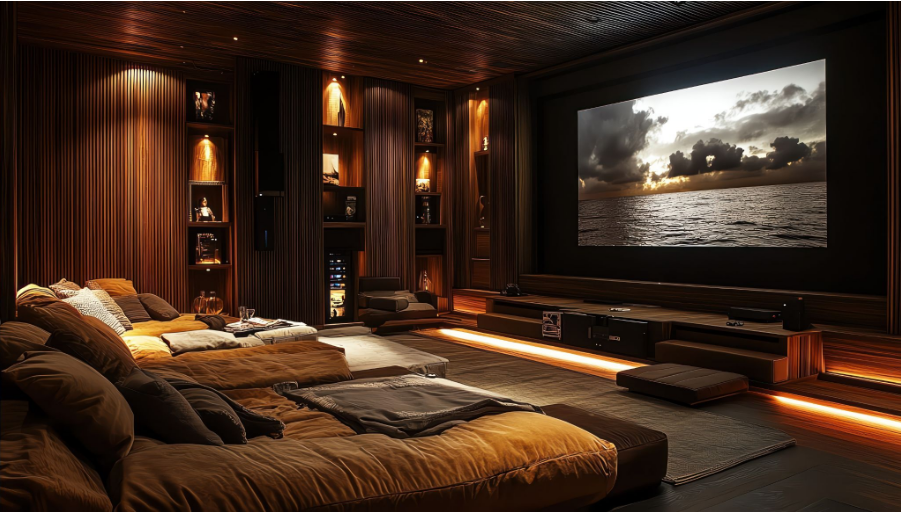
An OLED TV lights each pixel individually rather than relying on a backlight, which is what allows it to turn a pixel fully off and produce true black instead of a dark grey. That advantage is most visible in a dim or dark room, where there’s little competing light to wash out the contrast. In a room drenched in sunlight, even a mid-range or high-end OLED can struggle to look as punchy as it does in the showroom, and an entry-level OLED, often the dimmer of the lineup, can genuinely underwhelm against strong daylight. A bedroom used mainly at night, with curtains drawn and no skylight overhead, happens to be close to the ideal setting for exactly the strength OLED is built around.
Two Questions That Tell You Whether a Room Suits OLED
- Is the TV watched mostly during the day, or in a room that gets a lot of ambient light?
- Does the spot it’s going into sit under a skylight or beside several uncovered windows?
Answering yes to either one doesn’t rule out OLED entirely, but it’s usually a sign that a brighter LED or QLED panel will look more consistent in that particular spot, while a dimmer room, a bedroom especially, tends to be where OLED’s contrast advantage gets to show up uncompromised.
Burn-In Is a Real Risk, But an Unlikely One for Ordinary Viewing
OLED panels can, in principle, develop burn-in, faint ghosting of an image that stayed on screen too long, but in practice this mainly affects static elements left unchanged for hours at a stretch, a channel logo, a news ticker, or a paused frame left up overnight. Regular viewing with varied content, switching between shows, streaming apps, and different channels, carries very little real-world risk. Most current OLED models also include automatic protections, pixel-shifting and periodic refresh cycles, that run quietly in the background specifically to counter this, which is part of why reviewers who’ve used OLEDs for years consistently describe burn-in as a manageable, largely theoretical concern rather than a daily worry.
None of this makes OLED the wrong choice for a brighter room, or a 55-inch screen the wrong size for a living room. It just means matching the panel technology to where it’s actually going tends to matter more than either spec sheet alone suggests, and a bedroom’s relative darkness is often the setting where a 55-inch OLED gets to look exactly as good as it did in the showroom. A living room with heavy curtains or no direct window exposure can offer the same advantage, so the room’s actual lighting matters more than which room it happens to be.
Working out whether OLED suits a specific room is easiest with a quick conversation about where it’s going. Contact Harvey Norman Singapore before deciding between panel types.