
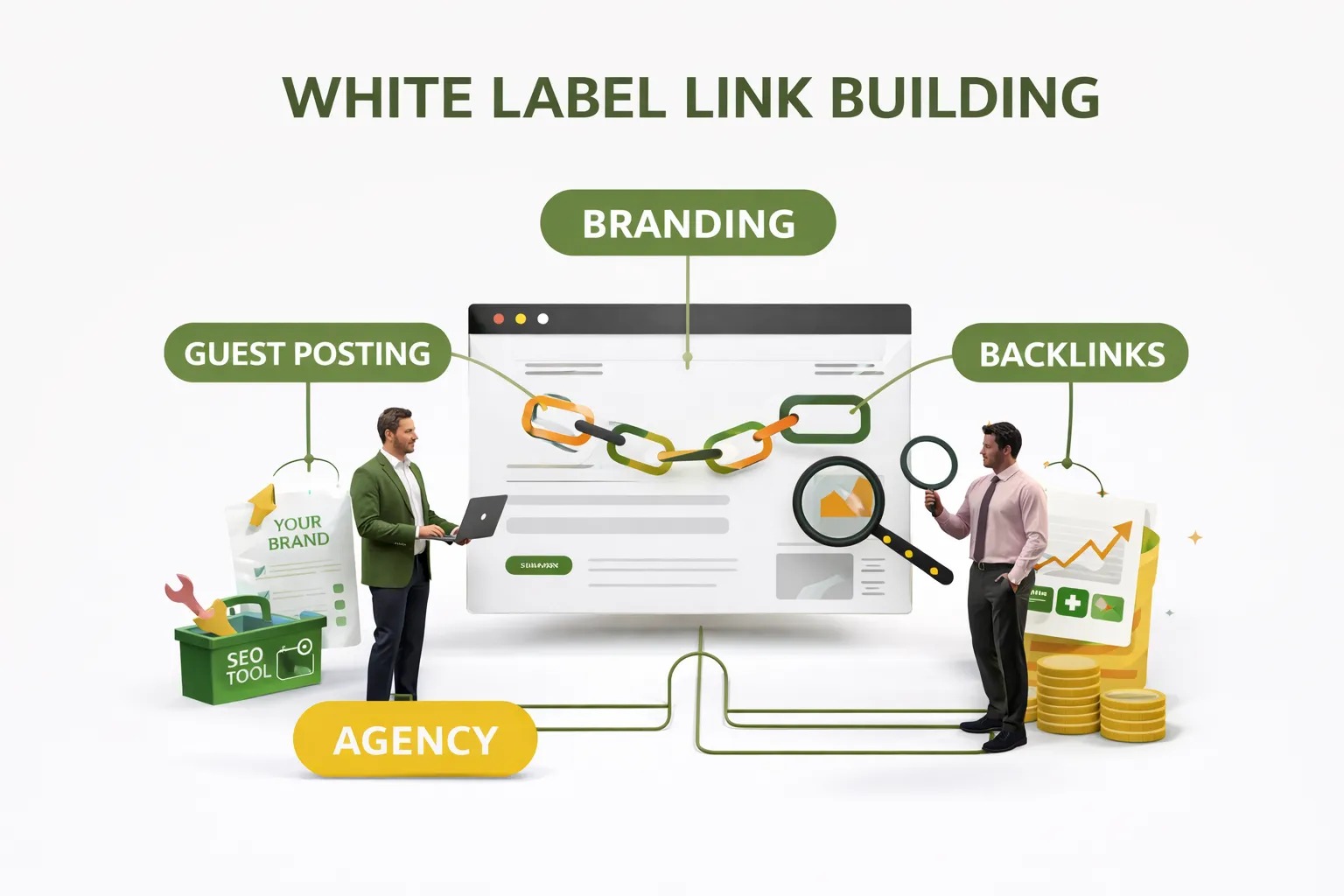
For digital agencies managing SEO deliverables on behalf of clients, the decision to bring in outside help for link building is rarely made lightly. The concern is not simply about cost or capacity — it is about what happens downstream when a third party acts on your agency’s behalf. If the links they produce are low quality, irrelevant, or built through methods that violate search engine guidelines, the agency carries the reputational and operational consequences. The client relationship suffers. Rankings drop. Trust erodes.
This dynamic has made partner vetting a genuinely important operational task, not just a procurement formality. Agencies that have been burned by poor partnerships tend to describe the same pattern: the early deliverables looked acceptable, the reporting appeared clean, and then problems surfaced months later — penalty exposure, link removal requests, or client churn tied directly to declining organic performance.
What follows is a framework built around five criteria that hold up under real-world scrutiny. These are not abstract ideals. They reflect the actual fault lines where white label partnerships tend to succeed or fail.
1. Editorial Standards and Link Acquisition Methods
When agencies evaluate white label link building services, the first and most consequential question is how the links are actually acquired. This question matters more than price, turnaround time, or the size of the vendor’s network. Methods determine risk, and risk in SEO compounds over time in ways that are difficult to reverse.
There is a meaningful difference between link building that involves genuine editorial relationships — where content earns placement through relevance and quality — and methods that rely on link networks, private blog networks (PBNs), or mass outreach with templated pitches that publishers have learned to ignore or monetize through paid placement disguised as editorial coverage. According to Google’s Search Essentials documentation, links intended to manipulate PageRank are a violation of their spam policies, regardless of how they are packaged or presented.
Why Method Transparency Is Non-Negotiable
A credible white label partner should be willing to explain their outreach and placement process in enough detail that you can assess it independently. This does not mean they need to disclose proprietary contacts or templates, but it does mean they should be able to describe how a link goes from prospect to placement — what editorial standards the target publication applies, how pitches are developed, and what happens when a placement does not meet quality expectations.
Partners who are evasive about process, or who substitute vague claims about their “network” for actual explanation, are signaling that transparency is not something they have structured their operation around. That should raise concern, not just curiosity.
2. Relevance and Topical Alignment Across Placements
The relevance of a link — meaning whether the linking site and the content surrounding the link are topically related to the client’s business — has a direct effect on how that link performs. A link placed in an article about home renovation pointing to a tax software company is not a neutral addition to a backlink profile. It is noise, and in sufficient volume, it can actively distort the signals that search engines use to understand what a site is about.
White label partners who operate at scale sometimes default to placing links wherever volume can be generated most efficiently. This produces link counts that look impressive in reports but fail to contribute meaningfully to organic performance. Worse, they can make a backlink profile appear inorganic when viewed in aggregate.
Evaluating Relevance Criteria Before Signing an Agreement
Before committing to a partner, agencies should ask for sample placements from past campaigns in industries that are comparable to their client base. Looking at the actual articles — not just the domain names — reveals whether the partner is applying consistent topical reasoning or simply filling slots. Are the placements contextually appropriate? Does the surrounding content reflect genuine expertise in the subject area, or does it read like keyword-stuffed filler designed to host links?
The answer to that question tells you a great deal about the partner’s quality standards and their understanding of what makes a link valuable over time rather than just on a delivery report.
3. Reporting Clarity and Data Ownership
Agencies operating under a white label arrangement are, by definition, presenting another party’s work as their own. This creates a structural need for reporting that is accurate, accessible, and owned by the agency — not locked inside a vendor’s platform in a format that cannot be extracted or verified independently.
Reporting that works for white label relationships includes placement details that can be cross-referenced: the URL of the published content, the anchor text used, the date of publication, and domain authority metrics from a recognized tool. It should not require the agency to take the vendor’s word for the value of each link. Good reporting supports the agency’s own analysis rather than replacing it.
The Risk of Reporting That Obscures Rather Than Clarifies
Some white label providers generate polished reports that emphasize volume and visual presentation while making it difficult to assess individual link quality. Metrics are aggregated, outliers are averaged away, and the report reads as a summary rather than a record. Agencies that accept this type of reporting without verification are accepting operational risk. If a client audits the backlink profile independently and finds links that raise quality questions, the agency is in a difficult position — unable to explain decisions they never actually reviewed.
Data ownership also matters at the point of partnership termination. Agencies should confirm that all placement records, outreach logs, and link data are fully transferable without restriction if the relationship ends.
4. White Label Process Integration and Workflow Compatibility
A link building partner may produce good work in isolation but create significant friction when integrated into an agency’s existing workflows. This friction is rarely obvious during sales conversations. It becomes apparent after the relationship has started and the operational realities surface — communication delays, format mismatches, unclear revision processes, or timelines that do not align with how the agency manages client reporting cycles.
Process compatibility is not a secondary concern. For agencies managing multiple client accounts simultaneously, each with different reporting dates, content approval requirements, and communication expectations, a partner who cannot adapt to those structures adds management overhead rather than reducing it.
What Workflow Integration Should Look Like in Practice
Effective white label partners understand that they are extending an agency’s operation, not running a parallel one. This means they are willing to work within the agency’s preferred communication channels, meet agreed-upon deadlines consistently, accommodate brand voice guidelines when content is part of the placement, and flag problems early rather than after a deadline has passed.
Agencies evaluating this criterion should ask for a realistic description of how the partner handles revisions, escalations, and missed deadlines. They should also ask about account management — specifically, whether there is a consistent point of contact or whether inquiries are handled by a rotating team. Consistency in communication is a proxy for consistency in operations.
5. Track Record With Agencies of Similar Scale and Vertical
A white label provider’s experience working with clients in specific industries and at specific scales matters more than general experience. A partner who has primarily served e-commerce clients in consumer verticals may lack the editorial contacts, content expertise, and placement instincts needed to build links effectively for a B2B technology company or a regulated professional services firm. The same logic applies to scale — a partner built for small campaigns may struggle to maintain quality when volume increases.
This is not a question of whether the partner is capable in theory. It is a question of whether their processes and relationships are calibrated for the type of work your agency needs to deliver. A track record in comparable contexts is the most reliable indicator of what they will actually produce for your clients.
How to Assess Track Record Without Relying Solely on References
References are useful but limited. A more complete assessment involves reviewing actual placements the partner has made for clients in similar industries, asking specific questions about how they have handled vertical-specific content requirements, and looking at whether their stated process holds up when applied to realistic examples. Agencies can also assess track record indirectly by examining the partner’s own content and communication quality — vendors who cannot maintain editorial standards in their own materials are unlikely to maintain them consistently for clients.
It is also worth asking how long the partner’s typical agency relationships last. High turnover among agency clients suggests that the initial impression does not hold up over time. Long-standing relationships — even a few — suggest that the partner delivers consistently enough for agencies to continue renewing the arrangement.
Closing: A Framework Built for Long-Term Reliability
The five criteria covered here — editorial standards, topical relevance, reporting clarity, workflow compatibility, and relevant track record — are not exhaustive, but they address the fault lines where white label link building partnerships most commonly fail. Agencies that apply this framework during the vetting process are not simply trying to avoid bad outcomes. They are trying to build relationships that remain sound under the pressure of real client demands and evolving search conditions.
The goal of vetting is not to find a partner who answers every question perfectly. It is to find a partner whose answers reveal a well-structured operation, a clear understanding of quality, and a genuine orientation toward accountability. Those qualities do not appear fully formed in a sales conversation. They emerge when you ask direct questions about process, push for specifics on past work, and evaluate how the partner responds to scrutiny.
Agencies that treat partner selection as a strategic operational decision — rather than a quick procurement task — tend to build white label arrangements that hold up over time, support client retention, and reduce the kind of backlink-related risk that is slow to appear and expensive to resolve. That outcome is worth the investment in a more deliberate vetting process.