
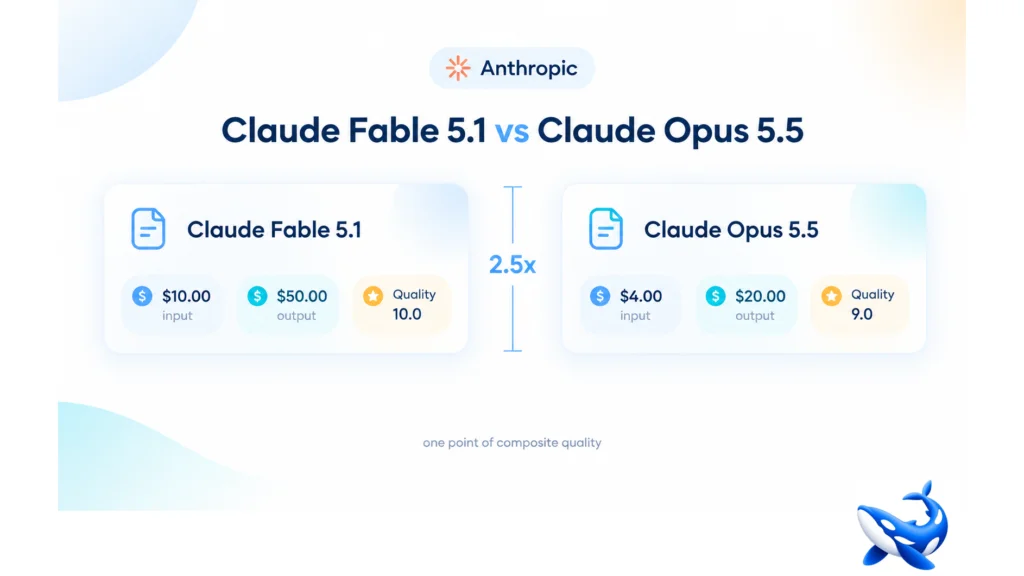
Most of the comparisons on OrcaRouter put two vendors in a ring and let you pick a side. The Claude Fable 5.1 vs Claude Opus 5.5 page is a harder conversation, because both cards come from Anthropic and the decision is not which company you trust. It is whether the top of the Anthropic range is worth two and a half times the card one step below it — when that cheaper card is already sitting in the same band our own quality column hands to five other models, and when the range itself keeps flattening as it climbs.
The two Anthropic cards, priced against each other
Read on 2026-10-13:
| metric | Claude Fable 5.1 | Claude Opus 5.5 | gap |
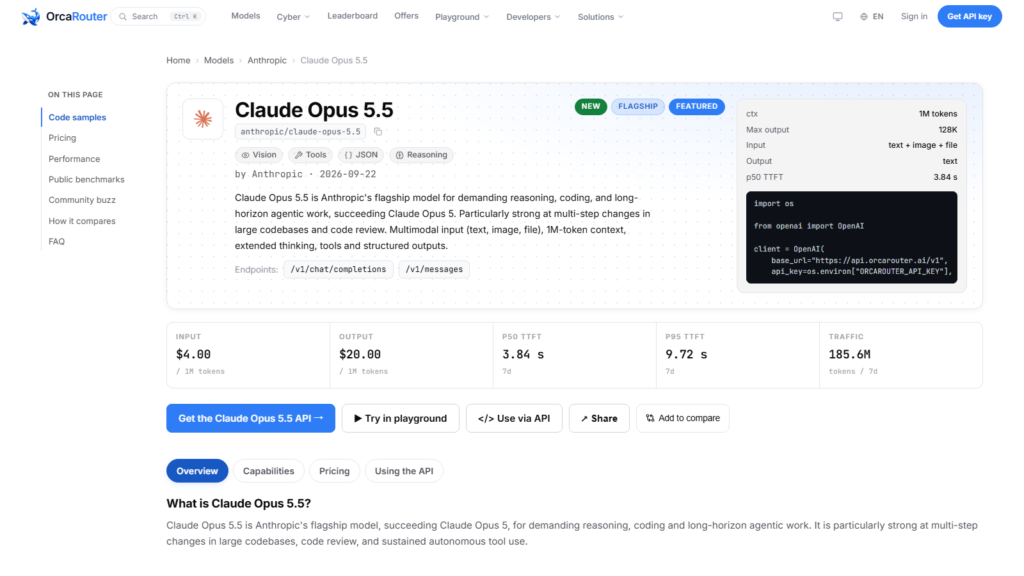
| input, per million tokens | $10.00 | $4.00 | 2.5x |
| output, per million tokens | $50.00 | $20.00 | 2.5x |
| output-to-input multiple | 5.0x | 5.0x | identical |
| context window | 1M | 1M | identical |
| composite quality, 0–10 | 10.0 | 9.0 | one point |
The gap is clean in a way that makes the argument simple. Both cards bill output at five times input, so the ratio between them holds whatever your read-to-write mix looks like. Both carry a 1M-token context window, so neither side is buying you room. The only things that differ are the price, by a factor of 2.5 on both lines, and the composite quality, by a single point.
What one point at the ceiling is actually buying
The composite score is ours: a 0–10 figure we compute from four families of evaluation we run against each endpoint — reasoning, code generation, long-context retrieval and instruction following — averaged into one number. It is not a third-party leaderboard and it is not a claim about which model is better in the abstract; it is a summary of what we measured on our own side.
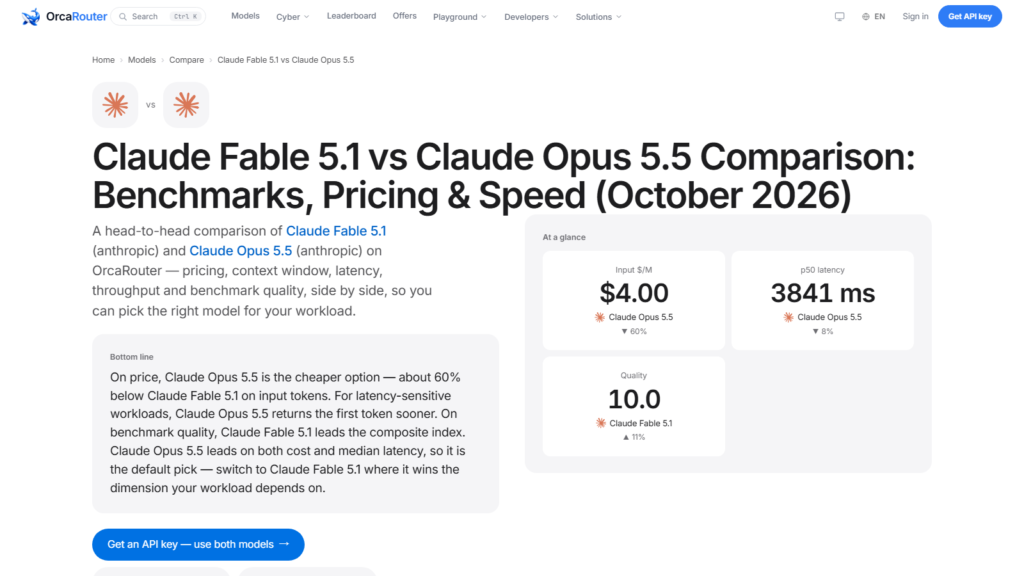
At the top of the range, a single point is scarce. All twelve of the models we price land between 8.0 and 10.0 on this scale, while input prices across the same twelve span from $0.60 to $30.00 — a fifty-fold range. The quality axis is crowded and the price axis is not, which means the last point of quality is the most expensive real estate on the board. Fable 5.1 and Opus 5.5 sit at 10.0 and 9.0 exactly on that boundary: the cheaper card shares its 9.0 with five other models in the set, and the expensive card is one of three sitting at the top.
Whether that is worth 2.5x depends entirely on what a marginal point of aggregate capability is worth to you. If your product is a support bot where a wrong answer costs a refund, one point is cheap. If your product is a batch summariser where a slightly worse answer costs nothing, one point is very expensive.
The trap in reading this pair as “the best model”
It is tempting to collapse a comparison page into a winner and move on, and on this pair the winner is unambiguous — Fable 5.1 scores higher on every quality axis we measure and costs more on every price axis. That is not the useful reading. The useful reading is that these two cards bracket the top of the Anthropic range, and the space between them is where most real deployments should be deciding.
Middle ground that this comparison does not show
There is a third Anthropic card in the same price table, and its absence from this pair is itself informative. Claude Sonnet 5.5 sits at $2.00 input and $10.00 output with a composite of 9.0 — the same quality score as Opus 5.5, at half the input price and half the output price. Against Fable 5.1 it is a five-times input discount for one point of quality.
So the Anthropic range is not a two-step ladder. It is a curve that flattens: going from the cheapest Anthropic card to the middle one buys the same quality point that going from the middle one to the most expensive buys again, at half the money. If you arrived at this pair convinced that the answer is either the cheapest or the best, the middle is the card that most often wins, and it is the one this page does not put in front of you.
Two cards, one integration
The practical reason a same-vendor pair like this is worth evaluating on a router rather than on a direct account is that the vendor is not the variable. Both endpoints are served at list price behind the same base URL, the same authentication and the same response shape, so switching between them is a string change and the only thing that moves is the invoice and the score.
That matters more here than in a cross-vendor comparison. Because Fable 5.1 and Opus 5.5 share a tokenizer family, a prompt that performs well on one generally transfers to the other, so a migration between them does not carry the usual prompt-rewriting tax. The experiment is cheap in engineering time as well as in dollars, which makes the 2.5x question testable rather than a matter of opinion.
What 2.5x looks like on a bill
The cleanest way to hold both price lines at once is a matched pair. Read a million tokens and write a million through each card. Claude Fable 5.1 bills $60.00. Claude Opus 5.5 bills $24.00. The difference is $36.00 on a single balanced pair, and because both cards bill output at five times input, that ratio does not move as your mix shifts — the gap is 2.5x at every read-to-write ratio.
Most premium pairs do not behave that way. Usually the more expensive card charges a steeper multiple for generated tokens, so a write-heavy workload widens the gap and a read-heavy one narrows it, and the honest answer depends on your traffic. Here the shape is fixed, which turns the 2.5x into a constant rather than a range: whatever your workload looks like, the expensive card costs two and a half times what the cheaper one does, and the only open question is whether one point of composite is worth that.
The takeaway
Claude Fable 5.1 and Claude Opus 5.5 are the two ends of the top of the Anthropic range, and the case for the expensive one is narrow: 2.5x on both input and output, for one point on a ten-point composite, with identical 1M context windows and identical five-to-one billing shapes on both sides. If your workload cannot tolerate a marginal drop in aggregate quality, Fable 5.1 is the card and the premium is the price of insurance. If it can, Opus 5.5 is the better buy on this page — and Claude Sonnet 5.5, which is not on this page, is the better buy than both at the same 9.0 quality.
Both are live at list price behind a single key, so the honest way to settle it is to run your own hardest prompts through each and see whether the point shows up where you need it.
Sourcing note: prices, context windows and output-to-input multiples were read off our own comparison page for this pair on 2026-10-13. The composite quality column is OrcaRouter’s own 0–10 scale, computed from four evaluation families we run against each endpoint, and is not a third-party index. The comparison page and the model page linked above are OrcaRouter production pages. All checked 2026-10-13.