
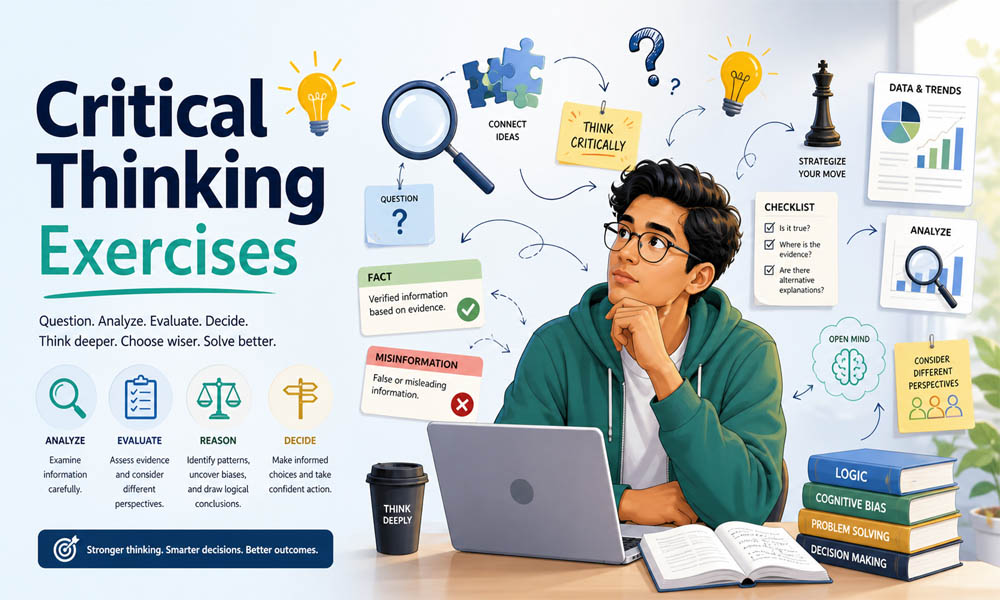
Every day, your mind has to deal with a lot of information. You see posts on social media. You hear news from many places. You watch videos, read comments, and listen to other people’s opinions. Some of this information is true. Some of it is wrong. Some of it is made to make you feel angry, scared, or excited.
This is why critical thinking exercises are so useful in 2026. They help you slow down and think clearly. They help you ask better questions before you believe something. They also help you make better choices in school, work, family life, and daily problems.
Critical thinking does not mean you have to argue with everyone. It also does not mean you should doubt everything in a negative way. It simply means you think before you accept something as true. In this article, we will talk about simple critical thinking exercises that can train your brain every day and help you become a smarter thinker.
What Are Critical Thinking Exercises?
Critical thinking exercises are simple activities that help your brain think in a clear and careful way. They teach you how to look at information, ask questions, check facts, and make better choices. You can think of them like small workouts for your mind.
Just like your body gets stronger when you exercise, your brain also gets stronger when you practice thinking. If you ask smart questions every day, your mind starts to notice weak ideas faster. If you check facts often, you become better at spotting false information.
These exercises are not only for students or experts. Anyone can use them. A worker can use them before making a big choice. A parent can use them while solving a family issue. A student can use them while studying. Even a person scrolling on social media can use them before sharing a post.
Why Critical Thinking Exercises Matter Today
Today, information moves very fast. One small post can reach thousands of people in minutes. A video can go viral before anyone checks if it is true. A strong opinion can look like a fact if it is shared with confidence.
This can make life confusing. You may ask yourself, “Should I believe this?” or “Is this person telling the full truth?” That is where critical thinking exercises help. They give you a simple way to stop, think, and check before you react.
These exercises also protect you from quick mistakes. For example, you may see a product online with big promises. It may say, “This will change your life in 7 days.” A critical thinker will not believe it right away. They will check reviews, look for proof, and ask if the claim makes sense.
How Critical Thinking Helps Your Brain
Your brain is like a muscle. If you use it in the right way, it becomes stronger. If you never challenge it, it may accept things too quickly. This is why daily thinking practice matters.
Critical thinking helps your brain in three simple ways. First, it helps with analysis. This means breaking a topic into smaller parts. For example, if someone says, “This diet is the best,” you can ask, “Best for whom?” “What proof do they have?” and “Are there any risks?”
Second, it helps with evaluation. This means checking if the information is strong or weak. You look at the source. You look at the facts. You ask if the person may have a reason to push one side. Third, it helps with inference. This means using the facts you have to make a fair and smart conclusion.
Critical Thinking Exercises for Asking Better Questions
One of the best critical thinking exercises is learning how to ask better questions. Good questions open your mind. They help you see what is missing. They also help you avoid believing something too fast.
Start with simple questions. Ask, “Why is this true?” Ask, “What proof supports this?” Ask, “Is there another side to this story?” These questions may look small, but they can change the way you think.
For example, imagine a friend tells you, “Everyone is making money from this app.” A quick thinker may join without checking. But a critical thinker will ask, “Who is everyone?” “Is there real proof?” “Could this be a trick?” This does not mean you are being rude. It means you are being careful.
Critical Thinking Exercises to Check Facts
Another useful habit is checking facts before you believe or share something. This is one of the most important critical thinking exercises for modern life. In 2026, false posts, edited videos, and half-truths can spread very fast.
When you see a claim online, do not trust it only because it looks professional. Check who said it. Look at the date. Find out if other trusted sources are saying the same thing. If there is no proof, be careful.
Here is a simple example. You see a post that says a famous person said something shocking. Before you share it, search for the full quote. Check if it came from a real interview. Look for the original source. This small habit can save you from spreading false news.
Critical Thinking Exercises for Seeing Both Sides
Many people only listen to ideas they already agree with. This feels comfortable, but it can also make thinking weak. A strong thinker tries to see both sides before making a final opinion.
One helpful method is called the devil’s advocate method. This means you try to argue from the opposite side, even if you do not fully agree with it. It helps you see if your own idea is strong or weak.
For example, imagine you believe working from home is always better. Now try to think from the other side. Maybe some people work better in an office. Maybe teams communicate faster in person. Maybe new workers need more face-to-face help. This exercise does not mean you must change your view. It only helps you understand the full picture.
Critical Thinking Exercises to Find Hidden Bias
Bias means a hidden leaning toward one side. Everyone has some bias. This does not make you a bad person. It simply means your past, feelings, likes, and fears can shape how you think.
One of the most helpful critical thinking exercises is asking yourself, “Am I being fair?” This question can slow down quick judgment. It helps you notice when emotions are leading your mind instead of facts.
For example, you may trust a review because the person likes the same things you like. Or you may reject an idea because it comes from someone you do not like. But a critical thinker tries to look at the idea itself. They ask, “Is this true?” instead of only asking, “Do I like the person saying it?”
Critical Thinking Exercises for Breaking Down Arguments
Arguments are everywhere. You see them in news articles, videos, ads, comments, and daily talks. Some arguments are strong. Some are weak. Some sound good but do not have real proof.
A great way to understand an argument is to break it into parts. First, find the main claim. What is the person trying to prove? Next, look at the evidence. What proof are they using? Then, look at the conclusion. Does the ending really match the proof?
For example, an ad may say, “This phone is the best because many people bought it.” But is that strong proof? Many people buying something does not always mean it is the best. It may only mean the phone had good marketing. This is why breaking down arguments is one of the most useful critical thinking exercises you can practice.
Fun Critical Thinking Exercises with Games and Puzzles
Critical thinking does not always have to feel serious. You can train your mind with fun games too. Puzzles, riddles, sudoku, word games, and brain teasers can help your brain stay active and sharp.
These games make you look for patterns. They also teach you to slow down and think before you answer. For example, when you solve a riddle, the first answer may not always be right. You have to look at the words again and think in a new way.
This is why games can be great critical thinking exercises. They build patience. They also help you practice problem solving without pressure. Even 10 minutes a day can help your brain become more alert and ready for daily challenges.
Critical Thinking Exercises for Better Decisions
Every day, you make choices. Some are small, like what to buy or what to eat. Some are bigger, like choosing a job, trusting a person, or spending money. Good choices need clear thinking.
One helpful exercise is to think about the “domino effect.” This means you ask yourself what may happen after your choice. One decision can lead to another result, just like one falling domino can push the next one.
For example, you may want to buy an expensive phone. Before buying it, ask yourself, “Can I afford it?” “Will I still have money for bills?” “Do I really need it now?” These simple questions can save you from regret later. This is one reason critical thinking exercises are so helpful in real life.
Daily Critical Thinking Exercises You Can Practice
The best part about critical thinking is that you can practice it every day. You do not need a special class or a big plan. You only need a few simple habits.
You can start by reading one news story carefully. Do not just read the headline. Ask what the story is really saying. Check who wrote it. Look for proof. Ask if anything important is missing.
You can also ask three simple questions before sharing a post online. Is it true? Is it fair? Is it useful? These questions are easy, but they can make a big difference. They help you become more careful with what you believe and what you share.
Another daily habit is writing down pros and cons before a choice. For example, if you want to change your job, write what is good about the change and what could be risky. When you see your thoughts on paper, your mind becomes clearer.
Common Mistakes to Avoid in Critical Thinking
Critical thinking is useful, but some people misunderstand it. They think it means rejecting every idea. That is not true. Critical thinking means checking ideas fairly, not saying no to everything.
Another mistake is overthinking. Some people keep thinking so much that they never decide. They check every small thing again and again. This can make life stressful. Good thinking should help you move forward, not keep you stuck.
A third mistake is only listening to people who agree with you. This feels safe, but it can limit your mind. A strong thinker listens to other views too. You do not have to agree with every view, but you should try to understand it before judging it.
How to Make Critical Thinking Exercises a Habit
The easiest way to build this habit is to start small. Do not try to change the way you think in one day. Pick one simple exercise and use it daily.
For example, you can start by asking, “What proof do I have?” whenever you hear a strong claim. Or you can spend five minutes each night thinking about one choice you made that day. Ask yourself, “Did I think clearly?” and “What could I do better next time?”
You can also use critical thinking exercises in normal life. Use them while shopping. Use them while reading reviews. Use them while watching videos. Use them during talks with friends. Slowly, clear thinking will become a natural part of your day.
Conclusion
Critical thinking is not only for school, work, or big life problems. It is for everyday life. It helps you understand information better. It helps you avoid weak claims. It helps you make choices that feel calm and smart.
The world in 2026 is full of fast news, strong opinions, and endless online content. Because of this, clear thinking is more important than ever. Critical thinking exercises give your mind a simple way to slow down, ask questions, and find better answers.
You do not need to be perfect. You only need to practice. Start with one habit today. Ask one better question. Check one fact. Listen to one different view. Over time, these small steps can train your brain and help you think with more confidence every day.
You may also read: MyLawyer360: How This Legal Platform Helps People Find Lawyers