
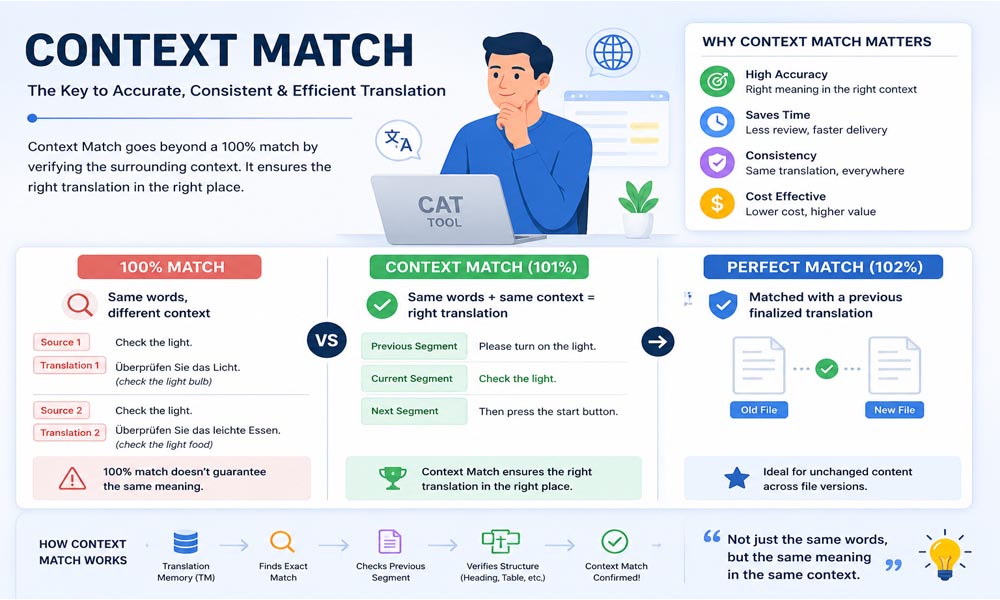
Have you ever seen something in your CAT tool that says “101% match” and thought, wait… how can anything be more than 100%? You are not alone. Many translators and even project managers feel confused when they first see this.
At first, it looks strange. You might think a 100% match should be perfect. But in real work, things are not that simple. The same sentence can mean different things in different places. This is where context match becomes very important.
In this article, we will explain context match in the easiest way possible. You will learn how it works, why it is better than a normal match, and how it helps save time, money, and effort. By the end, you will feel confident and clear about this topic.
What Is Context Match in Simple Words
Let’s keep it very simple.
A context match means the text is the same, and the situation around it is also the same. It is not just about words. It is about meaning.
Think about this. If someone says the word “Run,” what does it mean?
-
It can mean running fast.
-
It can mean starting a program.
Now imagine your CAT tool sees the word “Run” and finds it in your Translation Memory. A normal match will say, “Yes, this word is the same.” But it does not check what it means in this situation.
A context match goes one step further. It checks the surrounding text. It makes sure the meaning is also the same. That is why context match is much more reliable.
How CAT Tools Use Context Match
Before we go deeper, let’s quickly understand how CAT tools work.
CAT tools (Computer-Assisted Translation tools) help translators work faster. They use something called Translation Memory (TM). This is like a smart storage that saves sentences you have already translated.
When you get new text, the tool checks your TM. It tries to find similar or exact matches. Then it shows a percentage, like:
-
80% match
-
100% match
-
101% match (context match)
Now here is where context match comes in.
The tool does not just look at the sentence. It also looks at:
-
The sentence before it
-
The structure (like heading or table)
If everything matches, it gives you a context match. This tells you, “This is not just the same text. It is the same situation too.”
Context Match vs 100% Match: What’s the Difference
This is where most confusion happens.
A 100% match means the sentence is exactly the same as before. Every word matches. Sounds perfect, right? But there is a small problem.
A 100% match does not check the meaning.
Let’s look at a simple example. The sentence is: “Check the light.”
Now think:
-
In a car manual, it means check the headlight
-
In a diet guide, it could mean check light food
Same sentence. Different meaning.
A 100% match will not catch this difference. But a context match will. It checks what comes before and where the sentence is used.
So the main difference is simple:
-
100% match = same words
-
Context match = same words + same meaning
Why Context Match Is More Reliable
Now you can see why context match is so powerful.
When the tool checks the full context, it removes confusion. You do not have to guess what the sentence means. The tool already confirmed it for you.
This makes your work easier. You can trust the result more. You do not need to spend too much time checking again and again.
Think about working on a big project with thousands of lines. If many of them are context matches, you can move faster. You feel more confident. And you make fewer mistakes.
That is why many professionals say that context match is more reliable than a normal match.
How Context Match Works Step by Step
Let’s break it down in a very simple way.
For a context match to happen, three things must be true.
First, the text must be exactly the same. Every word must match. This is like a normal 100% match.
Second, the sentence before it must also be the same. This helps the tool understand the flow and meaning.
Third, the structure must match. For example:
-
If it was a heading before, it must still be a heading
-
If it was in a table, it must still be in a table
When all these things match, the tool says, “Yes, this is a context match.”
You can think of it like a puzzle. All pieces must fit perfectly. Only then you get that extra level of trust.
Context Match vs Perfect Match Explained
Now let’s talk about something even higher: Perfect Match (102%).
A perfect match is like an advanced version of a context match. But it works in a slightly different way.
Instead of only using Translation Memory, a perfect match compares your current file with an old, already translated file. It checks full sections, not just one sentence.
If a whole part of the document has not changed at all, the tool marks it as a perfect match. This means:
-
Same text
-
Same context
-
Same file structure
In simple words:
-
Context match checks TM and nearby text
-
Perfect match checks full files and versions
Both are very powerful, but perfect match is often used in updates, like manuals or legal files.
Why Context Match Saves Time and Money
Now let’s talk about something everyone cares about — time and money.
When you get a context match, you do not need to do much work. The translation is already correct and fits the situation. So you can move forward quickly.
This saves a lot of time. Imagine skipping hundreds of lines because they are already perfect. That is a huge boost in speed.
It also saves money. In many projects:
-
Context matches are paid very low
-
Sometimes they are even free
Why? Because they need little or no effort.
For companies and clients, this is a big win. For translators, it means faster projects and less stress.
How Context Match Improves Translation Quality
Now let’s talk about quality, because this is where context match really shines.
When the tool checks the full situation, the meaning becomes clear. You are not just copying words. You are using the right meaning in the right place. This reduces mistakes a lot.
Think about a big project like a software manual. The same sentence can appear many times. If you use context match, the translation stays the same everywhere. This builds strong consistency. And consistency is very important in professional work.
Another good thing is trust. When clients see clean and consistent translations, they feel confident. They know the work is reliable. That is why many teams depend on context match for high-quality results.
Understanding Fuzzy Matches and Where Context Match Fits
Not every match is perfect or exact. This is where fuzzy matches come in.
A fuzzy match means the sentence is similar, but not exactly the same. For example, one word might be different, or the sentence might be slightly longer. CAT tools show this as a percentage like 70% or 85%.
Let’s break it down simply:
-
High fuzzy (85–94%) → small changes
-
Medium fuzzy (75–84%) → some editing needed
-
Low fuzzy (50–74%) → more work needed
Now compare this with context match. A context match is much stronger. It is not just similar. It is exact and confirmed by context.
So in simple words:
-
Fuzzy match = helpful suggestion
-
Context match = almost ready and safe to use
Smart Ways to Get More Context Match in Projects
Now you might be thinking, how can I get more context match in my work? Good question.
One smart way is to keep your Translation Memory clean. If your TM has clear and correct translations, your matches will be better. Old or wrong entries can cause problems.
Another tip is to use a consistent writing style. If your content follows the same pattern again and again, the tool can easily find context matches. This is very helpful in long projects.
Also, try to use templates. For example, if your company creates similar documents every time, using the same format will increase context match rates. Small changes in structure can break matches, so consistency is key.
Context Match in AI and the Future
In 2026, things are moving fast. AI is getting smarter every day. So where does context match fit in the future?
Right now, context match in CAT tools is rule-based. It checks exact text and structure. It follows strict rules. That is why it is very reliable for billing and professional work.
On the other hand, AI tools use something called natural language understanding. They try to understand meaning even if the words are different. This is exciting, but it is still not perfect for match scoring.
In the future, we may see both systems working together. AI can help understand meaning, while context match keeps things accurate and safe. This mix will make translation even faster and smarter.
Common Mistakes to Avoid with Context Match
Even though context match is powerful, some mistakes can still happen.
One common mistake is trusting a 100% match too much. People think it is perfect, but it may not fit the context. Always remember, meaning matters more than words.
Another mistake is ignoring structure changes. If the format is different, the meaning can change too. This can break the context match and cause confusion.
Also, poor TM management can cause problems. If your Translation Memory is messy, your matches will not be reliable. Keeping it clean and updated is very important for good results.
Conclusion
So, what have we learned?
Context match is not just a small feature. It is a powerful tool that helps you work smarter. It checks both words and meaning, which makes it more reliable than a simple match.
It saves time. It reduces effort. It improves quality. And it helps both translators and businesses get better results.
If you understand and use context match well, you gain a big advantage. You can handle projects faster and with more confidence. In today’s fast world, that makes a real difference.
So next time you see a 101% match, you will not feel confused. You will smile and think, this is going to be easy.
(FAQs)
What is a context match in simple words?
A context match means the text is exactly the same, and the situation around it is also the same. The CAT tool checks the sentence, the previous sentence, and the structure. This makes the translation more accurate and safe to use.
Why is context match better than a 100% match?
A 100% match only checks if the words are the same. It does not check meaning. A context match checks both words and meaning. That is why it is more reliable and needs less checking.
What does 101% match mean in CAT tools?
A 101% match is another name for a context match. It means the sentence is fully matched and the context is also verified. Some tools also call it an ICE (In-Context Exact) match.
What is the difference between context match and perfect match?
A context match checks text and nearby context using Translation Memory. A perfect match (102%) compares full files with older versions. Perfect match is often used in updated documents where nothing has changed.
Do I need to check context match segments?
In most cases, context match segments need very little checking. They are already verified by the tool. However, a quick look is still a good idea, especially in important projects.
Why are context matches often free or very cheap?
Context matches need almost no work. The translation is already correct and fits the situation. That is why clients usually pay very little or nothing for them.
How can I get more context match in my projects?
You can get more context match by:
-
Keeping your Translation Memory clean
-
Using the same writing style
-
Following consistent structure
-
Using templates for similar documents
What happens if the context changes slightly?
If the context changes, even a little, the tool will not give a context match. It may show a 100% match or a fuzzy match instead. This is because the meaning may also change.
Are context matches always 100% correct?
Context matches are very accurate, but not always perfect. Small errors can still happen if the original translation had a mistake. So a quick review is always smart.
Will AI replace context match in the future?
AI is improving fast, but context match is still very important. AI understands meaning, but context match gives strict and reliable results. In the future, both will likely work together.
You may also read: Warmup Cache Request: How to Make Your Website Load Fast Every Time