
You’re walking to your car one morning, glance down, and notice something odd about your tyre. There’s a bulge on the sidewall, or maybe a network of fine cracks running across the rubber. Your first instinct is probably to wonder whether it’s serious, or whether you can leave it a little longer.
That moment of uncertainty is exactly what this guide is here to resolve. Whether you’re driving around Aldershot, commuting through Farnborough, or doing the school run in Fleet, tyre damage is something every driver will encounter at some point. The question isn’t if it happens, it’s knowing what to do when it does.
This article walks you through the most common types of tyre damage, what each one means for your safety, and when replacement stops being optional.
What Different Types of Tyre Damage Actually Mean
Not all tyre damage is equal. Some damage is immediately dangerous. Some require monitoring. And some are cosmetic enough to keep an eye on without panic. The problem is that most drivers can’t tell the difference at a glance, and that uncertainty can lead to either unnecessary worry or, more dangerously, ignoring something that genuinely needs attention.
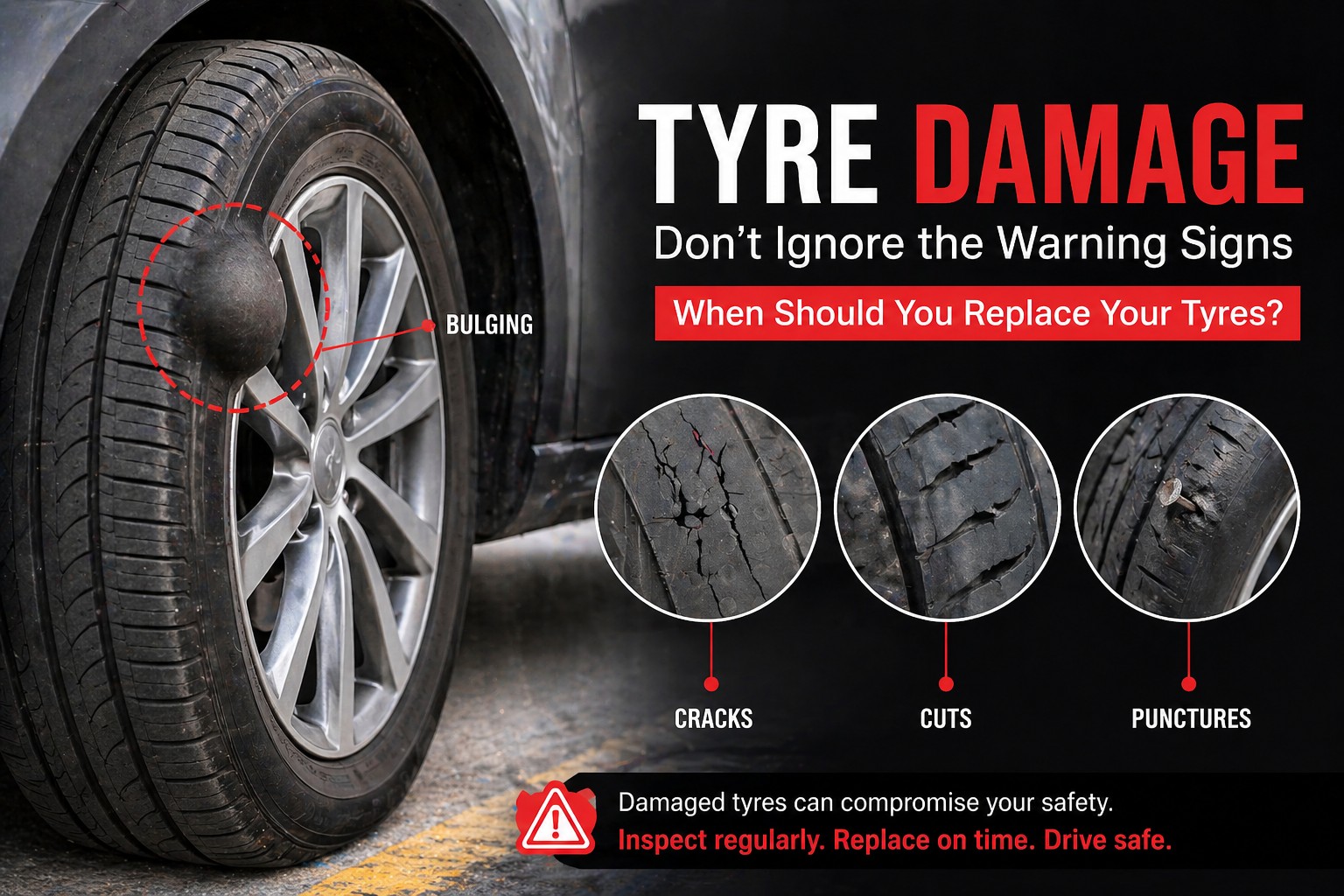
There are four main types of tyre damage you’re likely to encounter:
- Bulges and bubbles, a raised lump appearing on the sidewall or tread, caused by internal structural failure.
- Cracking and crazing, fine lines or deeper splits in the rubber, often related to age or UV exposure.
- Cuts and gashes, external damage from sharp objects, kerbs, or road debris.
- Punctures, air loss caused by a foreign object penetrating the tyre.
Each type has a different cause, a different risk level, and a different course of action. The sections below break each one down clearly so you know exactly what you’re dealing with.
Tyre Bulges: Why They’re More Serious Than They Look
A tyre bulge, sometimes called a tyre bubble, is one of the most misunderstood forms of tyre damage. It looks like a small swelling on the sidewall, and because it doesn’t always affect how the car drives immediately, many drivers assume it can wait.
It cannot.
What’s actually happening inside the tyre:
When a tyre hits a pothole, mounts a kerb at speed, or takes a sharp impact, the internal cords that give the tyre its structure can snap. Once those cords break, there’s nothing to contain the air pressure in that section. The outer rubber bulges outward under pressure, and that bubble is essentially the tyre wall holding back a blowout.
Drivers around Farnborough and Aldershot will know that local road surfaces aren’t always forgiving. Potholes are a common culprit, and even a single sharp impact at the wrong angle can cause this kind of internal damage without any visible sign at the time.
Why you shouldn’t drive on a bulging tyre:
- The structural integrity of the tyre is already compromised.
- Heat builds up during driving, increasing pressure inside the tyre.
- A blowout can happen suddenly, with little warning, at any speed.
- The risk increases significantly on faster roads like the A331 or A325.
A tyre bulge is not a “book it in for next week” situation. It is to replace it as soon as possible, ideally before driving any further distance. If you notice sidewall damage like this, getting expert advice on G Force Tyres Aldershot can help you replace unsafe tyres quickly and avoid the risk of a sudden blowout.
Cracked Tyres: Cosmetic Issue or Structural Risk?
Tyre cracking is far more common than most drivers realise, and it causes genuine confusion. You might notice a web of fine lines across the sidewall, or small cracks appearing in the tread grooves. The question is whether those cracks are simply the rubber showing its age, or a sign that the tyre is no longer safe.
The answer depends on the depth, location, and pattern of the cracking.
| Type of Cracking | Appearance | Risk Level |
| Surface crazing | Fine, shallow lines across the sidewall | Low, monitor regularly |
| Tread groove cracking | Small cracks within the tread channels | Moderate, inspect professionally |
| Deep sidewall cracks | Wide or deep splits in the sidewall rubber | High, replacement advised |
| Cracking near the bead | Cracks close to where tyre meets the rim | High, replace immediately |
What causes tyres to crack?
Rubber degrades naturally over time, even if a tyre has plenty of tread remaining. UV exposure, ozone in the air, and long periods of inactivity all accelerate this process. A tyre that’s been sitting on a car parked outside in Ash or Farnham for several years may look fine on the surface but be significantly degraded internally.
Most manufacturers recommend replacing tyres after ten years regardless of tread depth, and many suggest inspection from five years onwards. If you don’t know how old your tyres are, check the four-digit code on the sidewall, the first two digits are the week of manufacture, the last two are the year. A tyre reading “2318” was made in the 23rd week of 2018.
Deep or widening cracks, particularly on the sidewall, mean the rubber’s structural integrity is weakening. At that point, the tyre is no longer able to perform safely under load or at speed, and replacement is the only sensible course of action.
Cuts, Gashes, and Punctures: When Can a Tyre Be Repaired?
Not every piece of tyre damage means an automatic replacement. Cuts and punctures, depending on their size and location, can sometimes be repaired professionally rather than replaced entirely.
When a repair may be possible:
A puncture in the central three-quarters of the tread area, caused by an object no wider than 6mm, may be repairable using an industry-standard patch and plug method. This is the only type of damage where a repair is typically considered safe.
When replacement is necessary:
- The damage is on the sidewall, sidewalls cannot be safely repaired.
- The cut or puncture is larger than 6mm in diameter.
- The tyre has been driven on while flat, even for a short distance.
- There are multiple punctures or the damage is close to the tyre’s edge.
- The tyre shows any signs of internal damage, distortion, or bulging alongside the puncture.
If you’re unsure whether your tyre can be repaired or needs replacing, a professional inspection is always the right call. Attempting to repair a tyre that falls outside safe repair parameters is a false economy, and a safety risk.
How to Check Your Tyres for Damage
Catching tyre damage early is far easier than dealing with a blowout or a failed MOT. A quick visual check takes less than five minutes and can save you a great deal of trouble. Make it part of your routine, ideally once a fortnight and before any longer journey.
Here’s what to look for:
- Walk around the car and crouch down to look at each tyre at eye level.
- Check the sidewalls on both the inner and outer face for bulges, bubbles, cracks, or cuts. The inner sidewall is easy to miss, use a torch if needed.
- Inspect the tread area for embedded objects, cuts, or uneven wear patterns.
- Check tyre pressure when the tyres are cold, incorrect pressure accelerates damage and wear.
- Look at the tread depth using a 20p coin. Insert it into the tread groove, if the outer band of the coin is visible, your tread is below the legal 1.6mm minimum.
Drivers in North Camp, Tongham, and Ash Vale often cover a mix of urban and faster rural roads, which means tyres take varied stress. Regular checks matter more than many people realise.
If you spot anything you’re unsure about, particularly any sidewall distortion or cracking that seems deeper than surface level, get it looked at by a professional rather than making a judgement call on the roadside.
Will Tyre Damage Cause an MOT Failure?
Yes, and more often than drivers expect. Tyres are one of the most commonly failed items on an MOT, and even damage that seems minor can result in a refusal.
Under MOT standards, a tyre will fail for any of the following reasons:
- A bulge or lump anywhere on the tyre, this is an automatic fail with no exceptions.
- A cut that exposes the ply or cord structure beneath the rubber.
- Tread depth below the legal minimum of 1.6mm across the central three-quarters of the tyre.
- Cracking or splitting that is judged to affect the structural integrity of the tyre.
- A tyre that is the wrong size or type for the vehicle.
It’s worth noting that an MOT tests the tyre’s condition on the day of the test. A tyre that passes one year may not pass the next, particularly if cracking has progressed or tread has worn unevenly over the year.
If you’re preparing for an MOT and you have any doubts about your tyres, it’s worth having them inspected beforehand. Booking an MOT in Aldershot can help identify tyre damage early and prevent avoidable test failures caused by bulges, cracks, or worn tread.
The government’s official guidance on MOT standards confirms that tyres must be free from cuts, lumps, and bulges, and must meet the minimum tread depth requirement across the tyre’s width.
When to Replace Immediately vs When to Get It Checked
One of the most practical things this guide can do is give you a clear decision framework. Not every tyre concern requires an emergency stop, but some absolutely do.
Replace immediately: do not delay:
- Any visible bulge or bubble on the sidewall or tread.
- A cut that exposes the internal cords or ply.
- A tyre that has been driven on while completely flat.
- Deep sidewall cracking that is widening or feels soft to the touch.
- Any damage accompanied by vibration, pulling to one side, or handling changes.
Book a professional inspection soon:
- Surface crazing or fine cracking across the sidewall.
- A small puncture or cut in the tread area that may be repairable.
- Uneven tread wear that suggests alignment or pressure issues.
- Tyres that are five or more years old, regardless of apparent condition.
Monitor and check regularly:
- Very fine surface crazing on a tyre that is less than five years old and otherwise in good condition.
- Minor scuffing from a kerb with no visible cuts or distortion.
Understanding tyre replacement costs in the UK before you need to act can also help you plan, knowing what to expect takes the stress out of making a quick decision when something does go wrong.
The Link Between Tyre Condition and Overall Vehicle Safety
It’s easy to think of tyres as just another maintenance item, something you deal with when you have to. But tyres are the only part of your vehicle in contact with the road. Every braking distance, every cornering manoeuvre, every emergency response depends entirely on four patches of rubber the size of your hand.
A damaged tyre doesn’t just risk a blowout. It compromises braking performance, reduces grip in wet conditions (particularly relevant on the roads around Fleet and Farnham in autumn and winter), and affects how the car responds in an emergency. These aren’t theoretical risks, they are measurable, documented reductions in the safety of your vehicle.
Keeping your tyres in good condition is also closely tied to keeping the rest of your car in good working order. A car that’s regularly serviced is a car whose tyres are checked, pressures are correct, and alignment is maintained. If your vehicle is due for a check-up, a full car service gives your tyres and the wider vehicle a thorough inspection from people who know what they’re looking at.
Conclusion
Tyre bulges, cracks, and cuts are not just cosmetic concerns, they are signals that something in your tyre’s structure has changed. Some forms of damage demand immediate action. Others warrant a professional inspection. Very few can safely be ignored.
The most important thing you can do as a driver is look at your tyres regularly and act on what you find. A two-minute check every fortnight costs nothing. A blowout on the A331 at speed costs considerably more, in every sense.
If you’ve spotted something on your tyres and you’re not sure what you’re looking at, the right move is always to get a professional opinion. Drivers across Aldershot, Farnborough, Ash, Tongham, North Camp, Ash Vale, Fleet, and Farnham have access to local expertise, use it.
Don’t wait until your MOT to find out your tyres were unsafe. Act early, drive safely.
Frequently Asked Questions
Is it safe to drive with a bulge in my tyre? No. A tyre bulge means the internal structure has already failed. The tyre is at serious risk of a sudden blowout and should be replaced before driving any significant distance.
Can a cracked tyre pass an MOT? It depends on the severity. Fine surface crazing may not result in a fail, but deep or structural cracking, particularly on the sidewall, will cause an MOT failure. If in doubt, have the tyre inspected before your test.
What causes tyre bulging? Bulges are caused by sudden impacts that break the internal cords of the tyre. Common causes include hitting a pothole, striking a kerb, or driving over a sharp object at speed. The damage can occur even if the impact doesn’t seem severe at the time.
How do I know when a damaged tyre needs replacing? Any bulge, deep cut, or structural cracking means replacement is needed. If damage is limited to a small tread puncture or surface crazing, a professional inspection will confirm whether repair or replacement is the right course of action.
Can tyres crack from age alone? Yes. Rubber degrades over time due to UV exposure, ozone, and heat cycles, even if the tyre hasn’t been used heavily. Tyres over five years old should be inspected annually, and most manufacturers recommend full replacement after ten years regardless of tread depth.