
Something feels off with your car. Maybe there’s a faint sulphur smell when you pull away from the lights, or a rattle you’ve been putting off investigating. Perhaps your car just feels sluggish in a way it didn’t six months ago. For drivers in Aldershot, Farnborough, Ash, and across Hampshire, these kinds of symptoms are easy to dismiss as “one of those things.” The trouble is, when it comes to a failing catalytic converter, ignoring the early signs almost always means a bigger bill later.
The catalytic converter is one of those components most drivers never think about until something goes wrong. It sits quietly in your exhaust system doing an important job, and when it starts to struggle, your car finds plenty of ways to let you know. This guide walks you through every warning sign to look for, what causes the problem in the first place, and exactly what you should do about it before the damage compounds.
What Does a Catalytic Converter Actually Do?
Before diving into the warning signs, it helps to understand what you’re dealing with. The catalytic converter sits between your exhaust manifold and your silencer, and its job is to convert the toxic gases produced during combustion into far less harmful substances. Carbon monoxide, hydrocarbons, and nitrogen oxides pass through a ceramic honeycomb structure coated in precious metals, platinum, palladium, and rhodium, and are transformed into water vapour, carbon dioxide, and nitrogen.
Catalytic converters have been a legal requirement on UK-registered cars since 1993. They are not optional, and driving without a functioning one puts you on the wrong side of UK law, as well as at serious risk of failing your MOT. When a catalytic converter works well, you never notice it. When it starts to fail, your car makes sure you do.
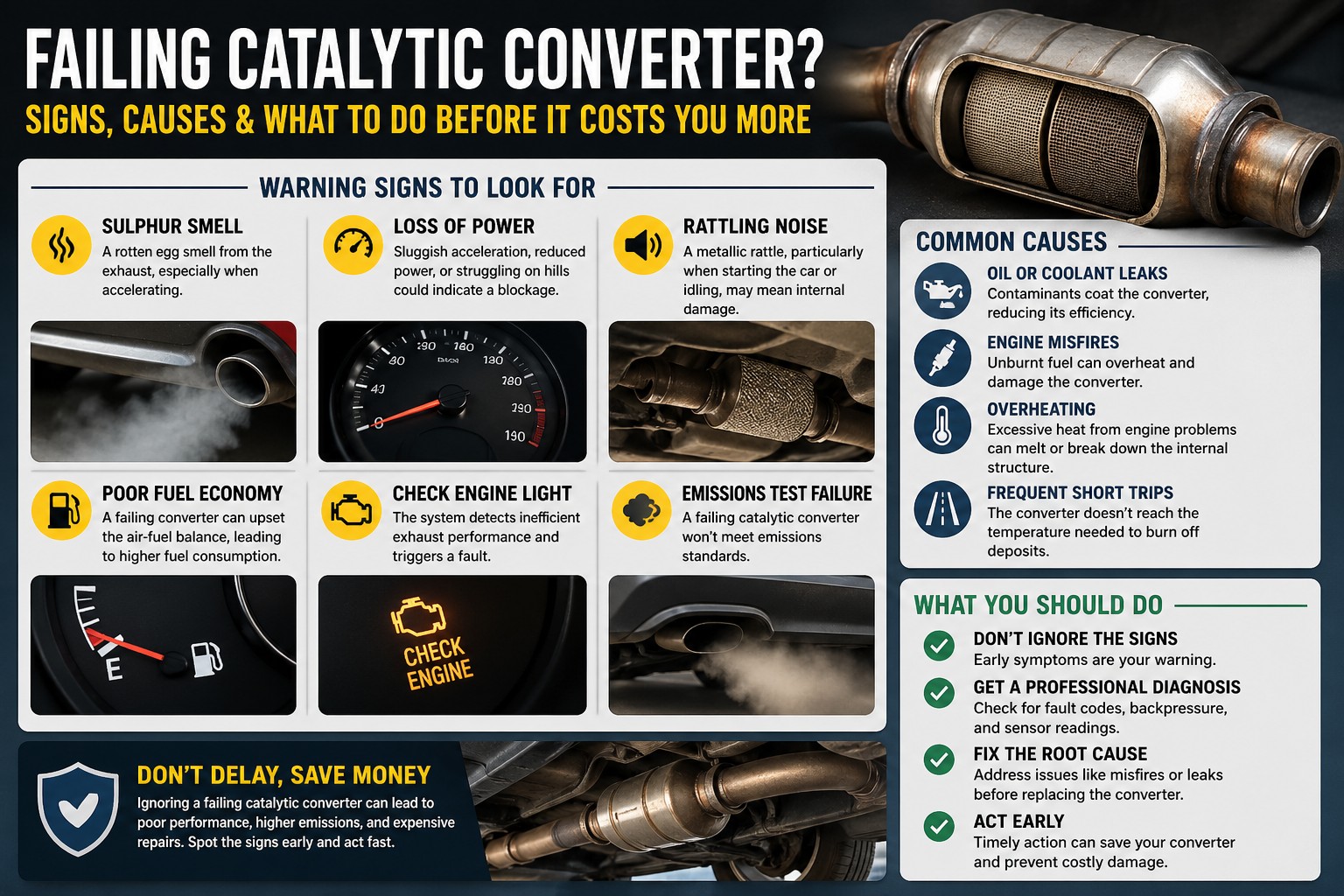
Six Warning Signs Your Catalytic Converter Is Failing
This is where most drivers get caught out. The symptoms of a failing catalytic converter can look like half a dozen other problems, which is exactly why so many people delay acting on them. If you notice any of the following, take them seriously.
- A rotten egg or sulphur smell from the exhaust
This is one of the most distinctive and unpleasant signs. During normal combustion, petrol contains sulphur compounds that your catalytic converter processes into odourless sulphur dioxide. When the converter is failing, it can no longer complete this conversion, and hydrogen sulphide escapes through the exhaust unchanged. The result is that unmistakable rotten egg smell, most noticeable when you accelerate hard. If you’ve noticed this smell on runs along the A31 through Farnham or on the dual carriageway towards Fleet, don’t put it down to a nearby farm.
- A rattling noise from underneath the car
A rattling sound from beneath your car, particularly on cold starts or during acceleration, is one of the more urgent signs on this list. Inside the catalytic converter, the ceramic honeycomb substrate can fracture under extreme heat or physical impact, from a pothole, a speed bump taken too fast, or simply prolonged thermal stress. Once it breaks apart, the loose fragments rattle around inside the casing. This is not a noise that goes away on its own, and it means the converter is failing structurally.
- The engine management light coming on
Modern vehicles constantly monitor the efficiency of the catalytic converter through upstream and downstream oxygen sensors. When the system detects that the converter is not processing exhaust gases as it should, it triggers the engine management light on your dashboard. Fault code P0420 is the most common code associated with catalytic converter inefficiency, though it can also point to a faulty lambda sensor. Either way, the light needs investigating, you can read more about what to do when your engine management light comes on to understand your next steps.
- Sluggish acceleration and reduced power
When the catalytic converter becomes clogged, exhaust gases cannot exit the engine efficiently. This creates backpressure, essentially, the engine is trying to breathe out against resistance. The result is a noticeable drop in power, hesitation when you press the accelerator, and a general feeling that the car is working harder than it should for very little reward. Drivers who cover the A325 between Farnborough and Farnham regularly will notice this kind of sluggishness particularly on uphill stretches.
- Noticeably worse fuel economy
A clogged catalytic converter forces the engine to work harder, which means it burns more fuel to achieve the same output. If you’ve noticed that you’re filling up more often without any obvious change in your driving habits or routes, reduced exhaust flow could be the reason. This symptom alone rarely points conclusively to the catalytic converter, but combined with any of the others on this list, it strengthens the picture significantly.
- Dark or thick exhaust smoke
Under normal operation, your exhaust should produce little to no visible smoke. Dark or thick smoke from the tailpipe suggests incomplete combustion, unburnt fuel is passing through the exhaust system and not being dealt with properly. This can damage the catalytic converter rapidly by coating its precious metal substrate and reducing its ability to function. If the smoke has a bluish tinge, it may indicate oil burning, which is a separate issue that can also poison the converter over time.
What Causes a Catalytic Converter to Fail?
Understanding the cause is just as important as recognising the symptoms, because replacing a catalytic converter without fixing the underlying problem is a very expensive way to end up back in the same position six months later.
The most common culprit is an engine misfire. When a cylinder misfires, unburnt fuel is pushed directly into the exhaust system and ignites inside the catalytic converter itself. Temperatures inside can exceed 1,000°C during this process, far beyond what the honeycomb substrate is designed to handle. Over time, this destroys the internal structure entirely.
Oil or coolant entering the combustion chamber causes a similar problem. Both can coat the precious metal surface of the converter, poisoning the catalyst and rendering it progressively less effective. Leaking valve stem seals or a blown head gasket are frequent causes of this contamination.
Frequent short journeys are a less obvious but very real cause of premature failure. The catalytic converter only reaches its optimal operating temperature after a sustained period of driving, typically at least ten minutes at normal road speed. Drivers in Ash Vale, Tongham, and North Camp who primarily use their car for short local trips may find the converter never fully warms up, leading to carbon deposits building up over time.
Poor quality fuel and neglected servicing round out the main causes. Both lead to increased levels of contaminants in the exhaust stream, which the converter was never designed to handle indefinitely.
Is It the Catalytic Converter: or Just the Sensor?
This is the question that trips up a lot of drivers, and it is worth spending a moment on because the answer has a significant bearing on what you end up paying.
A faulty lambda sensor (also called an oxygen sensor) produces symptoms that look almost identical to catalytic converter failure. The engine management light comes on, fuel economy worsens, and performance can suffer. Many drivers are told they need a new catalytic converter when the real culprit is a sensor that costs a fraction of the price to replace.
The only reliable way to tell the difference is a proper diagnostic scan using an OBD-II reader. This reads the fault codes stored by your car’s engine management system and, crucially, assesses the live data from both oxygen sensors to determine whether the converter is genuinely failing or whether a sensor is giving a false reading. A car diagnostic test is an essential first step before agreeing to any catalytic converter work. Never let a garage replace the converter based on the engine management light alone, without scanning for the specific fault code first.
Booking a professional car diagnostic test is the safest way to confirm whether the issue is the catalytic converter, a lambda sensor, or another engine fault.
Can You Keep Driving the Car?
The short answer is: not for long, and not without consequences.
If the converter is mildly worn rather than clogged, you may be able to drive short distances without immediately damaging anything further. But the legal and practical risks stack up quickly. Under UK law, a vehicle emitting pollutants above permitted limits is illegal to drive on public roads, regardless of whether the converter is physically present. Police can issue a fine of up to £1,000, and your vehicle will receive an automatic MOT failure. The relevant regulations are set out under the Road Vehicles (Construction and Use) Regulations, which make it clear that maintaining your vehicle’s emissions equipment is a legal obligation, not a recommendation.
Beyond the legal side, continuing to drive with a clogged converter risks serious engine damage. The backpressure caused by a blocked exhaust can eventually cause the engine to stall, overheat, or misfire more severely, creating a chain reaction that turns a catalytic converter problem into a far more costly engine repair. Drivers in Fleet, Farnham, and across the Aldershot area who rely on their car daily simply cannot afford to let this escalate.
What You Should Do Next
If you recognise any of the symptoms in this article, here is a clear sequence of steps to follow.
- Do not ignore the symptoms and hope they resolve
Catalytic converter problems do not self-correct. The symptoms will worsen, and the longer the root cause goes unaddressed, the more damage accumulates. The rattle that starts on cold mornings will become a permanent feature, and the sluggish acceleration will get progressively worse.
- Book a diagnostic scan before anything else
This is the single most important step. A professional OBD-II diagnostic scan identifies exactly what fault codes are stored and whether the data points to the converter, a sensor, or something upstream like a misfire or fuel system issue. Do not agree to any parts replacement without this step completed first.
- Identify and fix the root cause
If an engine misfire or oil leak has caused the converter to fail, those issues must be fixed before a new converter is fitted. Installing a replacement converter without addressing the underlying problem means the new part will fail in exactly the same way.
In these cases, a trusted car repair service in Aldershot can identify the root cause and prevent repeated catalytic converter failure.
- Get a clear assessment: repair or replace?
Once the root cause is known, a good garage will be able to tell you clearly whether the converter can be cleaned and preserved, or whether a full replacement is the only viable route. Minor sensor issues are sometimes the entire fix. More significant internal damage means replacement is unavoidable.
- Act promptly to prevent secondary damage
Once you have a clear diagnosis and a quote, do not delay the repair. A clogged converter left in place continues to stress the engine with every journey. Secondary damage to other exhaust components, oxygen sensors, or the engine itself can turn a manageable repair into something far more involved.
Book your vehicle in for a full service and inspection if your car is also overdue a service check, a catalytic converter issue is often the first symptom of a wider maintenance deficit.
Repair or Replace? A Quick Guide
| Situation | What It Likely Means | Recommended Action |
| Engine management light only, no other symptoms | Possible sensor fault rather than converter failure | Diagnostic scan first |
| Rotten egg smell, no rattling | Converter struggling to process exhaust gases | Inspection and diagnostic |
| Rattling noise on cold start or acceleration | Internal substrate fracture | Urgent inspection, likely replacement |
| Failed MOT on emissions | Converter not meeting legal output requirements | Full diagnostic and probable replacement |
| Sluggish power combined with two or more symptoms above | Significant converter deterioration | Professional assessment, replacement likely |
Catalytic Converter Symptoms at a Glance
| Symptom | What It Suggests | How Urgent |
| Rotten egg or sulphur smell | Converter not neutralising hydrogen sulphide | Book soon |
| Rattling noise underneath | Internal ceramic substrate broken | Book urgently |
| Engine management light on | Sensor or converter efficiency fault | Diagnostic needed immediately |
| Loss of acceleration or power | Exhaust backpressure from blockage | Book soon |
| Worse fuel economy | Restricted exhaust flow, engine working harder | Monitor and book |
| Dark or thick exhaust smoke | Incomplete combustion, possible contamination | Book promptly |
Conclusion
A failing catalytic converter rarely arrives without warning. The rotten egg smell, the rattle on a cold morning, the car that just does not pull the way it used to, these are all your car’s way of telling you something needs attention. For drivers in Aldershot, Farnborough, Ash, Tongham, Farnham, Fleet, and across the surrounding area, catching these signs early is the difference between a straightforward fix and a far more serious and costly repair.
The most important thing you can take from this article is simple: get a proper diagnostic check before anyone starts replacing parts. A catalytic converter replacement is not a small job, and it is entirely avoidable in cases where the real fault lies with a sensor or an upstream engine issue. Act on the symptoms, follow the steps, and give your car the attention it is asking for before the problem escalates.
Frequently Asked Questions
Can I still drive with a failing catalytic converter?
You can drive short distances if the converter is only mildly worn, but it is not advisable. If your vehicle is emitting pollutants above the legal limit, you are breaking UK law and could face a fine of up to £1,000. A severely clogged converter can also cause engine damage through backpressure. Book a diagnostic as soon as symptoms appear.
Will a bad catalytic converter cause my MOT to fail?
Yes. MOT testers check both the physical presence of the converter and the emissions output from your exhaust. A failing or missing catalytic converter results in an automatic failure. Catalytic converters have been a legal requirement on UK cars since 1993.
How long should a catalytic converter last?
Most catalytic converters last between 70,000 and 100,000 miles on a well-maintained vehicle, or roughly 10 years. Premature failure is most commonly caused by engine misfires, oil or coolant contamination, or frequent short journeys that prevent the converter from reaching its optimal operating temperature.
Could it be the oxygen sensor rather than the catalytic converter?
Yes, and this is one of the most common misdiagnoses. A faulty lambda sensor produces very similar symptoms, including an illuminated engine management light and reduced fuel economy. An OBD-II diagnostic scan revealing fault code P0420 is the reliable way to distinguish between the two. Always scan before replacing.
How much does catalytic converter replacement cost in the UK?
Costs vary depending on your vehicle’s make and model. An independent garage will typically be more competitive than a franchised dealer. Minor issues such as a faulty sensor can cost significantly less than a full converter replacement, which is precisely why getting a proper diagnostic first always saves money in the long run.