
I used to think AI would either replace creators or stay as a helper tool. But both ideas feel incomplete now.
What actually happened is more interesting.AI didn’t remove creators from the process; it changed how creation itself works.
Instead of producing everything manually, creators now design systems that produce content.
The focus moved from execution to direction. And that shift is reshaping the entire creator economy.
The Wrong Question: Will AI Replace Creators
This question shows up everywhere, but it misses the real change.
In practice, AI is not replacing creators. It is changing the structure of creative work.
Before AI, content creation was linear and manual:
From idea, to script, production, editing, and finally publishing.
Every step required direct human effort.
Now the workflow is more layered and flexible.
You go from a simple idea to AI-assisted planning, then generation, refinement, distribution, getting feedback, and finally iteration.
The difference is not just speed. It’s control.
AI absorbs parts of execution, while creators spend more time shaping direction and decisions.
So instead of replacing creators, AI is redistributing how creative work is done.
What AI Actually Changed
I think it helps to separate what AI actually affects from what it doesn’t.
AI clearly helps with repetitive or structured tasks.
However, AI does not replace the parts that define creative work:
- deciding what is worth making
- understanding audience behavior
- shaping narrative tone
- maintaining brand identity
- making strategic creative choices
So the real shift is simple: AI handles execution-heavy tasks, while humans stay responsible for meaning and direction.
That balance is where modern content creation is heading.
Content Creation Is Becoming a System, Not a Sequence
One of the biggest changes I’ve noticed is that content is no longer treated as a single production line.
Instead of thinking in steps, creators are starting to think in systems.
A system-based workflow looks like this:
- idea input layer
- content generation layer
- editing and optimization layer
- distribution layer
- performance feedback loop
Each part connects to the next. Nothing starts from scratch every time.
This matters because AI reduces the cost of iteration. You can test more ideas, adjust faster, and refine content based on real feedback.
Creation becomes less about finishing one piece and more about improving a continuous flow.
Where All-in-One Video Tools Fit Into This Shift
As workflows become more complex, switching between multiple tools starts to slow everything down. That’s where integrated systems start to matter more.
At this point in my own exploration, I started looking at tools that connect the entire workflow instead of breaking it apart. One example is Loova AI.
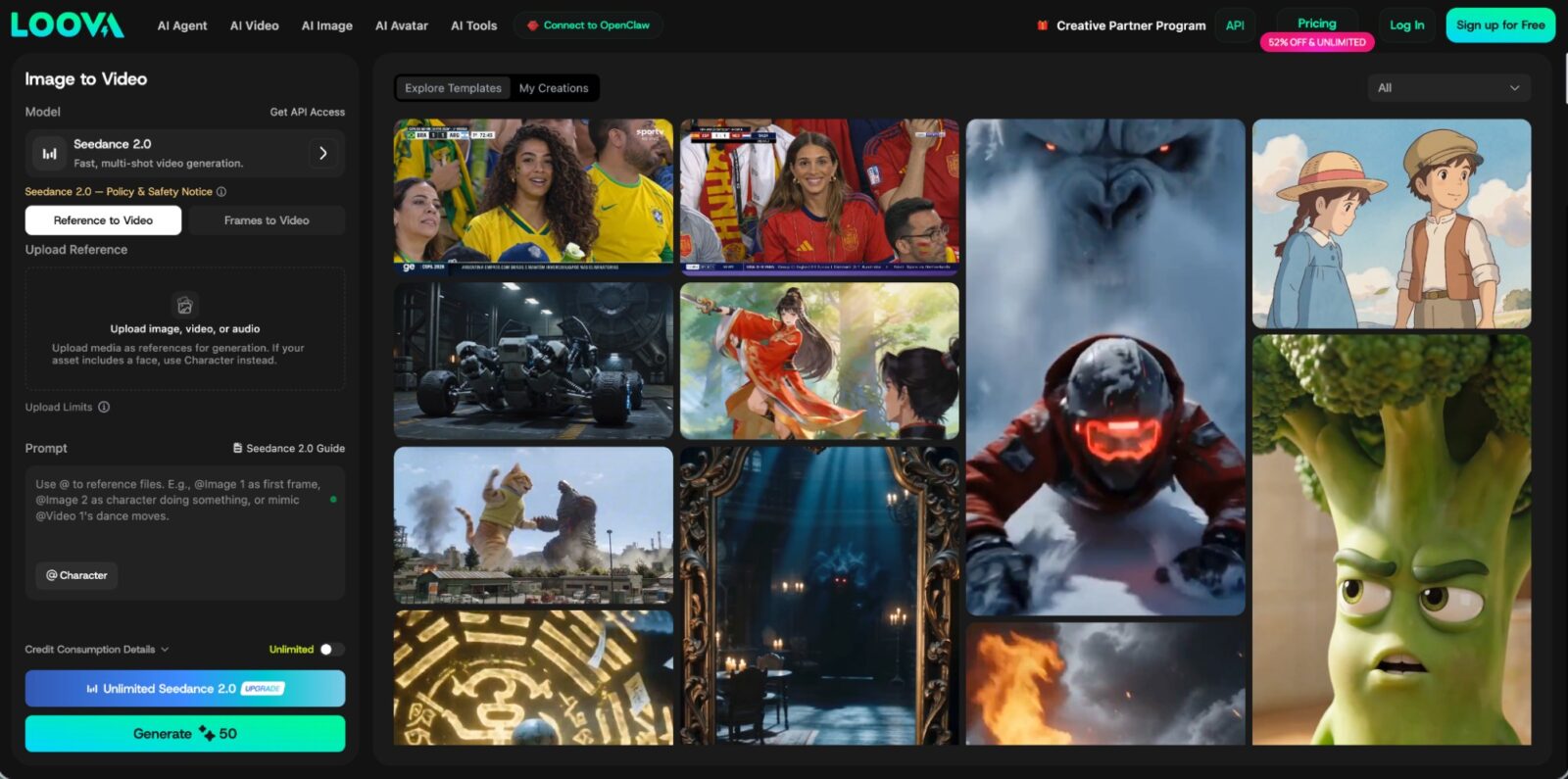
Loova is not just a single AI video generator. It is a full creation platform that combines multiple AI video and AI image models in one place.
What stood out to me is not just the individual features, but the idea behind it. It is built around an all-in-one video workflow instead of isolated steps.
For content creators, especially those producing short-form video regularly, this changes how work feels. Instead of constantly switching tools, you operate inside a single system that supports the full process from idea to final output.
That shift is what makes scaling content much easier.
How AI Changed the Role of a Creator
The most important change is not technical. It’s role-based.
Creators used to be deeply involved in execution. They edited, wrote, and produced every detail.
Now that AI handles more of that work, the creator’s role is shifting.
From executor to system designer
Instead of producing everything manually, creators now design how content is produced. They decide:
- how ideas enter the system
- how content is structured
- how outputs are reused and iterated
From single content to content systems
Instead of focusing on one video at a time, creators build pipelines that produce multiple pieces of content from one idea.
From manual work to creative direction
The focus moves toward strategy, not execution. Creators spend more time deciding what to create and why it matters.
This is a major shift in how creative work is defined.
AI Video Generation Still Plays a Core Role
Even with all these changes, AI video generation is still central to the workflow. It just plays a different role now.
Instead of being the final step, it becomes one part of a larger system.
For example, an ai video generator can now be used to:
- quickly test multiple creative directions
- generate variations of the same concept
- explore different hooks and styles
- speed up early-stage experimentation
The value is not in producing one perfect output. It enables fast iteration.
Creators can now learn faster by producing more variations and refining based on results.
That feedback loop is what makes modern content systems effective.
Why Solo Creators Are in a Strong Position
Interestingly, this shift benefits solo creators more than large teams in many cases.
Large teams often have established workflows that are harder to change. Solo creators, on the other hand, can adapt quickly.
With AI-supported workflows, a single creator can:
- produce content at scale
- test ideas rapidly
- adjust direction in real time
- manage multi-platform output
This levels the playing field in a way we haven’t seen before.
Success is no longer tied to team size. It depends more on how well your workflow is designed.
What Hasn’t Changed in Creative Work
Even though AI changes the process, the core of creative work is still the same.
Good content still depends on:
- clarity of thinking
- understanding of audience
- strong ideas
- consistent voice
AI can help execute, but it cannot decide what matters.
In fact, as production becomes easier, judgment becomes more important. There is more content being created than ever, which means selection and direction matter more than execution speed.
The Future: From Tools to Systems
If I look at where things are going, I don’t think we are moving toward better tools. We are moving toward better systems.
The evolution looks like this:
- tools help execute tasks
- AI helps generate content
- systems manage workflows
Eventually, creators will not manually build every piece of content. They will operate systems that continuously produce and refine content based on goals and feedback.
Creation becomes less about doing everything yourself and more about designing how creation happens.
That is the real shift AI is driving.
Final Thoughts
AI didn’t replace creators. It changed where creative effort goes.
Execution is no longer the main bottleneck. Direction and system design are.
Once you see content creation as a system instead of a sequence of tasks, everything becomes easier to scale and manage.
And that is where platforms like Loova fit naturally, especially for creators who want a more unified and structured way to handle video production without juggling multiple disconnected tools.
FAQs
Did AI replace creators?
No. AI changed how creators work by automating parts of production and shifting focus toward strategy and system design.
How is AI changing content creation?
AI is turning content creation from a linear workflow into a system-based process with faster iteration and feedback loops.
What parts of creation does AI actually replace?
AI helps with scripting, editing, captions, ideation, and content repurposing. It does not replace creative judgment or strategy.
Do creators still need hands-on skills?
Basic skills help, but AI reduces the need for deep technical execution, especially in video editing and production.
Why are systems more important than tools now?
Because modern content workflows require multiple steps. Systems connect those steps into a repeatable and scalable process.
What is the biggest change AI brings to creators?
The biggest change is the shift from execution-heavy work to system design and creative direction.