
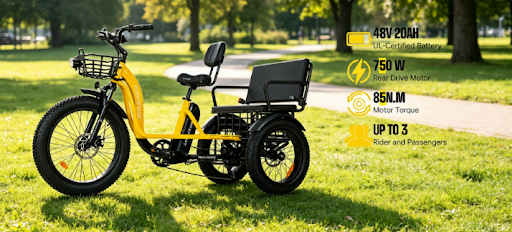
Walk through any electric tricycle listing in the U.S. market and you’ll see the same handful of numbers repeated: motor wattage, battery capacity, range in miles. Those specs are easy to compare and easy to advertise. What they don’t tell you is whether the trike will still run the same way after two summers of daily riding, or whether it’s quietly cutting corners in places a buyer would never think to check. The MaxFoot MF-33 is worth examining precisely because it treats those invisible details — frame alloy, battery construction, and internal wiring — as seriously as the numbers on the spec sheet.
Starting With the Frame
Everything on a trike hangs off its frame, so it’s the first place quality shows up or fails to. The MF-33 uses a thickened 6061 aluminum alloy frame, a grade known for resisting fatigue cracking under repeated stress and holding up against corrosion in humid or wet climates — both real considerations for a trike expected to carry two adults on a regular basis, not just occasionally. A low step-through design rounds this out, letting both driver and passenger board without stepping over a high top tube.
Power and Stability on the Road
The MF-33 pairs a 750W rated rear-drive motor with up to 1400W of peak power and about 85 N·m of torque, enough to climb moderate hills and accelerate confidently even with a passenger aboard. A rear differential — borrowed from automotive design — automatically balances the speed of the two rear wheels through turns, which meaningfully reduces the tipping risk that shows up in cheaper trikes when cornering under load.
A Battery Pack Built Against Heat
The Samsung 48V 20Ah battery, UL2271 certified, uses a potting compound to fill the space between individual cells instead of leaving air gaps. That single manufacturing choice spreads heat evenly across the pack during hard riding, reduces the mechanical wear that shortens cell life over repeated charge cycles, and — critically — creates a physical barrier that helps contain an overheating cell instead of letting it spread to its neighbors.
The Detail Most Buyers Never Think to Ask About: The Cables
A 750W motor drawing up to 1400W at peak isn’t a small current draw, and every bit of that power has to travel from the battery through wiring to reach the motor. This is where a lot of budget e-trikes quietly cut costs — thin wiring with low-grade copper works fine at low power, but under sustained high-current draw, undersized cables heat up internally, and that heat buildup is one of the more common, and more preventable, causes of electrical failure and fire risk in e-bikes.
The MF-33 uses thicker, high-quality copper wiring engineered specifically to handle its full power output without overheating. In practical terms, that means:
- Less resistance, less wasted heat. Thicker copper conductors carry high current with lower resistance, so less energy converts to heat inside the wire — precisely when the motor is drawing the most power, like on a climb with a passenger on board.
- A real safety margin, not a bare minimum. Wiring rated with headroom above what the system actually draws stays cooler under sustained use instead of running at the edge of its limits on every ride.
- Connections built to last, not just to work on day one. Paired with quality connectors, properly sized wiring resists the heat cycling that causes terminals to loosen or corrode over years of riding — the difference between a trike that still feels new after two years and one that develops mysterious power cutouts after a few hot summers.
None of this ever appears in a headline spec, but it’s exactly the kind of choice that reveals whether a company designed a trike to be sold once or to be ridden for years.
Built for a Passenger, Not Just a Rider
The MF-33’s rear seat is a 27.5-inch cushioned bench with a backrest, armrests, and footrests, rated for two additional adults and a combined load capacity around 500 lbs. A front suspension fork (about 50mm of travel) and wide fat tires smooth out the mixed pavement and gravel common on American trails and neighborhood streets. Safety comes from dual 180mm disc brakes on every wheel, a parking brake for stable loading, LED lighting, and a turn-signal-equipped taillight so drivers behind can see your intent clearly.
The Real Test of Quality
Anyone can advertise 750W and 85 miles of range. What’s harder to fake is a frame that doesn’t fatigue, a battery pack engineered against thermal runaway, and wiring sized to carry real power without cutting corners. That’s the case the MaxFoot MF-33 makes for itself — not through the numbers on the box, but through the materials underneath them. For American riders comparing electric tricycles and thinking past the first six months of ownership, that’s the part actually worth checking.