
Have you ever wondered how people know which industry a business belongs to? For example, a hospital, a bank, an online store, and a software company all serve different needs. They also follow different rules. They sell different things. They speak to different customers.
This is where business vertical classification categories become very useful. These categories help us place businesses into clear groups. They make the business world easier to understand. Instead of looking at thousands of companies one by one, we can group them by what they do and who they serve.
In 2026, this idea is more important than ever. Many companies now work in fast-changing markets. A finance company may also use technology. A hospital may also offer online care. A real estate company may also use smart apps. So, knowing the right business category can help a company grow in a smarter way.
In this article, we will explain business vertical classification categories in very easy words. We will talk about what they mean, why they matter, how they help startups, and what the main business verticals are. We will also look at examples like technology, healthcare, finance, retail, and education.
What Are Business Vertical Classification Categories?
Business vertical classification categories are groups that help organize businesses by industry. In simple words, they show what kind of work a company does. They also show which market the company serves.
For example, a company that sells medicine belongs to the healthcare vertical. A company that builds mobile apps belongs to the technology vertical. A company that sells clothes online belongs to the retail or e-commerce vertical. These groups make it easier to understand the role of each business.
Think of it like organizing books in a library. If all books were placed randomly, it would be hard to find anything. But when books are grouped by topics, like history, science, business, or fiction, things become simple. In the same way, business vertical classification categories help organize companies into clear industry groups.
These categories are used by business owners, investors, marketers, government teams, and analysts. They help people compare companies, study markets, and understand trends. Without these categories, the business world would feel messy and hard to follow.
A vertical is usually based on shared things. These may include the product, service, customer type, rules, business model, or market need. That is why two companies may use similar technology but still belong to different verticals. A payment app for hospitals is not the same as a payment app for online stores. The technology may be similar, but the market is different.
Why Business Vertical Classification Categories Matter
Business vertical classification categories matter because they help a company know where it belongs. When a business knows its vertical, it can explain itself more clearly. Customers can also understand it faster.
Imagine a startup says, “We make software.” That sounds too broad. But if it says, “We make software for dental clinics,” the message becomes clearer. People quickly know who the product is for. This makes the business look more focused and useful.
These categories also help with marketing. A healthcare customer does not think the same way as a retail customer. A school does not buy software the same way a bank does. Each industry has its own needs, problems, and language. When a company knows its vertical, it can speak to customers in a way they understand.
Investors also care about verticals. They often compare companies inside the same industry group. A finance startup may be judged differently from an education startup. Even if both earn the same money, their growth speed, risks, and rules may be different.
Rules are another big reason. Some industries have strict laws. Healthcare companies must protect patient data. Finance companies must handle money safely. Food businesses must follow safety rules. So, business vertical classification categories help companies understand what rules they may need to follow.
In short, the right vertical helps a business build trust. It also helps with planning, branding, marketing, funding, and long-term growth.
How Business Vertical Classification Categories Help Startups
Startups need clear direction. A new company cannot serve everyone at once. It needs to know who its best customers are. This is why business vertical classification categories are so helpful for startups.
When a startup chooses a clear vertical, it can focus better. It can build products for a specific group of people. It can write better ads. It can create better sales pages. It can also solve real problems inside one industry instead of trying to solve everything for everyone.
For example, let’s say two startups both build booking software. One makes booking tools for salons. The other makes booking tools for doctors. Both products may look similar on the surface. But their customers need different features. Doctors may need patient records and privacy tools. Salons may need beauty service menus and staff schedules.
This is why vertical focus matters. A startup that understands its vertical can build the right features from the start. It can avoid wasting time on things customers do not need.
Investors also like startups that know their market. When a founder says, “We serve small healthcare clinics,” it sounds stronger than saying, “We serve all businesses.” A focused startup feels easier to understand. It also feels easier to measure.
Clear vertical classification can also help a startup stand out. Many markets are crowded. There are thousands of apps, tools, agencies, and platforms. But when a business says exactly who it helps, it becomes easier to remember.
For example, “software for law firms” sounds more useful to lawyers than “business software.” This simple change can make the brand feel more trusted and more valuable.
Main Types of Business Vertical Classification Categories
There are many business vertical classification categories, but some are more common than others. These are the big industry groups that people often use to understand the market.
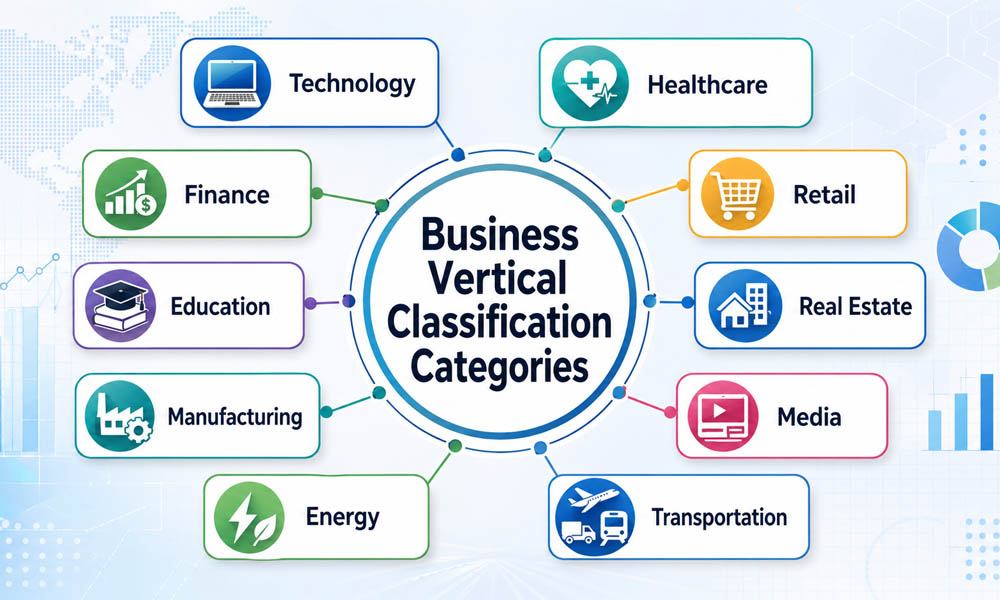
Some of the most common verticals are technology, healthcare, finance, retail, education, manufacturing, real estate, media, energy, agriculture, transportation, and legal services. Each one has its own type of customer. Each one also has its own problems, rules, and growth path.
For example, the technology vertical includes software companies, cloud platforms, AI tools, apps, and cybersecurity firms. The healthcare vertical includes hospitals, clinics, medicine companies, medical device brands, and telemedicine platforms. The finance vertical includes banks, insurance companies, payment apps, and investment firms.
Retail is another major vertical. It includes physical stores, online stores, marketplaces, and direct-to-consumer brands. Education includes schools, colleges, online learning platforms, tutoring tools, and training companies.
Manufacturing includes companies that turn raw materials into finished products. Real estate includes property development, property management, and real estate technology platforms. Media includes news, streaming, music, gaming, and digital content businesses.
These categories help people see the big picture. They also help businesses find where they fit. A company does not need to guess. It can study its product, customers, and revenue source to understand its main vertical.
In 2026, many companies also work across more than one vertical. This is common because technology is now part of almost every industry. But even then, most businesses still need one main vertical to explain their identity clearly.
Technology Business Vertical Classification Categories
Technology is one of the most active and fast-growing business vertical classification categories today. It includes companies that build digital tools, software, hardware, systems, and online platforms.
This vertical covers many types of businesses. Some companies build apps. Some create cloud storage tools. Some offer cybersecurity services. Some build artificial intelligence tools. Others create business software, websites, automation tools, or data platforms.
A simple example is a SaaS company. SaaS means “software as a service.” It means people use software online instead of installing it on one computer. Tools like customer management systems, email marketing platforms, project tools, and accounting software often use this model.
The technology vertical is powerful because it connects with almost every other industry. Healthcare uses technology. Finance uses technology. Education uses technology. Retail uses technology. Even farming now uses sensors, apps, and data tools.
This is why many new sub-verticals have appeared. HealthTech mixes healthcare and technology. FinTech mixes finance and technology. EdTech mixes education and technology. PropTech mixes real estate and technology.
In simple words, technology is not only one vertical anymore. It also helps create new business verticals inside older industries. That is why understanding technology categories is very useful for founders, marketers, and investors.
A technology business also needs clear positioning. Saying “we are a tech company” is often too broad. It is better to say what kind of tech company it is. For example, is it cybersecurity? AI? SaaS? Cloud? HR tech? Legal tech? This detail helps customers and investors understand the company faster.
Healthcare Business Vertical Classification Categories
Healthcare is one of the most important business vertical classification categories because it deals with human health. It includes businesses that help people stay healthy, treat illness, manage care, or improve medical services.
This vertical includes hospitals, clinics, doctors, medicine companies, medical device makers, health insurance companies, health data platforms, and telemedicine services. It also includes newer areas like digital health, mental health apps, remote care tools, and AI-based medical systems.
Healthcare is different from many other industries because trust is very important. People want safe care. They want correct information. They want their personal health details to stay private. Because of this, healthcare businesses often follow strict rules.
For example, a healthcare app may need to protect patient data. A medical device company may need approval before selling a product. A medicine company may need to follow many testing steps. These rules can make healthcare harder to enter, but they also make trust more valuable.
This is why healthcare businesses must understand their vertical very clearly. A company selling software to hospitals needs a different message than a company selling wellness products to everyday people. Both may be in healthcare, but they serve different needs.
HealthTech is also growing fast in 2026. Many people now use online doctor visits, health tracking apps, wearable devices, and digital patient tools. This has created new opportunities for startups.
Still, healthcare is not a market where businesses can be careless. The customer needs are serious. The rules are strict. The trust level must be high. That is why proper classification helps healthcare companies plan better and communicate more clearly.
Finance Business Vertical Classification Categories
Finance is another major part of business vertical classification categories. This vertical includes companies that deal with money, payments, savings, loans, investment, insurance, and risk.
Banks are the most common example. They help people store money, borrow money, and send payments. But the finance vertical is much bigger than banks. It also includes investment firms, payment processors, digital wallets, lending platforms, insurance companies, and FinTech startups.
FinTech has become one of the strongest modern business areas. It means financial technology. A FinTech company may help people send money online, manage spending, invest from a phone, buy insurance, or get business loans faster.
Finance is a trust-based vertical. People want to know their money is safe. They also want fast service, clear fees, and strong security. This is why finance businesses must take rules and safety very seriously.
For example, a payment app must protect user data and stop fraud. A lending platform must follow lending rules. An investment app must give clear information and follow financial laws. These rules can be complex, but they protect customers.
This vertical is also highly competitive. Many companies offer banking apps, wallets, payment tools, and finance software. So, a finance company must be clear about what makes it different.
Is it serving small businesses? Is it helping freelancers? Is it built for banks? Is it made for online stores? Is it focused on international payments? These details help define the company’s real place inside the finance vertical.
That is why finance is not just one big group. It has many smaller categories. These include banking, insurance, payments, wealth management, crypto, lending, and business finance tools.
Retail and E-Commerce Business Vertical Classification Categories
Retail is the business of selling products to customers. It is one of the easiest business vertical classification categories to understand because we see it every day. When you buy clothes, food, shoes, phones, or home items, you are taking part in the retail world.
Retail includes physical stores, online stores, marketplaces, direct-to-consumer brands, wholesale sellers, and subscription businesses. A small clothing shop, a large supermarket, and a big online marketplace can all belong to this vertical.
E-commerce has changed retail in a big way. In the past, many people went to stores to buy most things. Now, many customers order products from websites, apps, and social media shops. This has created new ways for businesses to sell.
For example, a brand can now sell directly to customers without opening a store. A small business can use an online marketplace to reach buyers in many cities or countries. A subscription brand can send products to customers every month.
Retail businesses care a lot about customer experience. People want easy shopping, fair prices, fast delivery, simple returns, and good support. If a store makes shopping hard, customers can quickly go somewhere else.
This vertical also depends on strong marketing. Product photos, reviews, social media, discounts, and brand trust all matter. In e-commerce, a small change in a product page can improve sales.
Retail classification is useful because not all retail businesses work the same way. A luxury store is different from a grocery store. A marketplace is different from a direct-to-consumer brand. A subscription box is different from a wholesale company.
So, when a business understands its retail sub-category, it can choose better pricing, better ads, better products, and better customer service.
Education Business Vertical Classification Categories
Education is a business vertical that focuses on learning, skills, training, and knowledge. It includes schools, colleges, universities, online course platforms, tutoring companies, learning apps, and corporate training services.
This vertical has become much bigger in recent years because learning is no longer limited to classrooms. In 2026, many people learn from home, mobile apps, online videos, digital courses, and live virtual classes.
EdTech is one of the most important parts of this vertical. EdTech means education technology. It includes online learning platforms, school management tools, learning games, test preparation apps, and skill-based training websites.
For example, a student may use an app to learn math. A working person may take an online course to learn marketing. A company may use training software to teach employees new skills. All of these fit inside the education vertical.
Education businesses must focus on trust and results. People want to know if a course, school, or app can truly help them learn. Parents want safe and useful tools for children. Students want clear lessons. Workers want skills that can help them get better jobs.
This is why education companies need clear classification. A platform for children is different from a platform for business workers. A university is different from a short online course brand. A tutoring app is different from a school software company.
When an education company knows its exact place, it can create better lessons, better messages, and better tools for the right learners.
Vertical Markets vs Horizontal Markets
To understand business vertical classification categories better, you also need to know the difference between vertical markets and horizontal markets. These two ideas may sound a little formal, but they are very easy to understand.
A vertical market focuses on one clear industry. For example, software made only for hospitals is a vertical product. It is built for doctors, nurses, clinics, and healthcare teams. It does not try to serve every business in the world.
A horizontal market is different. It serves many industries at the same time. For example, email tools, video meeting apps, cloud storage, and accounting software can be used by many types of businesses. A school, a law firm, a shop, and a factory may all use the same email tool.
Both choices can work. A vertical business can become very strong in one field because it understands the customer deeply. A horizontal business can grow fast because it serves a larger group of people.
But there is also a trade-off. A vertical business may have a smaller market, but it can charge more because the product feels special. A horizontal business may reach more people, but it may face more competition. That is why every company must think carefully before choosing its path.
For example, imagine two software companies. One sells a general calendar app. The other sells a calendar app only for dental clinics. The dental clinic tool may include patient bookings, treatment reminders, and clinic staff schedules. This makes it more useful for dentists, even if fewer people need it.
This is why business vertical classification categories help so much. They show whether a business is trying to serve one clear industry or many industries at once.
Hybrid Business Vertical Classification Categories
In 2026, many businesses no longer fit into only one simple group. This is why hybrid verticals have become very popular. Hybrid verticals mix two or more industries together.
For example, FinTech mixes finance and technology. HealthTech mixes healthcare and technology. EdTech mixes education and technology. PropTech mixes real estate and technology. AgriTech mixes agriculture and technology.
These hybrid business vertical classification categories show how modern companies are changing. A company may not only be a finance company. It may be a finance company powered by smart apps, data, and online tools. A school platform may not only be education. It may also be a technology business.
This makes the market more exciting. It also creates new chances for startups. A founder can look at an old industry and ask, “How can technology make this easier?” That simple question can lead to a new business idea.
Think about telemedicine. Years ago, most people visited a clinic in person. Now, many people can speak to a doctor through a phone or video call. This sits between healthcare and technology. That is why it is part of HealthTech.
The same thing happened in real estate. People can now search for homes online, check prices, book tours, and even manage property through apps. This created PropTech.
Hybrid verticals are useful because they solve real problems in new ways. They also help businesses stand out. Instead of saying, “We are a tech company,” a brand can say, “We are a HealthTech company for small clinics.” That sounds much clearer and more powerful.
Common Classification Systems Businesses Use
Many businesses also use official systems to classify industries. These systems help governments, investors, researchers, and companies organize business data in a standard way.
One of the most known systems is NAICS. It stands for North American Industry Classification System. It is used in the United States, Canada, and Mexico. NAICS helps group businesses by the type of work they do.
Another older system is SIC. It stands for Standard Industrial Classification. This system was used before NAICS. Some old databases and reports still use SIC codes, but NAICS is more modern.
There is also GICS. It stands for Global Industry Classification Standard. This system is often used by investors and public markets. It helps compare public companies across the world.
Other systems also exist in different places. For example, India uses NIC, which stands for National Industrial Classification. These systems may look different, but they all have the same goal. They help organize industries clearly.
These systems matter because they make business research easier. If every country and every company used totally different names, it would be hard to compare industries. But with clear systems, analysts can study growth, jobs, revenue, and market trends in a better way.
For a small business or startup, these codes may feel boring at first. But they can be useful. They may help with reports, funding, taxes, market research, and investor documents. They also help a company explain its industry in a more trusted way.
So, business vertical classification categories are not only used in marketing. They are also used in official records, research, and investment work.
How to Choose the Right Business Vertical Classification Category
Choosing the right vertical is very important. A business should not pick a category just because it sounds popular. It should choose the category that truly matches what it does.
The first thing to check is the main product or service. What does the company sell? Is it software, health care, education, food, legal help, property service, or something else? This gives the first clue.
The second thing to check is the main customer. Who pays for the product? Is it a hospital, a school, a small business, a bank, a shop, or a normal consumer? The customer often shows the real vertical.
The third thing is revenue. Where does most of the money come from? If 60% or more of income comes from one type of customer or product, that is usually the main vertical.
For example, a company may use AI, but if it sells AI tools mainly to banks, it may belong more clearly to FinTech or financial AI. If it sells AI tools to hospitals, it may belong to HealthTech. The tool is AI, but the customer changes the vertical.
A business should also study its competitors. How do similar companies describe themselves? What category do investors place them in? What words do customers use when searching for this type of product?
Messaging is also important. A company should ask, “Can people understand what we do in a few seconds?” If the answer is no, the vertical may be too broad or unclear.
The best vertical is usually the one that makes the company easy to understand, easy to trust, and easy to compare with the right competitors.
Mistakes to Avoid When Choosing a Business Vertical
Many businesses make mistakes when choosing their vertical. The most common mistake is being too broad. A company may say, “We serve all businesses.” But this can make the brand feel weak and unclear.
It is often better to start with a clear niche. For example, “software for small law firms” is clearer than “software for everyone.” A clear niche helps the business speak directly to the right people.
Another mistake is using confusing words. Some companies try to sound smart by using big terms. But customers want clarity. If people do not understand what the company does, they may leave and choose another option.
A third mistake is trying to fit into too many verticals at once. This can confuse customers and investors. A young startup should usually focus on one main category first. It can expand later when it is stronger.
Some businesses also ignore rules. This is risky. Healthcare, finance, food, insurance, and legal services often have strict rules. If a company enters these markets without understanding the rules, it can face serious problems.
Another mistake is not updating the vertical as the business grows. A company may start as a small software tool but later become a full platform for one industry. When this happens, its classification may need to change.
This is why businesses should review their business vertical classification categories every year. Markets change. Products change. Customers change. A smart company stays clear and updated.
Future of Business Vertical Classification Categories
The future of business vertical classification categories will be more flexible. In the past, industries changed slowly. Today, new markets appear very fast.
AI is one major reason. Artificial intelligence is now used in healthcare, finance, education, retail, farming, and many other areas. This means new categories are forming all the time.
For example, AI-driven healthcare tools can help doctors read scans faster. AI in finance can help detect fraud. AI in education can help students learn at their own speed. These are not just normal tech tools. They are industry-specific solutions.
Micro-niches will also become more important. A business may not only serve healthcare. It may serve private dental clinics. It may not only serve education. It may serve online math tutors for young students. These smaller niches can be very powerful.
Green energy is another growing area. More companies are working on solar, wind, batteries, clean transport, and energy-saving systems. These businesses may sit inside energy, technology, and sustainability at the same time.
The creator economy is also growing. This includes platforms, tools, and services for influencers, video creators, writers, podcasters, and online teachers. A few years ago, this category was not as clear. Now, it is becoming a serious business vertical.
In the future, AI may also help classify businesses automatically. Instead of waiting many years for systems to update, data tools may study a company’s products, customers, and revenue in real time.
This means business categories may become more active and more detailed. Companies may also need to explain their main vertical and their sub-vertical more clearly.
Business Vertical Classification Categories for SEO and Marketing
Business vertical classification categories are also very useful for SEO and digital marketing. This is because people search online with very specific needs.
A broad keyword like “software” is very hard to rank for. It is also not very clear. But a keyword like “clinic booking software” or “school management software” is more specific. It tells you exactly what the person wants.
This is why vertical keywords can bring better traffic. The audience may be smaller, but the visitors are more serious. A person searching for “software” may only be exploring. But a person searching for “dental clinic software” may be closer to buying.
Vertical marketing also helps with content. A business can create blog posts, case studies, guides, and landing pages for one industry. This makes the brand look more helpful and trusted.
For example, a company that sells HR software can create content for restaurants, hospitals, schools, or retail stores. Each industry has different hiring problems. So each page can speak directly to that customer.
Paid ads also work better when they are focused. An ad for “business software” may feel too general. But an ad for “payroll software for small restaurants” feels more useful to the right person.
So, knowing your vertical is not only good for business planning. It also helps with SEO, content, ads, sales pages, and customer trust.
Business Vertical Classification Categories for Investors
Investors also use business vertical classification categories when they study a company. They want to know what market the business is in, how big the market is, and what kind of growth is possible.
A startup in healthcare may be judged differently from a startup in retail. A finance company may have more rules and risks. A SaaS company may be judged by monthly recurring revenue, churn, and customer lifetime value.
This is why clear classification helps founders during fundraising. If a founder explains the vertical well, investors can understand the business faster.
For example, a founder should not only say, “We are building a platform.” That sounds too broad. It is stronger to say, “We are building a SaaS platform for small medical clinics.” Now the investor knows the market, the customer, and the type of product.
Investors also compare companies inside the same vertical. They may ask: How fast are similar companies growing? What are normal profit margins? How much does it cost to get one customer? How long do customers stay?
These answers change by vertical. A retail brand, a FinTech app, and a healthcare SaaS platform do not have the same numbers. That is why classification matters.
A clear vertical can also make the company look more focused. It shows that the founder understands the market. It also makes the business story easier to believe.
Conclusion
Business vertical classification categories help make the business world easier to understand. They group companies by what they do, who they serve, and how they operate.
For business owners, these categories give direction. They help a company find its audience, shape its message, and build better products. For marketers, they help create better content, stronger ads, and clearer SEO plans.
For investors, these categories help compare companies in a fair way. They show the risks, growth chances, and market size of each industry. For customers, they make it easier to see if a company truly understands their needs.
In 2026, this topic is more important than ever. Industries are changing fast. Technology is mixing with healthcare, finance, education, real estate, agriculture, and many other areas. New hybrid verticals are growing. Smaller niches are becoming more valuable.
The best businesses are not always the ones that try to serve everyone. Many times, the strongest businesses are the ones that know exactly where they belong. They know their vertical. They know their customer. They know the problem they solve.
So, if you are building a startup, planning a brand, doing market research, or studying an industry, start with one simple question:
What business vertical does this company truly belong to?
Once that answer is clear, everything else becomes easier. Your message becomes sharper. Your market becomes clearer. Your customers understand you faster. And your business has a better chance to grow in the right direction.
You may also read: Arula: What Went Wrong and What Comes Next