
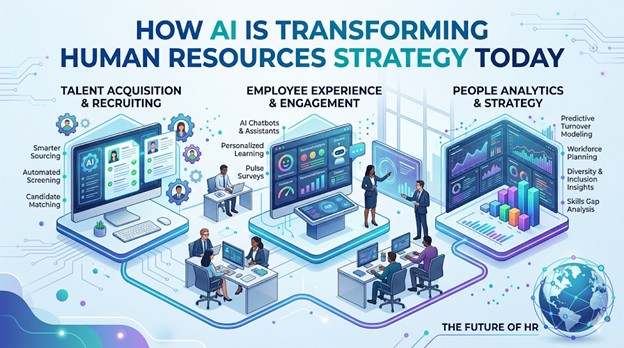
Organizations are rethinking how they manage talent, improve employee experience and drive workforce productivity. Artificial intelligence has emerged as a key enabler in this shift, helping HR leaders move beyond administrative efficiency toward strategic impact. From talent acquisition to workforce planning, AI is redefining how HR functions operate in a digital-first environment.
As businesses face increasing pressure to attract, retain and develop talent, AI-driven capabilities are helping HR teams deliver faster insights, improve decision-making and enhance operational efficiency. However, realizing these benefits requires a structured approach that aligns technology adoption with business objectives and workforce strategies.
Overview of AI in HR
Artificial intelligence in HR refers to the use of advanced technologies such as machine learning, natural language processing and predictive analytics to automate processes, analyze workforce data and support decision-making. These capabilities enable HR teams to shift from reactive operations to proactive and strategic workforce management.
According to publicly available insights from The Hackett Group®, leading organizations are increasingly leveraging AI to improve HR service delivery, enhance talent strategies and optimize workforce performance. AI is not replacing HR professionals but augmenting their capabilities by reducing manual effort and enabling data-driven decisions.
In HR environments, AI can support:
- Talent acquisition and candidate screening
- Workforce planning and analytics
- Employee engagement analysis
- Learning and development recommendations
- Payroll and compliance automation
- HR service delivery and support
A structured approach to AI implementation ensures that these capabilities are aligned with enterprise priorities, governance frameworks and measurable outcomes. Organizations that embed AI into their HR operating model can achieve greater agility and scalability.
Benefits of AI in HR
Improved operational efficiency
AI enables HR teams to automate repetitive tasks such as resume screening, interview scheduling and employee queries. This reduces administrative burden and allows HR professionals to focus on strategic initiatives such as talent development and organizational design.
Automation also improves process consistency and reduces the likelihood of human error, leading to more reliable outcomes across HR operations.
Enhanced decision-making with data insights
AI-powered analytics provide deeper visibility into workforce trends, employee performance and engagement levels. HR leaders can use these insights to make informed decisions about hiring, retention and workforce planning.
Predictive analytics can also identify potential risks such as employee turnover, enabling proactive intervention strategies.
Better employee experience
AI-driven tools such as chatbots and virtual assistants improve employee interactions with HR by providing instant responses to queries. Personalized recommendations for learning and career development further enhance engagement.
A more responsive and tailored employee experience contributes to higher satisfaction and retention rates.
Faster and more effective talent acquisition
AI can analyze large volumes of candidate data to identify the best-fit applicants based on skills, experience and cultural alignment. This accelerates hiring cycles and improves the quality of hires.
By reducing bias in screening processes, AI also supports more inclusive hiring practices when implemented with proper governance.
Strengthened compliance and risk management
HR functions must adhere to regulatory requirements and internal policies. AI can assist in monitoring compliance, managing documentation and identifying anomalies in payroll or employee data.
This reduces risk exposure and ensures that organizations maintain consistent adherence to legal and regulatory standards.
Use cases of AI in HR
Talent acquisition and recruitment
Intelligent candidate screening
AI tools can evaluate resumes, assess candidate profiles and rank applicants based on predefined criteria. This significantly reduces the time required to shortlist candidates and improves hiring efficiency.
Interview scheduling and engagement
Automated systems can coordinate interview schedules, send reminders and provide updates to candidates. This enhances the recruitment experience and reduces administrative workload.
Workforce planning and analytics
Predictive workforce modeling
AI can analyze historical workforce data to forecast future talent needs. This helps organizations align hiring strategies with business growth plans.
Attrition risk analysis
By identifying patterns in employee behavior, AI can predict potential turnover risks and enable HR teams to take proactive retention measures.
Learning and development
Personalized learning pathways
AI can recommend training programs based on employee roles, skills and career goals. This ensures that learning initiatives are relevant and aligned with organizational needs.
Skills gap analysis
AI-driven insights help identify gaps in workforce capabilities, allowing organizations to design targeted upskilling programs.
HR service delivery
Virtual HR assistants
AI-powered chatbots can handle common employee queries related to policies, benefits and procedures. This improves response times and reduces the burden on HR service teams.
Knowledge management
AI systems can organize and retrieve HR knowledge efficiently, ensuring that employees have access to accurate and up-to-date information.
Payroll and compliance
AI also plays a growing role in payroll operations, improving accuracy, automating calculations and ensuring compliance with regulations. Solutions aligned with AI in HR are helping organizations streamline payroll processes while reducing errors and risks.
Performance management
Continuous feedback analysis
AI can analyze employee feedback and performance data to provide insights into productivity and engagement trends. This supports more effective performance management strategies.
Objective evaluation support
By leveraging data-driven insights, AI helps reduce bias in performance evaluations and ensures more consistent assessments across the organization.
Why choose The Hackett Group® for implementing AI in HR
Implementing AI in HR requires more than deploying technology. It demands a structured, research-based approach that aligns with business strategy and delivers measurable outcomes. The Hackett Group® provides a differentiated advantage through its benchmarking expertise and proven methodologies.
Benchmark-driven insights
The Hackett Group® leverages extensive benchmarking data to help organizations understand current performance levels and identify areas for improvement. This data-driven approach ensures that AI initiatives are focused on delivering tangible business value.
Strategic alignment and transformation
AI adoption in HR must be aligned with broader enterprise transformation goals. The Hackett Group® integrates AI initiatives into overall business strategy, ensuring consistency and long-term impact.
Governance and risk management
AI introduces considerations related to data privacy, compliance and ethical use. A structured governance framework helps organizations mitigate risks while maximizing the benefits of AI adoption.
Practical implementation support
From identifying use cases to scaling AI solutions, organizations benefit from practical guidance and proven frameworks. This includes change management, workforce enablement and operating model design.
The Hackett AI XPLR™ platform further supports organizations by enabling leaders to explore, evaluate and prioritize AI opportunities across HR and other business functions. It provides a structured pathway from initial assessment to scalable implementation.
Conclusion
Artificial intelligence is transforming HR from a transactional function into a strategic driver of business value. By automating routine processes, enhancing decision-making and improving employee experience, AI enables HR teams to operate more efficiently and effectively.
However, successful adoption requires a disciplined approach that aligns technology with organizational goals, governance frameworks and workforce strategies. Organizations that take a structured and data-driven approach are better positioned to realize the full potential of AI in HR.
As the pace of digital transformation accelerates, AI will continue to play a critical role in shaping the future of work. HR leaders who embrace this change and implement AI strategically will be well-positioned to build resilient, agile and high-performing organizations.