
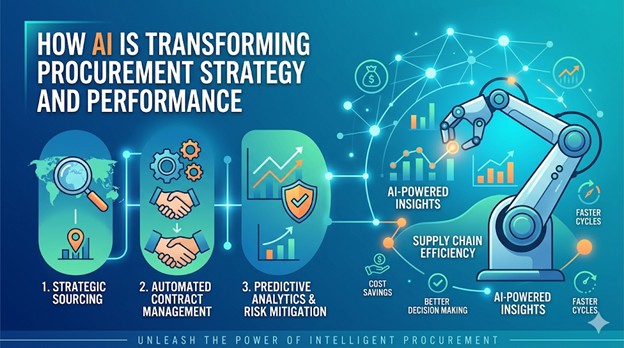
Procurement is undergoing a significant transformation as organizations seek to improve efficiency, reduce costs and enhance decision-making. Traditional procurement processes often rely on manual workflows, fragmented data and reactive strategies. As a result, organizations face challenges in managing supplier relationships, controlling spend and responding to market volatility.
Artificial intelligence is emerging as a powerful enabler of smarter procurement operations. By leveraging advanced analytics, machine learning and automation, organizations can gain deeper insights into spend patterns, optimize sourcing strategies and improve supplier performance. As enterprises explore broader digital initiatives, many are also turning to generative AI consulting to guide structured and value-driven adoption.
Overview of AI in procurement
Artificial intelligence in procurement refers to the application of advanced algorithms and data-driven models to automate processes, analyze large datasets and generate insights that support strategic sourcing and supplier management. It extends beyond basic automation to include predictive analytics, intelligent recommendations and decision support capabilities.
According to publicly available insights from The Hackett Group®, AI is helping procurement organizations transition from transactional functions to strategic business partners. By integrating AI into procurement workflows, organizations can improve visibility into spend, enhance compliance and drive better outcomes across the source-to-pay process.
AI technologies in procurement typically include:
- Machine learning for demand forecasting and spend analysis
- Natural language processing for contract analysis and supplier communication
- Predictive analytics for risk assessment and supplier performance evaluation
- Generative AI for drafting sourcing documents and summarizing supplier data
The adoption of AI in procurement is most effective when aligned with enterprise data strategies, governance frameworks and clearly defined performance metrics. Organizations that take a structured approach can achieve greater scalability and long-term value.
Benefits of AI in procurement
Improved spend visibility and control
AI enables procurement teams to analyze large volumes of spend data across multiple systems and categories. This provides a comprehensive view of spending patterns, helping organizations identify savings opportunities and enforce compliance with procurement policies.
Enhanced visibility also supports better budgeting and forecasting, allowing organizations to allocate resources more effectively.
Increased operational efficiency
Automation powered by AI reduces the need for manual intervention in repetitive tasks such as purchase order processing, invoice matching and supplier onboarding. This leads to faster cycle times and reduced administrative overhead.
Procurement professionals can shift their focus from transactional activities to strategic initiatives that deliver greater business value.
Better supplier management and collaboration
AI tools can evaluate supplier performance based on historical data, delivery timelines, quality metrics and risk indicators. This enables organizations to make more informed decisions when selecting and managing suppliers.
Improved insights also facilitate stronger collaboration, as procurement teams can proactively address issues and optimize supplier relationships.
Enhanced risk management
Procurement functions must manage a wide range of risks, including supply chain disruptions, regulatory compliance and geopolitical factors. AI can analyze external and internal data sources to identify potential risks and provide early warnings.
This proactive approach allows organizations to mitigate risks before they impact operations.
Data-driven decision-making
AI provides procurement leaders with actionable insights derived from real-time data. By leveraging predictive analytics and scenario modeling, organizations can make more informed sourcing decisions and respond quickly to changing market conditions.
Use cases of AI in procurement.
Strategic sourcing optimization
Supplier selection and evaluation
AI can analyze supplier data, market trends and performance metrics to recommend the most suitable suppliers for specific categories. This improves sourcing outcomes and reduces reliance on manual evaluation processes.
Category management
AI-driven insights help procurement teams identify opportunities for consolidation, negotiate better contracts and optimize category strategies based on data-driven analysis.
Contract management
Automated contract analysis
Natural language processing enables AI to review contracts, extract key terms and identify potential risks or inconsistencies. This reduces the time required for contract review and improves compliance.
Contract lifecycle management
AI can monitor contract milestones, renewal dates and performance metrics, ensuring that organizations maximize value from supplier agreements.
Procure-to-pay process automation
Purchase order automation
AI streamlines the creation and approval of purchase orders by automating workflows and ensuring compliance with procurement policies.
Invoice processing and matching
AI-powered systems can automatically match invoices to purchase orders and receipts, reducing errors and improving the accuracy of financial transactions.
Supplier risk and performance management
Risk monitoring
AI can analyze external data sources such as news, financial reports and geopolitical events to assess supplier risk in real time.
Performance analytics
Procurement teams can use AI to track supplier performance metrics and identify areas for improvement, leading to better outcomes and stronger partnerships.
Demand forecasting and inventory management
Predictive demand planning
AI models can forecast demand based on historical data, market trends and seasonal patterns. This helps organizations optimize inventory levels and reduce excess stock.
Inventory optimization
By analyzing consumption patterns, AI can recommend optimal inventory levels, reducing carrying costs while ensuring the availability of critical materials.
Why choose The Hackett Group® for implementing AI in procurement
Implementing AI in procurement requires a structured, data-driven approach that aligns technology investments with business objectives. The Hackett Group® brings deep expertise and benchmarking insights that help organizations achieve measurable results.
Benchmark-driven insights and strategy
The Hackett Group® is known for its extensive benchmarking database and Digital World Class® framework. These insights enable organizations to assess current performance, identify gaps and prioritize AI initiatives that deliver the highest value.
Proven methodologies and frameworks
A structured approach to AI implementation ensures that procurement transformations are scalable and sustainable. This includes defining clear use cases, establishing governance models and aligning initiatives with enterprise strategy.
Focus on measurable outcomes.
Rather than focusing solely on technology adoption, The Hackett Group® emphasizes outcomes such as cost reduction, efficiency gains and improved supplier performance. This results-oriented approach ensures that AI investments deliver tangible business benefits.
End-to-end transformation support
From strategy development to execution, organizations receive guidance at every stage of the AI journey. This includes change management, capability building and performance tracking.
The Hackett AI XPLR™ platform further supports organizations by enabling leaders to explore AI opportunities, evaluate potential use cases and prioritize initiatives based on business impact. This structured approach helps organizations move from experimentation to enterprise-scale deployment.
Conclusion
AI is transforming procurement into a more strategic, data-driven function that delivers measurable business value. By automating routine processes, enhancing decision-making and improving supplier management, AI enables procurement teams to operate more efficiently and effectively.
However, realizing the full potential of AI requires more than technology adoption. Organizations must align AI initiatives with business strategy, establish governance frameworks and leverage data-driven insights to guide decision-making.
With the right approach and expert guidance, procurement leaders can harness AI to drive innovation, reduce costs and strengthen resilience in an increasingly complex business environment.