
| THE QUICK ANSWER
A 52V 2000W build has to pass three separate tests — think of them as three budgets. ELECTRICAL: the battery and its BMS must supply the controller’s current (a 35A controller requires ~1,820W) without sag or cutout. ENERGY: 20/25/30 Ah packs store ~1,040/1,300/1,560 Wh — convert that to a realistic planning range before you choose. FIT: the rear dropout, wheel, brakes, drivetrain and battery space must all be confirmed by measurement, not by the product title. If any one budget is unknown, the kit has not yet been confirmed to fit — no matter how big the battery is. |
The easiest way to choose a high-power conversion kit is to read the wattage, estimate the speed, and pick the largest battery available. It is also one of the easiest ways to end up with a pack that sags under load, a range that never matches the listing, or a motor that will not seat in the frame.
This guide uses a typical 52V rear direct-drive system — the 52V 2000W ebike conversion kit — as the worked example, and organises the whole decision around one idea: a good build balances three budgets. Get all three right and the rest is detail.
Budget 1 — Electrical: Can the Pack Deliver the Power?
Voltage and wattage describe different things. Voltage is the electrical pressure available to the controller and motor; wattage describes power, the rate at which energy is used. A nominal 52V lithium pack is typically a 14-series design: it reaches 58.8V fully charged and declines through the ride.
The controller is the gatekeeper between battery and motor. In the worked example, the FOC sinewave controller is rated at 35A — and that current limit, not the motor’s label, sets the real output.
Two calculations make the point. 52V × 35A is about 1,820W nominal input (nearer 2,058W at 58.8V, just after charging). And 2,000W ÷ 52V is about 38.5A — more than the 35A the controller actually delivers. The label is a ceiling the system is tuned to sit below, deliberately.
The BMS is part of the power system
Every lithium pack contains a battery management system that monitors cell voltage, current and temperature and disconnects the pack in a fault. For a 35A controller, confirm the battery’s documented continuous-discharge rating covers that demand with margin. The safest route is a battery the kit supplier has explicitly matched to the controller; if you mix brands, get the voltage range, BMS continuous rating, connector and charger confirmed in writing before anything is plugged in.
Budget 2 — Energy: Will It Reach Your Destination?
Amp-hours are only comparable when voltage is held constant. All three options here are 52V, so amp-hours compare directly — but watt-hours are what actually predict range. 20Ah, 25Ah and 30Ah packs store roughly 1,040, 1,300 and 1,560 Wh. Stepping 20→25Ah adds 260Wh (+25%) for about 1.1 kg; 25→30Ah adds another 260Wh (+20%) and usually a larger case.
A better way to estimate real range
Range is an energy-budget problem. Start with nominal watt-hours, reserve about 15% rather than planning to arrive at zero, then divide the remainder by your expected Wh per km:
Planning range = usable battery energy ÷ expected Wh per km
| 52V pack | Nominal | Usable (85%) | At 30 Wh/km (hard) | At 20 Wh/km (gentle) |
| 20Ah | 1,040 Wh | 884 Wh | ≈ 29 km | ≈ 44 km |
| 25Ah | 1,300 Wh | 1,105 Wh | ≈ 37 km | ≈ 55 km |
| 30Ah | 1,560 Wh | 1,326 Wh | ≈ 44 km | ≈ 66 km |
These are planning scenarios, not test results. A rider pedalling on the flat may use under 20 Wh/km; frequent full-power acceleration on hills can exceed 30. For a new build, record distance and watt-hours over three representative rides and divide to get the bike’s own Wh/km — then plan from that number, not a brochure.
| OUR VIEW: the 25Ah pack is the sensible default — with one condition.
For most builds, 25Ah is the useful middle ground: 1.3 kWh of energy, a 5A fast-charge option, and none of the full weight and bulk of the 30Ah case. The condition is fit. A battery that cannot be mounted securely, removed from its rail, or kept clear of the crank has an effective capacity of zero. We would always choose a correctly-fitting 25Ah pack over a 30Ah pack that only ‘nearly’ fits. Buy capacity for a repeatable route, not for the largest number on the selector. |
The variables that change range most
| Variable | Effect on range |
| Speed | Aerodynamic drag rises sharply with speed — holding a high speed costs far more than briefly reaching it |
| Stops & acceleration | Repeated acceleration of a heavy bike draws high current; a smoother acceleration setting helps |
| Gradient | Long steep climbs increase demand and heat a direct-drive hub at low wheel speed |
| Mass | Rider, bike and cargo weight bite hardest when accelerating and climbing (the motor wheel alone is ~6.8 kg) |
| Tyres & pressure | Wide, soft or under-inflated tyres raise rolling resistance |
| Temperature & age | Cold or aged cells deliver less usable energy before the BMS cuts off |
| Controller settings | Current limits and assistance levels change how fast energy is drawn |
Budget 3 — Fit: Will It Physically Fit and Stay Safe?
Mechanical fit is half the conversion, and it starts at the rear dropout — not the wheel label. The worked-example motor wheel is offered in 26, 27.5, 28, 29 and 700C sizes with a listed rear dropout range of 135–142 mm. That range is broad, but width alone is a screening number, not a complete axle standard.
Remove the rear wheel and measure the clear distance between the inner faces of the dropouts, then inspect slot width, slot depth and the shape of the dropout. A conventional high-power hub axle has flats retained by nuts and needs open slots to seat fully — a closed thru-axle frame will not normally accept it. Aluminium should not be cold-set to force a fit, and carbon needs specialist sign-off. At this power the frame is part of the drive system: the axle feeds reaction torque into the dropouts on every acceleration, which is why a torque arm is fitted and why the axle must seat against flat, sound surfaces.
Wheel, tyre and brakes
Select the wheel from the tyre sidewall (record the ISO/ETRTO marking such as 40-622 or 57-622), not the bicycle’s marketing name. Confirm disc rotor pattern, diameter and calliper clearance. Braking deserves more attention than most guides give it: a 6.8 kg motor wheel plus a 5.1–7.55 kg battery adds roughly 12–14 kg before rider and cargo, on a bike that may now hold a higher average speed. Service or upgrade the brakes as part of the build.
Freewheel or cassette — order the correct motor version
A threaded freewheel and a cassette are different systems. The worked-example kit offers a seven-speed threaded-freewheel motor and a version for 8, 9, 10 or 11-speed cassettes. Remove the wheel, identify which you have, count the sprockets, and order to match — rather than downgrading a modern drivetrain to suit the wrong motor. Check derailleur and chainstay clearance once the motor, washers and sprockets are fitted.
Battery fit is a three-dimensional problem
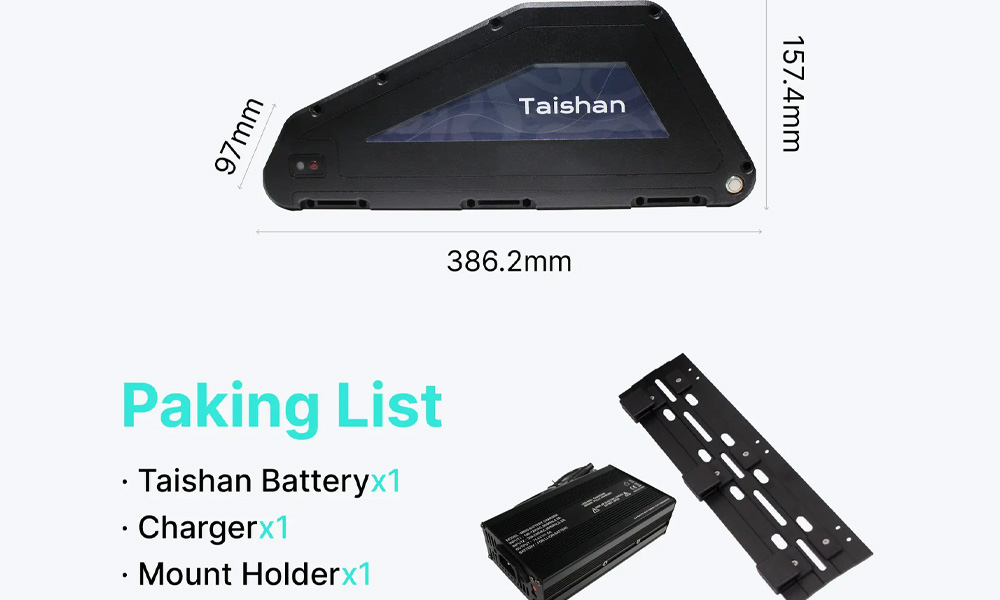
Battery fit is often judged from a side-on photo, which misses the mounting rail, key, cable exit and the direction the case slides to remove. Get the dimension drawing for the exact capacity (the 52V 25Ah Taishan case is about 386.2 × 97 × 157.4 mm), make a full-size cardboard template, and add the rail thickness plus at least the pack’s own length of removal travel. Mount low and central for predictable handling. Browse the 52V e-bike battery options only after measuring the usable space — capacity is the final filter, not the first.
What a Complete 52V 2000W System Should Include
A complete kit reduces guesswork, but every component still needs checking. The worked-example configuration combines a rear direct-drive motor wheel, a 35A FOC sinewave controller with a potted body and sealed connectors, a colour display, pedal-assist and brake sensors, wiring, and a matched 52V battery with charger. Potting and sealed connectors matter on an exposed conversion; FOC sinewave control makes a direct-drive hub feel quieter and smoother than a basic square-wave setup. Published maximum speed is roughly 50–60 km/h under suitable off-road conditions — actual speed varies with wheel size, voltage and settings.
Where Can a 2000W Conversion Be Used Legally?
Decide the legal use near the START of the purchase, not after installation. In Great Britain, a standard electrically assisted pedal cycle must have usable pedals, a motor of no more than 250W maximum continuous rated power, and assistance that cuts off above 15.5 mph. A 2000W conversion is well outside that at full rating and may be treated as a moped or motorcycle, with approval, registration, tax, insurance, a licence and an approved helmet. A display setting that limits speed or current does not change the motor’s rated power or vehicle classification. For most buyers the clean use case for full power is private land, or an off-road environment where the owner has permission. Rules change — editors should re-check current official guidance before publishing.
A Safe Pre-Order and Installation Sequence
- Define the use. Private-land performance, an approved motor-vehicle route, or standard EAPC — decide first.
- Inspect the donor bike. Frame, fork, dropouts, headset, brakes, tyres, alignment. Resolve cracks and worn bearings before converting.
- Record wheel & drivetrain data. Photograph tyre marking, rotor, sprockets and axle; identify freewheel vs cassette and count gears.
- Measure the rear interface. Internal dropout spacing, slot width and depth; check nut, washer, rotor and calliper clearance.
- Template the battery. Reproduce case, rail and removal travel full size; choose capacity only after it passes.
- Confirm the electrical chain. Full-charge voltage, controller current, BMS discharge, connector polarity, charger output.
- Install torque arm & brakes correctly. Follow torque specs; never improvise around an axle that will not seat.
- Commission at low power, then reinspect. Verify rotation, brake cut-offs and display; recheck axle nuts, torque arm, spokes and rail after the first rides.
Seven Mistakes That Cost Range, Reliability or Money
- Sizing the battery from the motor label. Controller current and BMS decide whether power can be delivered safely.
- Treating amp-hours as range. Convert to watt-hours, reserve energy, use a realistic Wh/km.
- Assuming 142 mm means thru-axle compatibility. Width and axle interface are separate checks.
- Ordering the wrong gear interface. A 7-speed freewheel is not interchangeable with an 8–11-speed cassette motor.
- Ignoring battery removal travel. A case can fit inside the frame yet be impossible to install or unlock.
- Keeping the original brakes without an audit. The conversion adds significant mass and may raise average speed.
- Using a limit setting as legal proof. Classification depends on the complete specification and the applicable law, not one menu option.
Frequently Asked Questions
Is 52V enough for a 2000W ebike kit?
Yes, when motor, controller and battery are designed as one 52V system. The more important detail is current: a 35A controller draws roughly 1.8 kW at 52V, and the battery BMS must supply that continuously without sag or cut-out.
How far will a 52V 20Ah battery go with a 2000W motor?
A 52V 20Ah pack stores about 1,040 Wh. Using an 85% planning allowance (884 Wh), that is roughly 44 km at a gentle 20 Wh/km and about 29 km at a hard 30 Wh/km. Your real figure depends on speed, weight, terrain and settings.
Is a 52V 30Ah battery always better than 25Ah?
No. It stores 260 Wh more but is heavier and often uses a larger case. It is better only when the route needs the reserve and the bicycle can mount and remove it securely. For many builds a well-fitting 25Ah is the smarter choice.
Will a 135–142 mm rear hub fit a 142 x 12 frame?
Not automatically. A 142 x 12 frame normally uses a closed thru-axle, while many high-power hub motors use a solid nutted axle with flats for open dropouts. Width and axle interface are separate checks.
Can I keep my existing cassette?
Only if you order the cassette motor version and your cassette speed is supported (the worked example lists 8–11-speed). A freewheel motor will not accept a cassette.
Do I need a torque arm on a 2000W hub motor?
Use the torque arm supplied or specified by the kit. At this power, axle reaction torque is substantial and the dropout must not be relied on alone.
Is a 2000W conversion kit road legal in the UK?
Not as a standard EAPC at full rating. Ordinary EAPC treatment requires no more than 250W maximum continuous rated power and assistance to 15.5 mph. A 2000W system may fall under moped or motorcycle rules — check current guidance and the full specification.
Build Around Three Budgets, Not One Big Number
The best way to plan a 52V 2000W conversion is to treat it as three linked budgets. The electrical budget matches full-charge voltage, controller current, BMS capability, connectors and charger. The energy budget converts watt-hours into a realistic range with a reserve. The fit budget confirms dropout, axle, wheel, brakes, drivetrain and battery space by measurement. This is more useful than comparing top-speed claims: a battery is not better if it cannot be removed, and a matching wheel diameter means little if the axle will not seat. Balance all three and the finished conversion is far more likely to be safe, reliable and worth the money.