
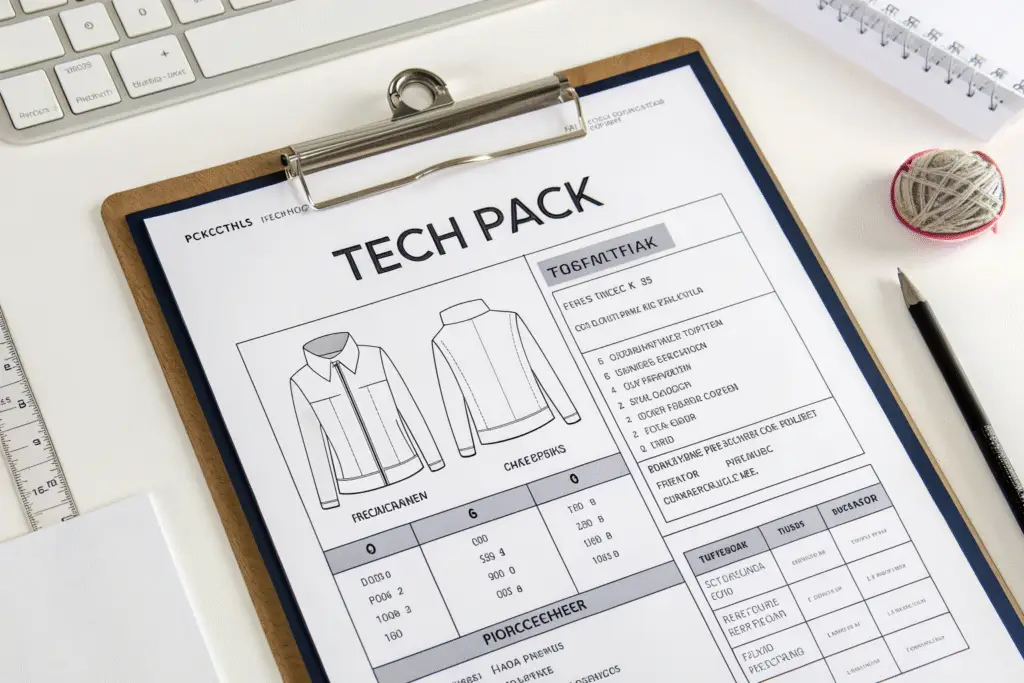
In the apparel production world, a “guesswork” tech pack is the primary cause of manufacturing delays and wasted capital. When approaching a custom legging manufacturer, a mood board or a few aesthetic sketches are insufficient. Production requires a blueprint.
A tech pack functions like the architectural plans for a building. Forgetting to specify structural details leads to expensive errors during the construction phase. In the fashion industry, these mistakes translate to thousands of dollars in wasted fabric and samples that fail to meet the original vision.
The following elements are essential to ensure production runs stay on track and profit margins remain protected.
1. The Technical Sketch (Flat)
Artistic fashion illustrations with stylized figures are for design inspiration, not production. Manufacturers require “flats”black and white 2D technical drawings. This must include a front view, a back view, and side views for specific seam details or pocket placements.
Every seam serves a purpose. Whether it is a flatlock stitch or a twin-needle coverstitch, the placement must be clear. When partnering with a professional custom legging manufacturer like Affix Apparel, providing these details ensures that reinforced seams are placed correctly for maximum durability.
2. A Detailed Bill of Materials (BOM)
The BOM serves as the master ingredient list. Stating “Spandex” is too vague. Specifications must include the weight (GSM), the specific blend (e.g., 75% Nylon, 25% Elastane), and the desired finish, such as matte, brushed, or glossy.
“Sundries” must also be included. This covers thread types, heat-transfer labels, and elastic bands. If a brand is also working with an underwear manufacturer for a coordinated collection, the quality of the elastic is the determining factor for fit. This same level of technical detail is required for leggings.
3. The Grading Scale and Size Table
A common pitfall for emerging brands is failing to define how a design scales. A perfect sample in a Size Small does not automatically translate to a balanced XL. A clear grade rule is mandatory, instructing the factory on exactly how many centimeters to add or subtract across the size range.
Leggings are particularly complex due to the “stretch factor.” If the grading does not account for the vertical and horizontal stretch of the specific fabric, the result is often “baggy knee” syndrome in larger sizes or “sheer-out” in smaller ones.
Expert Recommendation: Always request a “size set” of samples before authorizing bulk production. Testing a single middle size is a significant risk.
4. Construction Details and Stitching Specs
Activewear performance depends entirely on construction. Leggings undergo immense tension during physical activity. Stitch density (stitches per inch) must be specified. Too few stitches will lead to popped seams, while too many can cause “needle cutting,” which damages the fabric fibers.
Identify the exact seam types. For high-performance leggings, four-needle six-thread flatlock stitching is the industry standard. It provides a chafe-free experience and superior strength. Without this specification, a factory may opt for a standard overlock to reduce production time, resulting in an inferior product that lacks professional quality.
5. Branding and Packaging Instructions
Logo placement requires precision. The tech pack must indicate exactly how many centimeters the logo sits from the waistband or side seam. The method, whether screen-printed, embroidered, or silicone heat transfer, must be clearly defined with a placement map.
Packaging is equally important. Specify if the leggings should be folded in a particular way or placed in specific polybags or recycled sleeves. Without these instructions, a custom legging manufacturer will use standard defaults, which may conflict with a brand’s sustainability standards or retail presentation.
6. Point of Measurement (POM) Tracking
A table listing every critical measurement is the best defense against production errors. This includes waistband width, inseam length, front rise, back rise, and leg opening. The table should feature a column for “Planned” dimensions and a blank column for “Actual” measurements.
Upon receiving a prototype, the garment is measured against these POMs. If the inseam arrives shorter than specified, the documented tech pack serves as proof to request a correction without incurring additional sample fees. This document acts as the ultimate insurance policy.
Common Pitfalls to Avoid
High-figure losses often occur because a factory was expected to “just know” the design intent. If a detail is not in the tech pack, it does not exist in the eyes of the manufacturer.
- The “Color” Trap:Avoid descriptive names like “Midnight Blue.” Use Pantone TCX numbers. Digital screens vary in color display; a physical color standard is the only way to ensure consistency.
- The Gusset Detail:A legging without a well-designed gusset (the triangular or diamond-shaped crotch insert) is a functional failure. Specify the shape and the lining fabric.
- Vague Tolerances:No production run is 100% perfect. Define an acceptable “tolerance” (e.g., +/- 0.5cm). Anything outside this range is classified as a defect.
Final Thoughts
Making a complete tech pack can be an extremely long process; sometimes it can take longer than creating the original design, but this is also the most important tool for any clothing company. A tech pack is the only way to accurately quote an item when comparing the cost of a custom leggings manufacturer to that of an underwear manufacturer, and guarantee that everyone bidding on an item is bidding on exactly what the customer is requesting.
Clarifying everything is the end goal of creating a tech pack, meaning there is no interpretation of anything, so when going from designing an item or clothing line to producing bulk quantities of that item or clothing line, it is done easily, without any surprises, and will most likely make a profit as well.