
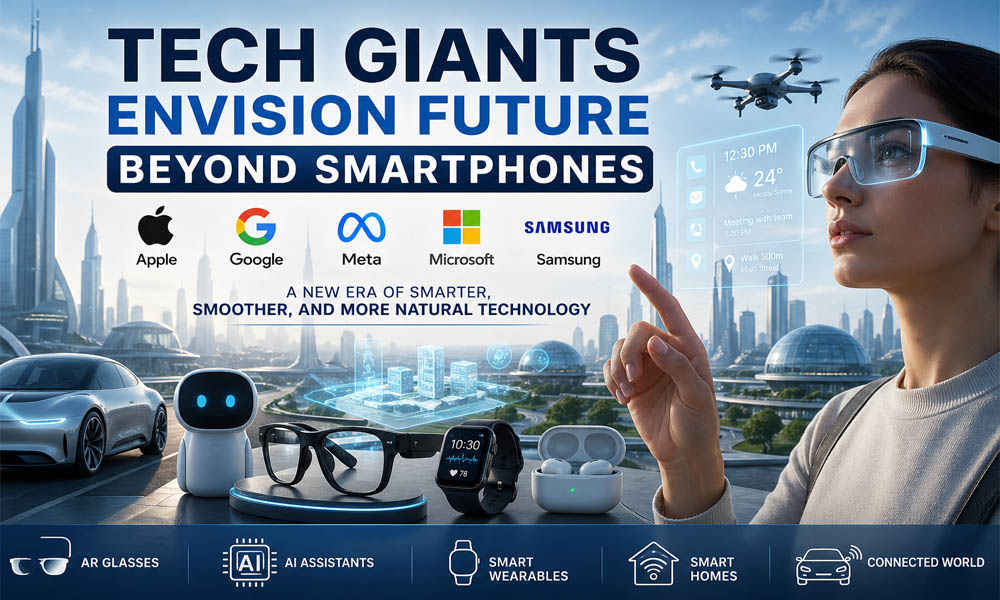
For many years, smartphones have been the center of our daily life. We wake up and check them. We use them for messages, maps, photos, work, and even shopping. It almost feels like life cannot run without a phone.
But here’s something interesting. In 2026, things are slowly changing. People are not as excited about new phones anymore. New models come out every year, but they don’t feel very different. You may even ask yourself, “Do I really need to upgrade?”
This is where things get exciting. Big companies like Apple, Google, Meta, and Samsung are already planning the next big step. They are working on a world where the phone is not the main device anymore. In this article, we will explore how tech giants envision future beyond smartphones and what could replace your phone in the coming years.
Tech Giants Envision Future Beyond Smartphones: Why Phones Are Losing Power
Let’s start with a simple question. When was the last time a new phone truly amazed you?
Most people would say, “It’s been a while.” That’s because phones today are already very powerful. They have great cameras, fast speed, and smooth screens. But the problem is, new upgrades feel small. A slightly better camera or a slightly faster chip is not enough to excite people.
Another reason is that people are keeping their phones longer. Before, many users upgraded every year. Now, they wait two, three, or even four years. This shows that phones are no longer changing fast enough to push people to buy new ones.
This is a big challenge for tech companies. They cannot depend only on phone sales anymore. That is why tech giants envision future beyond smartphones and are now building new types of devices that feel fresh and exciting again.
What Does “Beyond Smartphones” Really Mean?
Now you might wonder, does this mean phones will disappear? The answer is no.
When we say tech giants envision future beyond smartphones, it simply means phones will become less important. They will still exist, but they will not be the center of everything. Instead, many devices will work together to handle different tasks.
Think about it like this. Today, your phone does everything. But in the future, your watch may handle health tracking, your glasses may show messages, and your AI assistant may do tasks for you. Your phone becomes just one part of a bigger system.
This shift is very important. Technology is moving from “something you hold” to “something around you.” That means less screen time, less tapping, and more natural interaction.
Tech Giants Envision Future Beyond Smartphones With Smart Wearables
Let’s talk about something you may already use: wearables.
Devices like smartwatches and earbuds are no longer just accessories. They are becoming powerful tools. For example, a smartwatch can track your health, show messages, and even take calls without touching your phone.
Imagine going for a walk. You don’t carry your phone. Your watch tracks your steps. Your earbuds play music. You can answer a call with a tap. This is a simple example of how life is already changing.
This is exactly why tech giants envision future beyond smartphones with wearables. These devices are small, easy to use, and always with you. They make life simpler because you don’t need to pull out your phone every time.
In the future, we may see even more wearable devices like smart rings or smart clothing. All these tools will work together and reduce the need for a phone.
Tech Giants Envision Future Beyond Smartphones With AR Glasses
Now let’s move to one of the most exciting ideas: AR glasses.
AR stands for Augmented Reality. In simple words, it means adding digital information to the real world. Instead of looking down at your phone, you see useful information right in front of your eyes.
Imagine walking in a new city. Instead of checking your phone, you see arrows on the road showing you where to go. Or imagine reading a message without taking your phone out of your pocket. Sounds amazing, right?
This is why tech giants envision future beyond smartphones with AR glasses. Companies like Apple, Google, and Meta are all working on this. They believe glasses can become the next main device.
AR glasses feel natural. You don’t need to hold anything. You just look and interact. That is a big step forward compared to smartphones.
Tech Giants Envision Future Beyond Smartphones Using AI Assistants
Let’s talk about something that is growing very fast in 2026: AI.
You may already use voice assistants like Siri or Google Assistant. But now, AI is becoming much smarter. It can understand what you need and help you without asking too many questions.
For example, instead of opening apps and searching, your AI assistant can do the task for you. It can book tickets, send messages, summarize long texts, and even remind you about important things.
This is a big reason why tech giants envision future beyond smartphones. If AI can handle tasks for you, then you don’t need to open apps or scroll through screens all the time.
In the future, AI will feel like a personal helper that is always with you. It will work across all devices, not just inside your phone.
Tech Giants Envision Future Beyond Smartphones With Spatial Computing
Now let’s explore a new idea that sounds complex but is actually simple: spatial computing.
Today, you use a small screen to do everything. But with spatial computing, your screen is no longer limited to your phone. Instead, digital content appears around you.
Imagine sitting at your desk and having multiple virtual screens floating in the air. You can move them, resize them, and interact with them using your hands or eyes. This is already starting with devices like Apple Vision Pro.
This is another way tech giants envision future beyond smartphones. Instead of a small display, you get a full digital space around you.
This can change how we work, watch movies, or even learn new things. It makes everything bigger, more immersive, and more natural.
Big Tech Plans: Apple, Google, Meta and More
Now let’s look at what big companies are actually doing.
Apple is focusing on spatial computing and AR. Its Vision Pro headset is just the beginning. The long-term goal is to create lightweight glasses that may replace the iPhone one day.
Google is working on AI and ambient computing. This means technology will be everywhere around you, not just inside a device. Their AI systems are becoming smarter and more helpful every day.
Meta is investing heavily in AR glasses and virtual worlds. They believe glasses will replace phones as the main way we communicate and interact.
Samsung is taking a different path. It is building a strong ecosystem of devices like phones, wearables, and home tech that all work together smoothly.
All these efforts clearly show how tech giants envision future beyond smartphones. Each company has a different strategy, but the goal is the same: move beyond the phone.
Tech Giants Envision Future Beyond Smartphones Through New Interfaces
Let’s think about how we use phones today. We tap, swipe, and type. But what if this changes?
New ways to interact with devices are coming. Voice control is becoming more common. You can simply speak instead of typing. Gesture control lets you use your hands in the air to control things.
There is also eye tracking. Devices can understand where you are looking. Some companies are even working on brain-based control, where you can control devices using your thoughts.
This may sound like science fiction, but it is slowly becoming real. That is why tech giants envision future beyond smartphones with these new interfaces.
The goal is simple: make technology feel natural. No more constant tapping and scrolling.
How People’s Habits Are Changing Fast
Technology is not the only thing changing. People are changing too.
Many users today feel tired of screens. Too much scrolling can feel stressful. People want something simpler and less distracting.
At the same time, younger users love immersive experiences. They enjoy gaming, AR filters, and 3D environments more than simple apps. This is shaping what the future will look like.
People also want devices that work together. They don’t want to switch between apps or devices all the time. They want everything to feel connected and easy.
This is another reason why tech giants envision future beyond smartphones. They are not just creating new technology. They are responding to what people want.
Tech Giants Envision Future Beyond Smartphones With Foldable Devices
Before we fully move into a new world, there is a small step in between. This step is foldable devices.
You may have seen phones that fold like a book. These phones give you a bigger screen when you need it and a smaller size when you don’t. It feels new and different compared to normal phones.
But here’s the truth. Foldable phones are not the final future. They are just a bridge. They help companies test new ideas and understand what users like. That is why tech giants envision future beyond smartphones while still working on foldables.
These devices teach companies how people use bigger screens, how they multitask, and how they enjoy flexible designs. All of this learning will help build better devices like AR glasses and spatial systems in the future.
Challenges in a World Beyond Smartphones
Now, let’s be real. This future sounds exciting, but it is not easy to achieve.
One big challenge is privacy. If you wear smart glasses all day, they may have cameras and sensors. People may feel uncomfortable being recorded. So companies must build strong privacy rules.
Another problem is cost. New technology is often expensive. Not everyone can afford AR glasses or advanced devices right away. For this future to work, devices must become cheaper over time.
There are also technical limits. Batteries must last longer. Devices must be light and comfortable. No one wants to wear something heavy on their face all day.
This is why tech giants envision future beyond smartphones, but they are also working hard to solve these problems step by step.
When Will This Future Actually Happen?
You might be thinking, “So when will all this really happen?”
The change will not come overnight. It will happen slowly. Right now, in 2026, we are in the early stage. Some people are already using advanced wearables and early AR devices.
Between 2025 and 2030, more people will start trying these new tools. Early users will test them, and companies will improve them based on feedback.
From 2030 to 2035, these devices may become common. More people will use smart glasses, AI assistants, and spatial tools in daily life.
By 2035 to 2040, smartphones may no longer be the main device. They will still exist, but they will not be the center of everything.
This timeline clearly shows how tech giants envision future beyond smartphones in a gradual and realistic way.
How Life Will Change Without Smartphones
Now let’s imagine your daily life in this future.
You wake up in the morning. Instead of checking your phone, your smart glasses show your schedule. Your AI assistant reminds you about your tasks.
When you go outside, navigation appears in front of your eyes. No need to look down at a map. You simply follow the directions as you walk.
At work, you don’t need a laptop screen. You see virtual screens around you. You move them with your hands. You attend meetings in a 3D space where people feel present.
Entertainment also changes. Movies appear as big floating screens. Games feel like they are happening in your room. Shopping becomes easier with virtual try-ons.
This is the kind of life tech giants envision future beyond smartphones. It is simple, hands-free, and more natural.
Conclusion
So, what does all this mean for you?
Smartphones are not going away tomorrow. They are still useful and important. But their role is slowly changing. They are moving from being the main device to just one part of a bigger system.
The future is not about one device. It is about many devices working together. Wearables, AR glasses, AI assistants, and spatial systems will all connect to make life easier.
This is exactly how tech giants envision future beyond smartphones. They want technology to feel invisible, simple, and helpful.
We are already seeing the early signs in 2026. And in the coming years, this shift will become clearer.
The question is not “if” this change will happen. The real question is:
👉 Are you ready for a world without depending on your phone?
(FAQs)
Will smartphones completely disappear in the future?
No, smartphones will not disappear. They will still exist, but they will become less important. Other devices like AR glasses, wearables, and AI assistants will handle most daily tasks, so people won’t depend on phones as much as before.
What do tech giants mean by a future beyond smartphones?
When tech giants envision future beyond smartphones, they mean a world where technology is not limited to one device. Instead of using only a phone, people will use smart glasses, wearables, and AI systems that work together and feel more natural.
What device is most likely to replace smartphones?
AR glasses are the strongest candidate. They allow you to see messages, directions, and information directly in your view without holding a phone. Many companies believe glasses will become the main device in the future.
How will AI change life without smartphones?
AI will act like a smart helper. It will do tasks for you, like sending messages, booking things, or finding information. This reduces the need to open apps or scroll on a screen, making life faster and easier.
Are people already using post-smartphone technology in 2026?
Yes, early versions already exist. Smartwatches, voice assistants, and early AR devices are being used today. These are small steps toward the bigger future that tech companies are building.
Why are people getting tired of smartphones?
Many people feel tired of constant screen time. Scrolling all day can feel stressful. Also, new phones don’t feel very different anymore. That’s why users are open to simpler and more natural technology.
What are the biggest challenges in moving beyond smartphones?
The main challenges include privacy concerns, high costs, battery life issues, and social acceptance. Devices like smart glasses must become affordable, comfortable, and safe before everyone can use them.
How will daily life change without smartphones?
Life will become more hands-free. You may use voice, gestures, or glasses instead of tapping a screen. Navigation, communication, work, and entertainment will feel more natural and less distracting.
Which companies are leading the post-smartphone future?
Apple, Google, Meta, Samsung, Microsoft, and others are leading this shift. Each company is focusing on different areas like AI, AR glasses, spatial computing, and connected devices.
When will smartphones stop being the main device?
Experts believe this change will happen slowly. Between 2030 and 2035, new devices may become common. By 2040, smartphones may no longer be the main device people rely on every day.
You may also read: vRealize Infrastructure Navigator: The Smart Way to See Your IT Systems