
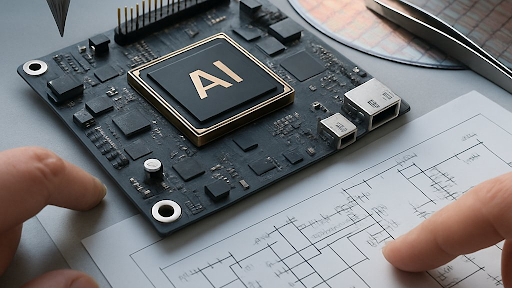
The bench-to-production gap is a manufacturing and thermal problem far more than a silicon problem. A working prototype on a lab bench with an oversized heatsink, a bench power supply, and hand-soldered rework tells you the architecture is sound and almost nothing about whether ten thousand units can be built to spec, cooled in a real enclosure, and shipped with acceptable yield. Most teams underestimate this phase by a factor of two on both time and cost.
The specific reason AI hardware is harder than general electronics is power density. Inference accelerators concentrate heat into small packages, memory bandwidth requirements push you toward exotic packaging and tight signal integrity margins, and a design that runs comfortably at 60 watts on an open bench can throttle badly in a sealed 1U chassis at 35 degrees ambient. Everything downstream, from enclosure design to component selection to your certification schedule, follows from decisions you make about power and thermals early.
What Design for Manufacturing Actually Changes in Your Board
The first proper DFM review usually rewrites more of the board than teams expect. Component footprints get standardised, test points get added, panelisation and fiducials are designed in, and parts that were fine to hand-place become problems for automated assembly. Expect two to four board respins between a working prototype and a design that a contract manufacturer will build repeatably, with each spin costing four to eight weeks depending on layer count and fab queue.
Component selection changes more than layout does. Prototype builds tolerate distributor stock and single-source parts because you only need five units, while production demands second sources, lifecycle commitments from the manufacturer, and lead times you can actually plan against. Advanced packaging components and high-bandwidth memory have been particularly tight in recent years, and industry supply data has repeatedly shown lead times on constrained categories stretching well beyond a year during allocation periods.
Design for test is the piece that gets skipped and hurts later. Every unit off the line needs a functional test that catches solder defects, verifies power sequencing, confirms memory training, and runs a representative inference workload with known-good outputs. Building that fixture and test software takes a dedicated engineer several months, and doing it after the first production run means you either ship untested boards or halt the line while you catch up.
Thermal Design and Power Delivery at Production Scale
Thermal validation is where prototypes most often lie to you. Bench testing typically happens in open air at comfortable room temperature with a short workload, while production units sit in racks or enclosures, run sustained inference for hours, and must hold performance at the top of their rated ambient range. The difference between those two conditions can easily be 20 degrees of junction temperature, which either costs you clock speed or costs you reliability.
Cooling approach determines much of your cost structure. Forced air with a well-designed heatsink handles most designs up to a few hundred watts per board, above which you are looking at vapour chambers, heat pipes, or liquid cooling, and each step up adds cost, complexity, and failure modes. Data centre customers increasingly accept liquid cooling, while edge and embedded deployments usually cannot, so your target segment effectively picks your thermal architecture for you.
Power delivery deserves the same scrutiny. Multi-phase regulators feeding a high-current accelerator need careful layout, adequate decoupling, and validated transient response under the sharp load steps that inference workloads produce. Teams that shortcut this see instability that only appears at temperature, at specific workloads, on a fraction of units, which is the most expensive category of bug to find after you have built inventory.
Certification, Compliance, and Realistic Timelines
Regulatory testing runs on its own clock and cannot be compressed much. EMC testing for FCC Part 15 in the US and CE marking under the EMC and Low Voltage Directives in Europe, plus safety certification to IEC 62368-1, typically consumes eight to sixteen weeks including the near-inevitable failure and retest. High-speed digital designs fail radiated emissions on first attempt often enough that you should plan for it rather than hope.
Booking lab time is itself a lead item, frequently four to eight weeks out at reputable facilities, so the schedule needs to be reserved before your board is finished. Pre-compliance scanning in your own lab with a basic spectrum analyser and near-field probes costs a few thousand dollars and routinely saves a full test cycle by catching the obvious problems first. Teams shipping into multiple regions add UKCA, and anyone selling into markets like Japan, Korea, or Brazil should map those requirements early because they are not automatic extensions of CE.
Because the interaction between certification scheduling, contract manufacturer selection, and component lead times is where most schedules actually break, hardware teams without a production veteran on staff often engage AI hardware advisory services to build the plan before committing to a manufacturing partner. The cost of that review is small against a six-month slip caused by discovering a sequencing problem in month four.
Choosing a Contract Manufacturer and Ramping Volume
Volume determines who will talk to you. Below a few thousand units a year you are working with smaller regional CMs and quick-turn houses, in the tens of thousands you become interesting to mid-tier manufacturers in Mexico, Eastern Europe, or Southeast Asia, and only above that do the largest players engage meaningfully. Picking a partner whose typical volumes are far above yours means you get the C team, and picking one far below means they learn on your product.
The ramp itself has a shape worth planning for. A first article build of five to twenty units validates the process, a pilot run of one hundred to five hundred surfaces yield problems and test fixture gaps, and only then does full production make sense. Rushing straight to a thousand units is how companies end up with a warehouse of boards carrying the same defect, and reworking assembled inventory costs several times what preventing it would have.
Yield expectations should be explicit and contractual. First article yields in the 70 to 85 percent range are common for complex boards and climb toward 95 percent or better as the process stabilises over the first few runs. Agree in advance who pays for scrap during that learning period, because the difference between your assumption and theirs can be a meaningful share of your early margin.
The consideration worth weighing before you commit capital is how quickly your product’s silicon becomes uncompetitive. AI accelerator generations turn over roughly every eighteen months to two years, and a hardware programme that takes twenty months from prototype to volume shipment can arrive with a performance-per-watt story that no longer wins. That pressure is real, but the answer is rarely to skip steps, since a fast product with thermal instability or a 12 percent field failure rate destroys more value than a late one.
What tends to work better is decoupling the parts of the design that age fastest from the parts that do not. If your chassis, power delivery, thermal solution, and firmware architecture are built to accept the next accelerator generation, your second product becomes a nine-month programme rather than another twenty-month one, and the manufacturing relationships and test infrastructure you built carry straight across.