
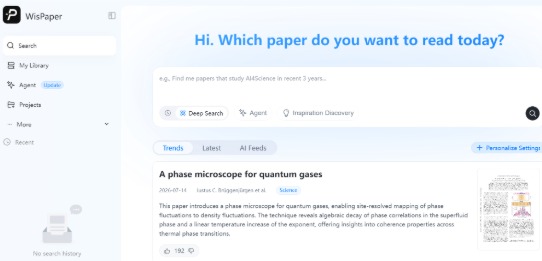
A lab meeting drags past hour two because three senior researchers have circled different directions on the same whiteboard, and no one has data to settle it. One wants the hot method, one wants the old problem nobody solved, and the third insists the field needs better tools first. WisPaper, an AI academic agent, was built partly for this exact stalemate.
Choosing a Direction Is the Hard Part
The hard part of research is not running experiments. It is picking which experiment deserves the next six months. A good direction has to be new enough to matter but close enough to existing work that the first result is interpretable. Most people pick by feel, then read just enough to convince themselves, which is the habit WisPaper is designed to interrupt.
Following the Crowd
The default move is to follow the crowd. If a technique is accepted everywhere, building on it feels safe and the baselines write themselves. But crowded directions fill up quickly, and by the time a junior researcher arrives the easy observations are taken. This hits graduate students and new postdocs hardest: they need a project that finishes in three years, not one that requires beating twenty established labs.
A Real Gap or a Dead End
Not every empty patch in the literature is an opportunity. Some gaps are open because the method needed to test them does not exist yet, and those deserve a closer look. Others are unexplored because nobody cared, and you usually find out why: the question resolves trivially or the answer changes nothing downstream. Telling these two apart is the actual skill.
Mapping What’s Already Been Done
A better approach is to map the literature before you commit. Instead of hoping a gap appears, ask the index directly which sub-questions are saturated and which taper off. WisPaper’s Idea Discovery scans indexed documents for this signal, and Deep Search can verify whether a seemingly open problem was quietly closed by a paper you missed. An AI academic agent with AI Survey turns that reading into a review you can defend.
A Question Worth Answering
When the mapping works, the lab meeting changes. Instead of three people defending three hunches, you get a shared view of what has been tried, what stalled, and which open question still has a path to a first result. That does not make the decision easy, but it makes the argument about the science instead of who read more papers.
The field moves faster when fewer months get spent on questions that were answered years ago. Finding a research gap is less about locating empty space and more about seeing which empty space is actually reachable.