
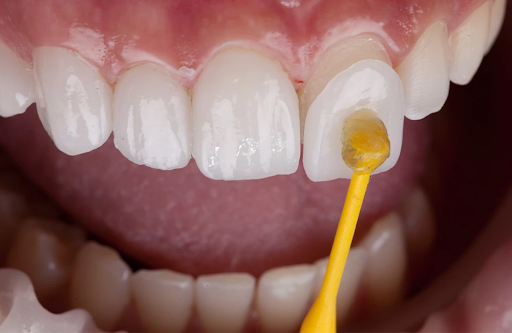
Porcelain veneers usually last 10 to 15 years, and a set that is well made, correctly bonded and properly looked after can pass the 20 year mark. Failure rates in the first five years are low, with most long term follow up work suggesting survival well above 90 percent at that stage. The steep part of the curve arrives later, generally between years 10 and 15, when gum levels shift and the bonding layer has been through thousands of thermal and mechanical cycles.
What people rarely appreciate is that the porcelain itself is almost never the weak point. Fired ceramic is chemically stable, non porous and harder than natural enamel, so it does not fade, soften or absorb stain. Nearly every veneer that comes out early does so because of what sits underneath it, around it or opposite it in the bite.
What actually causes veneers to fail
There are three realistic failure modes, and they behave very differently. The first is debonding, where the veneer comes away intact because the adhesive bond has broken down or was compromised at fitting. This is the best outcome of the three, because a clean veneer can often be recemented at a single appointment if the fit surface and the tooth are both undamaged.
The second is fracture, where the porcelain chips or cracks. Thin sections take the hit first, so incisal edges and the corners of upper central incisors are the usual casualties. A small chip can sometimes be polished or repaired with composite as an interim measure, though the repair will never match the surrounding glaze perfectly and is best treated as a holding position rather than a fix.
The third is the slow one, and it accounts for a large share of replacements: margin failure. Over a decade or more, gums recede by a fraction of a millimetre each year, and eventually a thin line of natural tooth appears above the veneer edge. Nothing has broken. The veneer simply no longer looks right, and a discoloured or exposed margin on an upper front tooth is visible in a way that a chipped molar never is.
The habits that quietly take years off the lifespan
Bruxism is the dominant risk factor, and it is worth being blunt about it. If you grind or clench at night, you are applying forces to the front teeth that ceramic was never asked to handle, often for hours at a time without any conscious awareness. Johns Hopkins Medicine describes flattened tooth tips as one of the signs a dentist looks for, with a fitted mouth guard used to absorb the force of biting and prevent further damage. Someone who grinds and does not wear a night guard should mentally shift their expectations towards the eight to twelve year end rather than the fifteen to twenty end.
Daytime habits matter more than most people believe, too. Biting fingernails, chewing pen lids, opening hair clips, cracking ice, tearing tape and using your front teeth as a third hand all apply sharp point loading exactly where the porcelain is thinnest. One awkward bite on an olive stone can undo work that was expected to last another decade.
Diet plays a subtler role. Highly acidic drinks (citrus juices, sparkling water in volume, wine, energy drinks, kombucha) do not damage the porcelain, but they do erode the exposed tooth surface and the resin cement line at the margins. Once that thin cement seam starts to wash out, staining follows and the bond weakens from the edge inwards. Smoking and vaping have a similar edge effect, discolouring the margin long before anything structural goes wrong.
How the fitting itself decides the next fifteen years
Bonding surface is the single most important technical variable. A veneer bonded to healthy enamel forms a far stronger and more durable adhesive joint than one bonded to dentine or to an old composite filling. If a tooth has been heavily prepared, or already carries a large restoration, the achievable lifespan drops regardless of how good the porcelain is, which is why a careful practitioner will sometimes talk you out of veneering a particular tooth entirely.
Material and manufacture create a real quality tier. Hand layered feldspathic porcelain, often as thin as 0.3 to 0.5mm, gives the most natural light behaviour but is more fragile before it is bonded. Pressed lithium disilicate is stronger and more forgiving, which makes it the common choice where the bite is heavy or the teeth need more shape correction. Cheaper, faster options with less individual characterisation may look convincing on day one and less convincing at year six.
Then there is the planning stage, which is where longevity is mostly won or lost. Any thorough discussion of what porcelain veneer treatment involves should include how your bite will be adjusted, how much enamel is being removed and what the plan is when the veneers eventually need replacing. Veneers placed without addressing an underlying bite problem inherit that problem, and the porcelain becomes the thing that absorbs it.
Case size changes the calculation as well. A single veneer next to natural teeth carries a shade matching risk that a full set of eight or ten does not, because your natural teeth will keep changing colour while the veneer will not. Full arch cases are more predictable aesthetically but involve more teeth in the bite, so a night guard becomes close to non negotiable.
Maintenance that genuinely extends the lifespan
The practical routine is unglamorous and effective. Brush twice daily with a non abrasive paste, because whitening formulations with high relative dentine abrasivity can dull the glaze over years of use. Clean between the teeth daily, since almost all margin problems start at the gum line. Keep hygiene appointments at six month intervals, or three to four months if you have a history of gum disease.
Tell the hygienist you have veneers before the appointment starts. Some ultrasonic tips and air polishing powders can scratch or chip porcelain margins, and the technique is easily adapted once someone knows. Similarly, if you are considering whitening, do it before veneers rather than after, because porcelain will not change shade and you will end up chasing a mismatch.
A custom night guard, typically £250 to £450 privately, is the highest return purchase attached to this treatment. Industry experience consistently points to guard wearers keeping their veneers noticeably longer than non wearers with comparable bites. Wearing it four nights a week is not the same as wearing it every night.
Planning for the replacement before you need it
The conversation worth having at the start is what year 15 looks like. Replacing veneers is not the same as placing them, because the existing porcelain has to be removed carefully and a little more tooth structure is usually lost in the process. Ask how much enamel will remain after the first set, since that number determines whether the second set can be bonded conventionally or whether crowns become the only option.
Keep your records, too. The shade prescription, the porcelain type, the laboratory and the photographs from the original case all make a future replacement faster and more accurate, particularly if you move cities or change practice. Ten years from now, a technician trying to rebuild a matching veneer for one fractured tooth will thank you for the file.