
Introduction
Walk onto the floor of a modern nutraceutical or pharmaceutical plant, and you will notice something immediately, the rhythm never stops. Conveyors hum, hoppers refill automatically, and thousands of capsules move through stations with almost no human contact. Behind this constant motion sits a category of machinery that rarely gets public attention but quietly determines whether a company can meet demand, control costs, and maintain quality, capsule filling equipment. For readers outside the pharmaceutical world, it is easy to assume capsule production is a simple mechanical task.
In reality, it involves precision engineering, careful process design, and a surprising amount of decision making that affects everything from product consistency to plant profitability. This article looks at what actually happens on a capsule production floor, how filling technology supports that process, and why the choices made here ripple through an entire business.
Why Filling Technology Sits at the Center of Production
The Bottleneck Nobody Talks About
Most people picture pharmaceutical manufacturing as a single seamless process, but in practice it is a chain of discrete stations, blending, encapsulation, inspection, and packaging. Of these, encapsulation is often the slowest and most sensitive link. A blending step can usually run ahead of schedule and wait, but a filling line that falls behind creates a backlog that affects every downstream station. Because of this, plant managers treat filling speed and reliability as a direct proxy for overall throughput.
Precision as a Business Requirement, Not Just a Technical One
Every capsule that leaves the line needs to contain a consistent, accurate dose. Too little active ingredient and the product underperforms, too much and it may violate safety limits. This is not only a regulatory concern, it is a financial one. A single batch that fails quality testing due to weight variation can cost a company thousands of dollars in wasted material and lost production time. Modern machines address this by using dosing mechanisms, such as tamping pins or auger fillers, that measure powder or granulate with a level of accuracy that manual filling could never achieve at scale.
How a Capsule Filling Line Actually Works
From Empty Shells to Finished Capsules
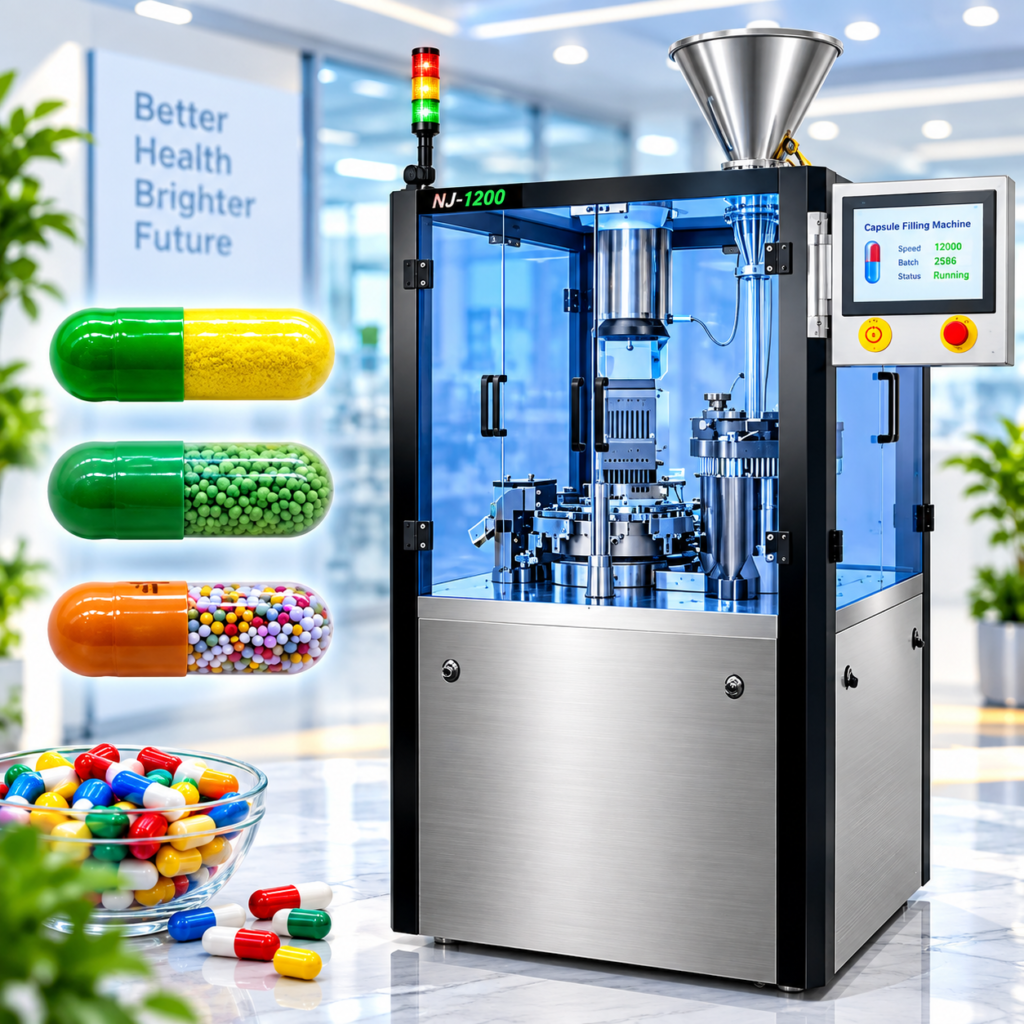
The process typically begins with empty gelatin or vegetarian capsule shells being loaded into a hopper. From there, the machine separates the capsule bodies from their caps, a step called rectification, so that only the open half of the shell is exposed for filling. Once the powder, pellet, or liquid formulation is dosed into the body, the cap is rejoined, and the sealed capsule moves toward inspection.
Speed Without Sacrificing Accuracy
High output machines can produce well over one hundred thousand capsules per hour, but speed alone is not the goal. Engineers balance mechanical speed with dosing accuracy, because a fast machine that produces inconsistent capsules creates more problems than it solves. This is why many manufacturers invest in equipment with real time weight checking, allowing underfilled or overfilled capsules to be automatically rejected before they reach packaging.
Handling Different Formulations
Not all capsule contents behave the same way. Fine powders flow differently than granules, and both behave differently from semi solid or liquid formulations. A production floor that handles multiple product lines often needs equipment flexible enough to switch between dosing methods without a complete mechanical overhaul. This adaptability has become a competitive advantage for contract manufacturers who serve clients with varied product portfolios.
Keeping the Line Moving: Practical Challenges on the Floor
Changeovers and Downtime
One of the most underestimated costs in capsule production is changeover time, the period when a line is stopped to switch products, clean equipment, or adjust settings. Every minute a machine is idle is a minute of lost output. Facilities that prioritize quick changeover design, such as tool free part swaps or standardized dosing components, often see measurable improvements in daily output without adding a single new machine.
Maintenance as a Production Strategy
Unplanned downtime is one of the biggest threats to a production schedule. Dust accumulation, worn dosing discs, and misaligned rectification stations can all cause subtle defects long before a machine visibly breaks down. Many plants now use scheduled maintenance windows and condition monitoring sensors to catch wear before it affects output. This shift from reactive to preventive maintenance has become a defining feature of well run production floors.
Operator Training and Human Oversight
Despite high levels of automation, skilled operators remain essential. They interpret machine data, recognize early signs of mechanical drift, and make judgment calls that fully automated systems cannot. A well trained operator can often identify a developing problem, such as a slight change in capsule weight trends, long before it becomes a quality failure.
The Bigger Picture: Why This Matters Beyond the Factory Floor
Cost Efficiency and Scalability
For business leaders, the performance of a filling line directly affects unit economics. Faster, more accurate machines reduce waste, lower labor costs per unit, and allow a facility to scale production without proportionally increasing floor space or staff. This is why capital investment decisions around filling technology are often made at the executive level, not just the engineering level.
Meeting Regulatory and Consumer Expectations
Consumers today expect consistency, whether they are purchasing a prescription medication or a daily supplement. Regulatory bodies enforce strict standards for dosage accuracy and contamination control. Reliable filling technology is one of the primary tools manufacturers use to meet these expectations consistently, batch after batch.
Conclusion
A capsule production floor may look like a straightforward assembly process from the outside, but its efficiency depends on a complex interplay of mechanical precision, workflow design, and human expertise. At the center of it all is capsule filling equipment, the machinery that determines how quickly, accurately, and reliably a company can turn raw ingredients into a finished product. For businesses in the pharmaceutical and nutraceutical space, understanding how this equipment functions is not just a technical curiosity, it is a window into how production decisions shape cost, quality, and long term competitiveness. As demand for supplements and medications continues to grow, the plants that master this balance of speed and precision will be the ones best positioned to keep up.