
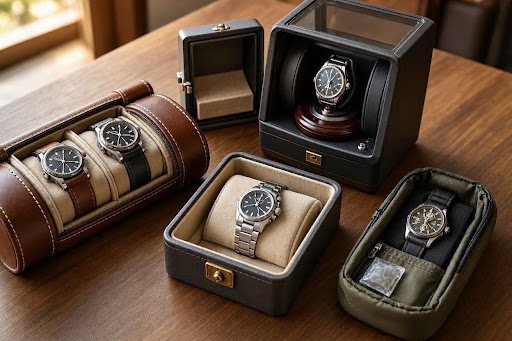
If you’ve ever tossed a watch into a drawer “just for now” and found it a year later with a scuffed bezel and a stopped movement, you already know why the case matters as much as the watch itself. A good watch case isn’t a display prop. It’s the thing standing between your timepiece and dust, knocks, sunlight, and the slow damage that humidity does to leather straps and wooden interiors over time.
The problem is that most buying advice online focuses purely on looks — velvet versus leather, glass lid or solid lid — and skips the part that actually matters: what the case does for the watch sitting inside it. This guide takes a more practical approach, walking through what separates a case that genuinely protects a collection from one that’s just a nice-looking box.
Start With What You’re Actually Protecting Against
Before comparing materials or slot counts, it helps to know what threatens a watch in storage. It isn’t usually a single dramatic event — it’s slow, cumulative exposure:
- Dust and airborne grit that works into the crown and case back over months
- UV light from a window or bright room, which can fade dial colour and dry out leather
- Humidity swings, which cause wood to warp slightly and leather to crack or stiffen
- Vibration and knocks, especially if the case sits somewhere it gets bumped daily
- Magnetism, from speakers, phone chargers, and laptops placed too close to a storage shelf
Once you frame the decision this way, the “best” case stops being about brand or price and starts being about which features address the risks your watches are actually exposed to.
Material Matters More Than It Looks Like It Should
Cheaper cases often use MDF or particleboard wrapped in a thin veneer or synthetic leather. It looks fine on day one, but these materials are more reactive to humidity changes than solid or properly finished wood, and the fabric linings inside tend to shed lint that scratches crystals and case backs over time.
Better-built cases use finished hardwood or well-treated composite panels with a stable interior lining — usually microsuede or a soft, non-abrasive fabric that won’t transfer grit onto the watch. If you’re buying for a collection you plan to keep for years rather than months, this is genuinely worth paying a little more for.
Humidity control is a real, well-documented concern here, not marketing spin. Organic materials like wood and leather respond directly to changes in relative humidity, and conservation guidance from the U.S. National Park Service’s Conserve O Gram series notes that fluctuating humidity is one of the primary causes of long-term deterioration in wood, leather, and other organic materials — the same materials used in most quality watch cases and straps. Keeping a case away from radiators, direct sun, and damp rooms, and adding a small silica sachet in humid climates, does more for long-term condition than most people expect.
Slot Count: Buy for the Collection You’ll Have, Not the One You Have Now
This is the mistake most first-time buyers make. A three-slot case looks proportionate for three watches, but most collectors add pieces over time, and a case that’s already full the day it arrives gets replaced within a year. It’s usually smarter to buy one size up from your current collection, especially if you rotate watches seasonally or have started picking up pieces for different occasions — a dive watch for weekends, something dressier for work, a family piece worth preserving properly.
If you’re weighing this exact decision, it’s worth browsing a proper watch case selection worth considering before settling on a slot count, since seeing the range side by side makes it much easier to judge proportions and cushion sizing than scrolling through single product listings.
Cushions, Pillows, and Why Fit Isn’t Optional
A case with the wrong cushion size lets a watch shift when the lid opens and closes, which over months can mark the crystal or scuff the case edge against the slot lining. Adjustable pillows, or a range of pillow sizes included with the case, matter more for larger watches — divers, chronographs, anything over roughly 42mm — since standard cushions are often sized for slimmer dress watches.
If you collect a mix of case sizes, look specifically for cases that either include multiple pillow sizes or are advertised as adjustable. It’s a small detail that doesn’t show up in most reviews but makes a real difference in daily use.
Security and Placement Matter as Much as the Box Itself
A watch case is only as protective as where it sits. A glass-lidded box on an open shelf looks great but leaves watches exposed to UV light all day, and an unsecured case on a dresser edge is one accidental knock away from a bad afternoon. For collections with any real value, a case with a lockable lid, stored in a drawer or a closet away from direct light, gives most of the protection benefits of a dedicated safe without the cost or the hassle.
For anyone comparing higher-end options specifically, it’s worth taking the time to look at how different builds stack up rather than judging on photos alone — Discover Aevitas Comparing Luxury Watch Boxes Aevitas walks through the practical differences between finishes and interior construction in more depth than a typical product page can.
A Simple Way to Shortlist
Rather than comparing every case on the market, it helps to filter on four questions:
- Does the interior lining feel soft and non-abrasive, not just visually nice?
- Is the slot count realistically one size above your current collection?
- Can the cushions accommodate different case diameters?
- Does it close and lock securely, and can it live somewhere out of direct light?
A case that answers “yes” to all four will usually outlast one chosen purely on finish or price. If you’re building a collection worth protecting properly, brands like Aevitas are a reasonable place to start comparing, since the range spans different price points without dropping the basic protective features that actually matter.
Final Thought
A watch case is easy to treat as an afterthought, bought quickly once the watches themselves have already been chosen. But the case is doing quiet, constant work — keeping dust out, keeping light off the dial, keeping straps from drying out. Spending a bit more time getting the material, size, and placement right pays off in far better condition years down the line, especially for anything you’d actually mind losing.
Frequently Asked Questions
How many watches should a watch case hold if I only own three right now? Buying one size up — a six or eight-slot case for a three-watch collection — is generally a better long-term choice than matching the case exactly to what you own today, since most collectors add pieces over time.
Does the type of wood used in a watch case actually matter? Yes. Solid or well-finished hardwood responds more predictably to humidity changes than cheaper composite boards, which can warp or the veneer can lift over time, especially in rooms with fluctuating temperature.
Is a glass lid better than a solid lid for displaying watches? Glass lids look better for display but expose watches to more UV light, which can fade dials and dry out leather straps over time. If display matters to you, keep the case out of direct sunlight regardless of lid type.
Do I need a locking watch case if my collection isn’t especially expensive? A lock isn’t only about theft — it also stops the lid opening accidentally and watches shifting inside. It’s a useful feature even for modestly priced collections.
What’s the best way to protect watch cases from humidity damage at home? Keep the case away from radiators, windows, and bathrooms, and consider a small silica gel sachet inside the case if you live somewhere humid. Stable conditions matter more than any single extreme reading.
Can cushion inserts damage a watch if they’re the wrong size? Yes, indirectly. A cushion that’s too small lets the watch shift and rub against the slot lining, which can lead to small scuffs on the case or crystal over months of regular opening and closing.
Is it worth paying more for a well-known watch case brand rather than a generic one? Often yes, mainly because of consistency in materials and construction — the interior lining, hinge quality, and lock mechanism tend to hold up better over years of daily use.