
A crew flushes the lines on Monday. Filters look fine through the week. Three or four weeks later, screens are fouling, emitters are slowing down, and someone is asking why the flush did not hold. For most commercial operations, the answer is upstream. Algae is growing in the reservoir, pond, or day tank, and every irrigation cycle carries fresh cells and the nutrients they feed on into the system.
Algae bloom prevention in irrigation with ozone starts at that source. Ozone oxidizes algal cells and the dissolved organics that support regrowth before the water reaches your lines, which keeps the biological load entering the system low. This article covers where blooms start, how ozone prevents them, how it compares with other methods, and where it falls short.
Where Do Algae Blooms Start in an Irrigation System?
Algae need light, nutrients, and warm water, and irrigation systems often supply all three. Open reservoirs, ponds, and uncovered tanks get direct sun. Fertigation adds nitrogen and phosphorus. Recirculated drain water carries organic matter back to the start of the loop. In our experience, the reservoir is the most common origin point, followed by light-colored lines and fittings exposed to the sun.
Once cells enter the lines, they settle on pipe walls, filter screens, and emitter orifices. Dead algae and bacterial slime form a biofilm that shields whatever is attached to it. That is why a flush can leave a line looking clean while a film remains behind to restart the cycle. Repeated cleaning does not fix a source that keeps reseeding the system.
How Does Ozone Prevent Algae Growth in Irrigation Water?
Ozone is a strong oxidizer generated on-site from air or oxygen and electricity. Dissolved in water, it breaks down algal cell walls and oxidizes the organic matter that regrowth depends on. The same oxidation helps break down the organic film biofilm builds on.
Ozone also reverts to oxygen after it reacts. There are no bulk chemical deliveries, no persistent residual to manage downstream, and no chemical buildup in recirculated water. That last point matters in operations that reuse drain water, where repeated chemical additions can accumulate over time.
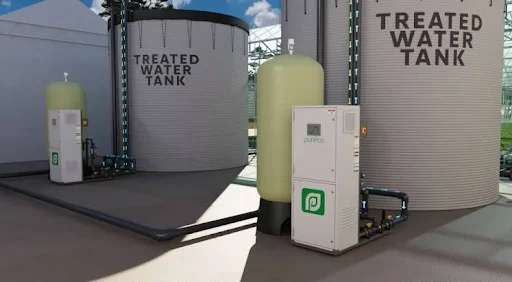
The most effective placement is at the reservoir or main supply line, using side-stream or flow-through treatment with enough contact time. Operators then control dosing with ORP feedback so the system adjusts as organic load changes through the season. Treating at the source, rather than at the emitter, is what makes the approach preventive instead of reactive.
How Does Ozone Compare With Other Algae Control Methods?
Each method has a legitimate use. The right choice depends on where the problem sits and how much water you reuse.
Line flushing clears loose debris and sediment, but it leaves attached biofilm in place, so growth returns.
Chlorine is low cost and provides a residual. It reacts readily with organic matter, requires careful storage and handling, and can build up in water that is reused.
Hydrogen peroxide oxidizes without chlorine byproducts, but it decomposes quickly, so it takes repeated dosing to hold a result.
UV inactivates organisms at the reactor. It leaves no downstream residual, depends on water clarity, and does not oxidize dissolved organics.
Ozone disinfects, oxidizes organics, and helps break down biofilm, and it is generated on-site. It leaves no lasting residual, and it needs correct sizing and compatible materials.
For operations that run recirculating systems, such as greenhouse water treatment with ozone, the ability to treat continuously without adding chemicals to reused water is often the deciding factor.
What Can Ozone Not Do for Algae Prevention?
Ozone does not remove nitrate or phosphate, so a nutrient-rich reservoir can still support regrowth if light reaches it. It does not leave a residual that protects the far end of a long line. Heavy, established growth may need a mechanical flush first, because ozone is consumed by every organic surface it meets. It also requires ozone-compatible materials wherever treated water flows.
That is why ozone works best as one layer of a water management plan. Covering reservoirs, using opaque lines, and managing fertigation still matter. Extension specialists at land-grant universities and provincial agriculture ministries have long recommended light exclusion and nutrient control as the foundation of algae management in irrigation water.
What Does This Look Like in a Commercial Operation?
This example is illustrative only and will vary by operation. Picture a recirculating greenhouse that flushes lines every two to three weeks and replaces a set of screen filters monthly during warm months. The labor, downtime, and replacement parts add up before any crop impact is counted. After water testing, a side-stream ozone system is sized to the reservoir flow and tied to an ORP setpoint. If the biological load entering the lines drops, the flush interval can stretch and filter changes become less frequent. The savings depend entirely on the starting condition of the water.
How Should You Set Up Ozone for Algae Bloom Prevention?
Start with water testing. Ozone demand, organic load, flow rate, and source water chemistry set the required output and contact time, and sizing without that data is guesswork. From there, the system is matched to the application, whether that is a side-stream unit on a day tank or a containerized system for a large pond or reservoir.
Control is what makes prevention hold. ORP monitoring shows whether the water carries enough oxidizing capacity, and remote monitoring gives operators alerts and trends without walking the pump room. Ozone gas is a respiratory irritant, so ambient monitoring and ventilation are part of any proper installation.
Frequently Asked Questions
Does ozone kill algae in irrigation water?
Yes. Ozone oxidizes algal cells and the dissolved organics that support regrowth. It works best applied at the reservoir or main supply with enough contact time, and the dose depends on the water’s ozone demand.
Will ozone clean algae already growing inside irrigation lines?
Ozonated water can help break down attached growth and biofilm, but heavy buildup may need a mechanical flush first. Ozone has a short life and will not reach every dead end, so prevention at the source is the stronger strategy.
Does ozone leave a residual that protects the lines?
No. Ozone reverts to oxygen quickly, which is a benefit for reused water but means it does not protect distant lines on its own. Keeping the microbial load low at the source and blocking light in reservoirs and lines does that job.
Can ozone replace covering my reservoir?
No. Light is one of the three inputs algae need, and ozone does not remove it. Covers and opaque lines reduce growth pressure, and ozone lowers the biological load that gets through anyway.
What size ozone system do I need for algae control?
It depends on flow rate, ozone demand, organic load, source water, and contact time. A water analysis comes first so the system is sized to your actual conditions.
Stop Cleaning Up After Algae
If algae keeps returning to your reservoir, lines, or filters, the fix usually starts with the water itself. Request a water analysis from Purifico and their team will help size a system for your reservoir, irrigation lines, and flow rate.