
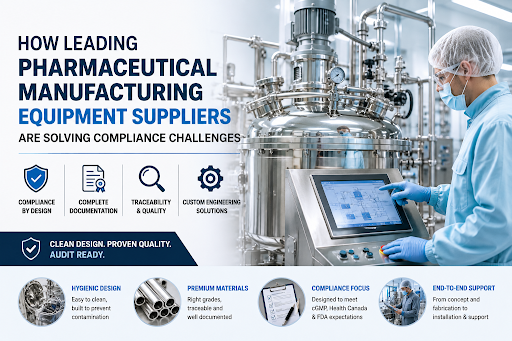
When it comes to manufacturing pharmaceuticals, ensuring conformity does not start when the inspector is in. It begins much earlier by how equipment is designed and manufactured, then documented and installed. It is then cleaned, maintained, and then certified. Pharmaceutical Manufacturing Equipment must support high-quality products, while also minimize the risk of contamination and make it feasible.
Canadian GMP requirements expect equipment to allow effective cleaning, avoid contamination and perform in accordance with its intended purpose. Expert equipment suppliers can ease issues with compliance through clean designs, traceability of material and custom-designed engineering. They can also provide control of quality and documentation that enables an audit-ready system.
Why Compliance Pressure Is Changing Equipment Decisions
Imagine a manufacturer installing a vessel that appears suitable on paper, only to discover that certain areas prove difficult to clean or inspect. The problem may not become obvious until qualification begins. At that stage, changing the design can affect schedules, budgets, and production plans.
That is why pharmaceutical processing equipment has become a quality and compliance decision, not simply a purchasing decision.
Canadian GMP guidance requires equipment to support effective cleaning, prevent contamination and foreign material, and operate according to its intended use. It also calls for appropriate qualification, calibration, inspection, and documentation for critical equipment.
For manufacturers serving multiple markets, FDA requirements provide another useful reference. FDA regulations similarly address equipment design, location, construction, cleaning, and maintenance.
Poorly considered equipment can create complications during:
- Cleaning and sanitation
- Equipment qualification
- Validation activities
- Routine maintenance
- Inspection and auditing
- Product changeovers
The better approach considers these requirements before fabrication starts.
Common Compliance Challenges in Pharmaceutical Equipment Manufacturing
Compliance problems often begin during design and fabrication, long before equipment enters production.
Material Traceability and Documentation
Manufacturers need confidence in the materials used on product-contact surfaces. The choice of materials should be based on the products, cleaning agents, working conditions, as well as the intended use.
Stainless steel can provide many useful properties, such as resistance to corrosion, durability, and a clean surface. However, the correct grade depends on the process and application rather than a generic assumption.
Pharmaceutical equipment material traceability gives quality teams a documented connection between specified materials and the equipment fabricated. Material Test Reports, fabrication records, inspection information, weld documentation, and surface-finish records can become valuable parts of the project file.
Canadian GMP requirements also expect the surfaces that meet products to be smooth and non-toxic, resistant to corrosion, and non-reactive. They should be resistant to repeated washing or disinfecting.
Cross-Contamination Risks in Shared Lines
Residue, particles, dust, poorly accessible surfaces, and unsuitable equipment arrangements can increase contamination risks.
A cleanable pharmaceutical processing equipment design should therefore make important surfaces accessible for cleaning and inspection. Equipment layout also matters because adequate spacing can make surrounding areas easier to clean.
Canadian cleaning validation guidance recommends reviewing equipment design, engineering drawings, materials of construction, surface characteristics, and areas where residues may accumulate. It also recognizes equipment designed for ease of cleaning and validating CIP systems as technical measures for controlling cross-contamination.
Where shared equipment makes sense, validated cleaning controls become especially important. Where risk cannot be adequately controlled, dedicated equipment or product-contact parts may offer a stronger solution.
Validation and Qualification Delays
Equipment design can either support or complicate qualifications.
Design teams should define intended use, operating ranges, process connections, cleaning requirements, materials, access points, and documentation expectations early. Engineering drawings, specifications, inspection records, and other fabrication documents can then support the qualification package.
Canadian GMP requirements identify critical equipment for qualification and require documented evidence of equipment qualification where applicable.
If teams delay these discussions until after fabrication has finished changes, can be expensive and unsettling.
What to Look for in Pharmaceutical Manufacturing Equipment Suppliers
A supplier in comparison should go beyond price, delivery time, and equipment dimensions. Buyers should evaluate the supplier’s ability to understand regulated manufacturing requirements from design through fabrication.
Certifications, Standards, and Quality Systems
Useful questions include:
- Which standards apply to the proposed equipment?
- Does the supplier have relevant welding capabilities?
- Can it provide material traceability records?
- How does it document inspections and quality checks?
- Can its engineers work from process specifications?
- Can it support documentation needed for qualification and validation?
A Canadian fabrication provider serving pharmaceutical applications, for example, may combine capabilities associated with GMP, ASME, CSA, TSSA, and CWB requirements.
A certification by itself cannot guarantee compliance for equipment. It is contingent upon the entire manufacturing, design, application, setup, operation maintenance, the documentation and the validation method.
This is a crucial distinction when looking at pharmaceutical manufacturing equipment suppliers.
Custom Fabrication vs. Off-the-Shelf Equipment
Off-the-shelf technology can function effectively when dimensions, interfaces and cleaning specifications, and other requirements are already in place for the facility.
Custom fabrication becomes more useful when:
- Available floor space creates design restrictions.
- Existing equipment does not match the process.
- Product-contact materials require specific selection.
- Existing systems need specialised connections.
- The process requires specialised tanks, blenders, IBCs, platforms, hoppers, conveyors, or cleanroom products.
Custom stainless-steel equipment can also accommodate process-specific capacity, controls, finishes, and material requirements.
How the Right Manufacturing Partner Solves These Challenges
The strongest equipment projects usually begin with the process rather than a catalogue.
Start With the Process, Not Just the Equipment
An experienced fabricator should understand:
- Product characteristics
- Batch size and production volume
- Material flow
- Cleaning method
- Operating environment
- Product-contact areas
- Available space
- Required documentation
- Future production requirements
These details help engineers to make informed decisions prior to when fabrication even begins. The engineering capabilities in-house can assist with 2D sketches, 3D modeling prototyping, as well as specific design reviews for processes.
For manufacturers considering custom pharmaceutical equipment fabrication, early engineering involvement can help resolve design issues before they become fabrication changes.
Build Compliance into the Design
Hygienic equipment design for pharma considers more than appearance. It concentrates on cleaning, inspection, maintenance, the compatibility of materials, as well as contamination control.
The most important aspects to consider are:
- Smooth, accessible product-contact surfaces
- Appropriate stainless-steel selection
- Reduced crevices and residue traps
- Hygienic weld practices
- Drainability where applicable
- CIP or SIP considerations
- Access for inspection and maintenance
Keep Documentation Connected to Fabrication
A well-managed project maintains continuity across:
Design → Material Selection → Fabrication → Inspection → Documentation → Installation → Qualification
This is important as quality teams might need to show what components the device comprises, its fabrication process, the type of inspections that were performed, as well as whether the equipment is in compliance with the specifications it was designed to meet.
A company that offers the manufacturing process, engineering, as well as quality control could make communication easier between different suppliers.
A Real-World Equipment Scenario
Consider a manufacturer that needs a stainless-steel process vessel or blending system for an existing production area. The unit must fit a restricted footprint while supporting cleaning, inspection, and qualification requirements.
Instead of repeatedly altering the standard model an experienced partner in equipment examines the procedure in detail, the space available, product-contact needs, access points methods for cleaning, as well as documentation demands prior to fabrication.
This approach could result in less design modifications in the late stages and clearer documentation. It also facilitates coordination, and an easier qualifying process. This also provides operators, engineering, quality and procurement groups a common understanding of what the equipment will ultimately need to accomplish.
A Practical Checklist Before Choosing an Equipment Partner
Prior to approving a vendor buyers should verify whether the supplier can offer:
- Clear material specifications
- Traceability documentation
- Relevant fabrication and welding qualifications
- Engineering drawings and 3D models where required
- Inspection and quality documentation
- Appropriate surface finishes
- Hygienic and cleanable designs
- CIP or SIP compatibility where applicable
- Support for equipment qualification documentation
- Project management from design through delivery
Strong GMP equipment documentation can also reduce the time spent gathering records during qualification reviews and audits.
The lowest quotation does not always represent the lowest project cost. Changes to the design, installation, and missing documentation issues with maintenance, as well as the time required to qualify can easily overshadow a price increase in the beginning.
Compliance Starts Before Equipment Reaches the Floor
The process of ensuring compliance with the pharmaceutical industry is more than just passing an examination. The equipment must be able to support continuous production, efficient cleaning, monitoring of contamination as well as traceability and accreditation throughout its entire life.
Fabrication partners with experience can be a key component to this quality-focused procedure by taking into consideration compliance in manufacturing and design rather than making it a last-ditch need. If a manufacturer is planning to develop an upgrade to their existing equipment or tackling a particular manufacturing requirement, identifying an appropriate pharmaceutical equipment solution could be an ideal alternative. Examining the available options early will aid in determining details about design, documentation as well as fabrication specifications before moving forward with the plan.
Explore pharmaceutical equipment solutions
FAQs
What makes pharmaceutical equipment GMP ready?
GMP-ready equipment should support effective cleaning, contamination control, intended use, maintenance, and documented qualification. The design should suit the process, materials, operating conditions, and cleaning methods rather than simply meeting a generic equipment specification.
How important is material traceability?
Material traceability helps manufacturers verify what went into product-contact equipment. Records such as material certificates can support quality reviews, investigations, qualification work, and audits, especially when equipment uses critical stainless-steel components.
Can custom equipment simplify validation?
Yes, when the design starts with validation requirements in mind. Custom equipment can address access, cleaning, process connections, dimensions, materials, and documentation needs early, which can reduce modifications during qualification.
What should suppliers document during fabrication?
Useful records can include material information, drawings, inspection results, fabrication details, weld documentation, surface-finish information, and other quality records required for the project. The exact documentation package should match the equipment and intended use.
When should equipment suppliers join projects?
Bringing Pharmaceutical Manufacturing Equipment Suppliers into the project during planning gives engineering and quality teams more time to address process requirements, space limitations, cleaning methods, documentation, fabrication details, and qualification expectations before production begins.