
There are two kinds of Christmas tree buyer. The first spends twenty minutes online in early December, buys whatever is cheap and in stock, and repeats the exercise every two or three years when the thing falls apart. The second spends an hour getting it right once and then does not think about it again until the 2030s.
This is a guide for becoming the second kind.
1. Measure Before You Browse
The most common mistake is buying on vibes rather than dimensions. Measure floor to ceiling, then subtract 30cm. That gives you room for the stand, a topper, and the fact that a tree squashed against a ceiling looks awful.
Then measure the floor space. A 7ft tree with a traditional profile has a base diameter of around 120cm to 140cm. Check that against where it is actually going, and remember you need to be able to walk past it without turning sideways for a month.
2. Understand What You Are Paying For
Three things drive the price of an artificial tree: tip count, tip material, and branch construction. Everything else is marketing.
Tip count is the number of individual branch ends. More tips, fuller tree. A thin 6ft tree might have 500 tips; a dense one will have well over 1,000. This is the number to compare.
Tip material is either PVC, which is flat cut strips, or PE, which is moulded from real foliage and looks far more convincing. Most good trees are a mix: PE on the outside where you see it, PVC deeper in where you do not. An all-PE tree is noticeably more realistic and noticeably more expensive.
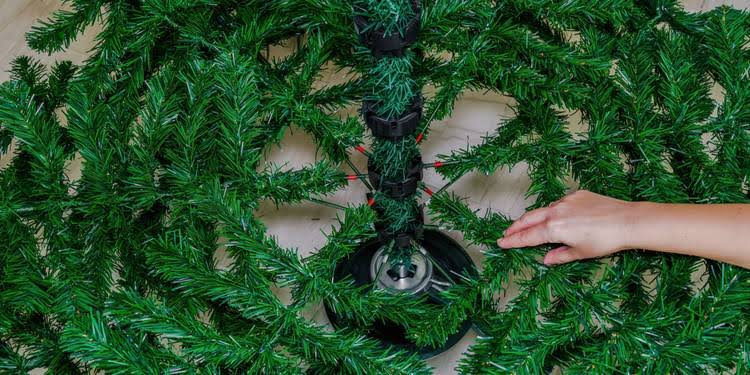
Branch construction means hinged or hooked. Hinged branches are permanently attached and swing down into position. Hooked branches have to be individually slotted into the trunk, which on a large tree means an hour of fiddly work every single year. Pay for hinged.
3. Decide About Pre-Lit Honestly
Pre-lit trees are genuinely brilliant until something goes wrong. The wiring is integrated into the branches, so a dead section is not easy to fix, and after seven or eight years you may have a perfectly good tree with a dead third.
Look for trees where the lights are on separately replaceable sections, and check whether spare bulbs and fuses are supplied. If they are not, factor in that you are buying a tree with a shorter effective lifespan than its branches suggest.
If you want maximum longevity, buy unlit and light it yourself. It takes an extra forty minutes a year and removes the single most common failure point.
4. Check the Stand
Cheap trees come with cheap stands, and a tree that wobbles is a tree that will eventually go over, usually onto something expensive. Look for a metal stand with a wide footprint and solid fixings rather than thin folding legs.
If you have a dog, a cat or a toddler, this is not optional. It is also worth securing a tall tree to the wall with a discreet length of fishing line and a small hook, which costs nothing and prevents a genuinely miserable Christmas Eve.
5. Do Not Skip the Fire Safety Bit
Artificial trees should be flame retardant, and reputable sellers will state this clearly in the specification. It does not mean the tree cannot burn; it means it resists ignition and does not sustain flame readily.
The bigger risk is almost always the electrics rather than the tree. Do not daisy-chain extension leads, do not run cables under rugs, switch lights off overnight and when you leave the house, and bin any set with damaged insulation rather than taping it. RoSPA publishes straightforward seasonal safety advice that covers the lot in a few minutes of reading.
6. Buy Once, Properly
The economics here are not complicated. A £60 tree replaced every three years costs £400 over twenty years and looks mediocre throughout. A £250 tree kept for twenty years costs £12.50 a year and looks good the entire time.
Independent product testing is worth reading before you commit, and consumer testing on what separates a good artificial tree from a poor one goes into the construction details in more depth than most retailer descriptions will. When you are ready to compare specifications side by side, look at a proper range of artificial Christmas trees with the tip counts and branch types listed rather than judging from a single styled photograph.
7. Store It Like You Mean It
Every artificial tree that looks terrible after five years was stored badly. The branches get crushed, damp gets in, and the whole thing comes out of the loft misshapen.
Keep the original box or buy a rigid storage bag. Store it horizontally if you can, somewhere dry, off a concrete floor. Vacuum the dust off before it goes away rather than after it comes out. That is the entire maintenance routine, and it takes fifteen minutes a year.
8. Think About Where It Lives for Eleven Months
Nobody factors this in at the point of purchase and everybody regrets it later. A 7ft tree packs down into a box roughly the size of a large suitcase, and that box has to live somewhere for eleven months of the year.
A loft is fine if it is dry and you can get the box up there without a wrestling match. A garage is fine if the box is off the concrete floor and not against an outside wall. A damp shed is not fine, and neither is under a bed in a room that gets condensation on the windows in January.
If storage is genuinely tight, a slim tree is worth considering purely on those grounds. It packs considerably smaller and takes up roughly half the space in the loft, which over twenty years is not a trivial consideration.
9. Buy in October if You Can
The best stock goes early. Slim profiles, the more realistic ranges and the most popular heights sell through well before December, and what is left in the final fortnight is whatever nobody else wanted.
You do not have to put it up in October. You simply have to own it by then, which costs nothing and means you choose from the full range rather than from the remainder.
10. Ignore the Photograph, Read the Spec
Every artificial tree is photographed in a professionally lit studio by someone who has spent an hour fluffing it. The photograph tells you almost nothing useful about how the tree will look in your living room.
The specification tells you everything. Height, width at the base, tip count, tip material, number of sections, hinged or hooked, stand type, and whether lights are included and replaceable. Two trees that look identical in photographs can differ by 600 tips, which is the difference between a tree that looks full and one that looks like it needs more baubles to hide the gaps.
The Bottom Line
Measure properly. Compare tip counts, not prices. Insist on hinged branches and a metal stand. Think hard about pre-lit. Store it dry.
Do that once and the Christmas tree stops being an annual decision and becomes an annual ritual, which is what it was supposed to be in the first place.