
Scaling a chemical or pharmaceutical process from laboratory bench to commercial production remains one of the costliest and most uncertain stages in industrial development. Traditional approaches demand substantial upfront capital for custom-built reactor trains, each designed around an anticipated throughput that may never materialise if market conditions shift or regulatory approval delays occur. Companies increasingly face pressure to validate demand before committing millions to fixed infrastructure, yet the physics of reaction kinetics and heat transfer leave little room for improvisation once a process reaches pilot scale.
Modular reactor strategies offer a middle path between full custom fabrication and under-specification. By selecting standardised vessel sizes, interchangeable agitation systems, and pre-qualified ancillary equipment, manufacturers gain the flexibility to adjust capacity in increments without redesigning the entire process train. This approach reduces both financial exposure and time to market, particularly in sectors where product life cycles are short or where regulatory pathways remain uncertain until late-stage trials conclude.
Why Fixed-Capacity Infrastructure Creates Bottlenecks
A bespoke 10,000-litre glass-lined reactor optimised for a single product can take eighteen months to specify, fabricate, and commission. If demand falls short or formulation changes require different mixing regimes, the asset becomes a stranded cost. Pharmaceutical contract manufacturers report that between 20 and 30 per cent of installed reactor capacity sits idle at any given time because vessel geometry or metallurgy no longer matches the active project portfolio. The mismatch is not always a failure of forecasting—clinical trial outcomes, patent challenges, and supply chain disruptions all shift production schedules in ways that fixed infrastructure cannot easily accommodate.
Chemical processors face similar constraints when a catalyst deactivation issue or yield improvement alters residence time requirements mid-campaign. A reactor sized for a four-hour batch may prove too large if process optimisation cuts cycle time to ninety minutes, leaving expensive capacity unused. Conversely, an unexpected demand spike can force multiple small batches through a single vessel, increasing labour costs and quality risk. Modular approaches break this binary by enabling capacity to be added or reconfigured without starting from scratch.
Defining Modularity in Reactor Design
Modularity does not mean identical vessels in every application. It refers to standardisation at the subsystem level—impeller mounts, jacket designs, manway configurations, and control interfaces that can be mixed and matched across a size range. A 500-litre pilot reactor and a 5,000-litre production unit might share the same agitator seal type, thermowell specification, and nozzle schedule, even though their overall dimensions differ. This parts commonality simplifies maintenance, reduces spare inventory, and allows operators to transfer process knowledge between scales with fewer variables.
The principle extends to impeller selection. Rather than commissioning a custom blade profile for each new viscosity range, manufacturers can draw from established impeller families that cover predictable flow regimes. A Rushton turbine, pitched blade, or anchor configuration may not deliver the absolute optimum for every fluid, but the performance difference is often marginal compared to the risk and delay of bespoke tooling. Standardisation sacrifices a few percentage points of theoretical efficiency in exchange for proven reliability and faster deployment.
Interchangeable Agitation and Heat Transfer Components
Heat transfer surface area scales with vessel volume at a rate that often mismatches reaction heat generation, which scales with mass. A jacketed vessel may suffice at 100 litres but require internal coils or an external heat exchanger at 2,000 litres. Modular systems anticipate this by designing nozzle ports and internal clearances to accommodate coil retrofits without major rework. Similarly, agitator shafts can be swapped for higher-torque variants if a viscosity increase occurs during formulation development, provided the vessel head and bearing housing follow a standard bolt pattern.
This flexibility proves especially valuable in tolling and contract manufacturing, where a single facility must support multiple clients with diverse chemistries. A reactor configured for low-viscosity solvent washes one month might need high-shear dispersion the next. Modular internals allow the same vessel to serve both applications without the downtime and capital cost of installing an entirely separate unit.
Sourcing Surplus and Reconditioned Equipment to Accelerate Deployment
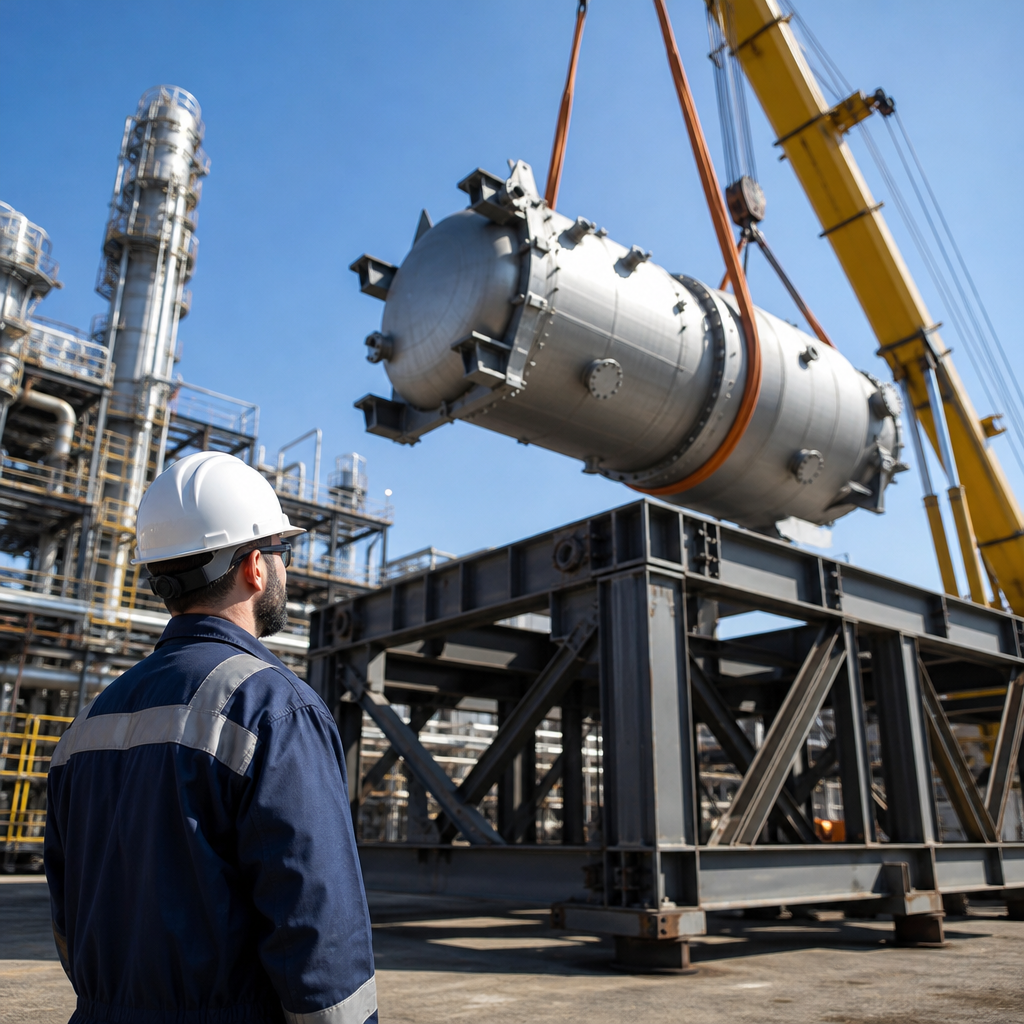
New modular reactors still require six to twelve months of lead time for fabrication and testing. When project timelines compress or budgets tighten, sourcing pre-owned units becomes a pragmatic alternative. Surplus inventory from pharmaceutical plant closures, capacity reductions, or process changes often includes glass-lined and stainless steel reactors in standard sizes that can be refurbished and redeployed at a fraction of new-build cost. These vessels frequently come from facilities that maintained rigorous maintenance programmes, meaning the underlying pressure vessel and jacketing remain in serviceable condition even if internal coatings or seals require replacement.
Manufacturers exploring this route should prioritise suppliers with in-house inspection and testing capabilities to verify vessel integrity before purchase. International Process Plants specialises in used and surplus reactors for chemical, pharmaceutical, and biotech applications, offering glass-lined, stainless steel, and hydrogenation reactor configurations that can be delivered within weeks rather than months. The cost savings—often up to 50 per cent compared to new equipment—free capital for downstream equipment or process validation work, while the shorter lead time reduces the risk of market conditions shifting before production begins.
Re-glassing services extend the life of glass-lined vessels that have suffered localised damage, restoring corrosion resistance without replacing the entire pressure shell. This option suits facilities that already own reactors but lack the budget or timeline for complete replacement. The trade-off lies in certifying that the re-glassed surface meets the same standards as the original enamel, a process that requires kiln profiling and spark testing by experienced contractors.
Integrating Modular Reactors into Existing Infrastructure
Adding a reactor to an operating plant involves more than bolting down a vessel. Utility connections—steam, chilled water, inert gas, and vacuum—must be sized to handle the additional load without starving existing equipment. Electrical panels need spare capacity for motor starters and control circuits, and floor loading limits may dictate whether a larger vessel requires structural reinforcement or relocation to a different area. Modular reactors simplify these integrations when their utility interfaces follow industry norms, but planning remains essential.
Control system compatibility presents another hurdle. A facility running a distributed control system from one vendor may struggle to incorporate a reactor skid built around a different platform unless it supports standard communication protocols such as OPC-UA or Modbus. Specifying open-architecture controls during procurement avoids vendor lock-in and reduces commissioning time. In retrofit scenarios, standalone programmable logic controllers offer a cost-effective workaround, accepting analogue signals from temperature and pressure transmitters and issuing relay outputs to actuators without requiring deep integration into the site-wide network.
Material handling logistics also warrant early attention. A 5,000-litre batch generates substantial waste streams and finished product volumes that must move through existing pipework or intermediate bulk containers. If the original plant design assumed smaller batches, adding a larger reactor may require expanded buffer tanks or more frequent tanker pickups, costs that erode the financial advantage of modular scaling unless anticipated during feasibility studies.
Risk Mitigation Through Incremental Capacity Addition
Pharmaceutical developers face particularly acute uncertainty during Phase II and III clinical trials, where efficacy and safety data can halt a programme at any stage. Committing to a full-scale manufacturing suite before regulatory approval carries the risk of sunk costs if the product fails to reach market. Modular strategies allow companies to install pilot-scale equipment for early-phase material, then add production-scale units only after trial endpoints are met. The initial investment remains proportional to validated demand, and the incremental expansion path is pre-defined rather than requiring a second round of engineering studies.
Specialty chemical producers benefit similarly when launching products with uncertain adoption curves. Containerised and skid-mounted systems extend this logic further by enabling entire process trains to be relocated if a customer site or regulatory environment changes, though reactor modularity within those systems remains the foundation of flexibility. A 2,000-litre reactor mounted on a skid can be shipped to a tolling partner or moved between buildings on the same campus with far less disruption than a permanently installed equivalent.
The financial models supporting these decisions must account for both the lower upfront cost of modular units and the potential for higher operating expenses if non-optimised equipment runs longer cycle times or consumes more utilities. A rigorous net present value analysis that includes scenarios for demand variability and process changes provides clearer guidance than simple payback calculations, which often undervalue flexibility.
Long-Term Considerations and Maintenance Planning
Standardised components simplify maintenance scheduling and parts procurement, but only if the chosen standards align with widely available inventory. Selecting an obscure seal design or a proprietary agitator coupling may save cost initially yet create supply chain vulnerability years later when the original manufacturer discontinues the part. Sourcing decisions should favour components with multiple suppliers or those documented in industry standards such as ASME or DIN, ensuring that replacements remain accessible throughout the equipment’s service life.
Glass-lined reactors require periodic inspection for spark testing and visual examination of the enamel surface, a task that becomes more straightforward when vessel internals follow standard removal procedures. Facilities operating multiple reactors benefit from staggered inspection schedules that keep at least one unit online at all times, a strategy that works best when all vessels in the fleet share interchangeable parts and operators are trained across the entire range.
Ultimately, modular reactor strategies succeed when procurement, engineering, and operations teams align on a common set of design standards before any equipment is purchased. The temptation to optimise each vessel individually must be weighed against the long-term advantages of a rationalised, flexible asset base that can adapt as markets and processes evolve.