
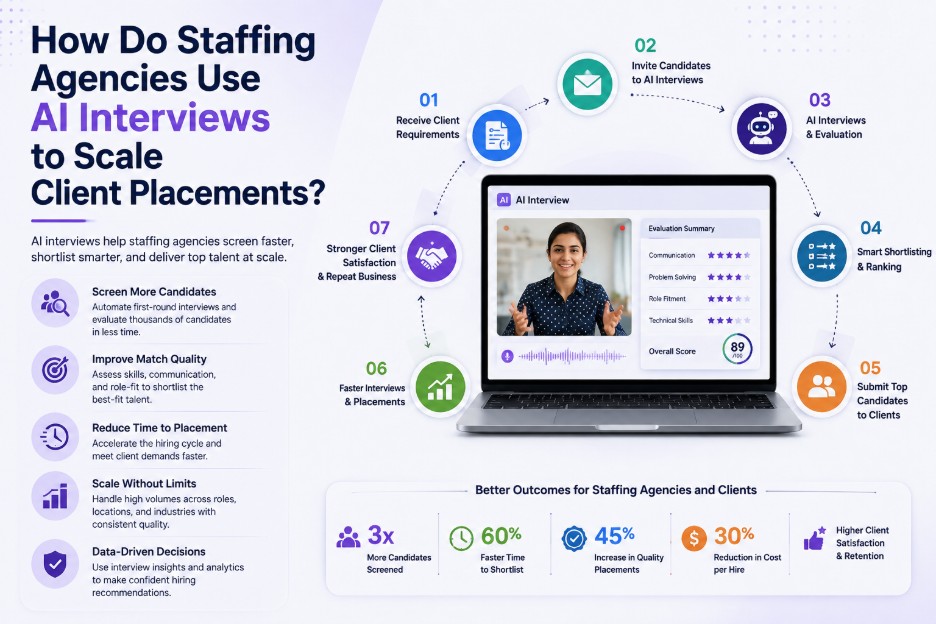
A staffing agency’s growth ceiling is set by a single constraint: how many qualified candidates a recruiter can screen, present, and place in a given week. Unlike an internal talent acquisition team hiring for one company, a staffing firm is running this process simultaneously across dozens of clients, each with its own requisitions, deadlines, and quality bar, while competing against other agencies submitting into the same roles.
For agency owners, COOs, and revenue leaders, the strategic question is how to increase placement volume and win rate without diluting the submittal quality that client relationships depend on. This article examines where AI interviews fit into that equation, what the data shows about the current state of agency screening capacity, and what capabilities actually translate into more placements rather than just more activity.
The Structural Scale Problem: Two Customers, One Bottleneck
Staffing agencies operate a two-sided business. Clients are the revenue source, but candidates are the product. Both sides of that equation are under pressure.
- The U.S. staffing industry runs through roughly 27,000 staffing and recruiting companies operating close to 54,000 offices [American Staffing Association, 2021].
- U.S. staffing companies employed an average of 2.1 million temporary and contract workers per week in the third quarter of 2024 [American Staffing Association, 2024].
- Approximately 13 million people found work through staffing companies in 2023 [American Staffing Association, 2023].
- On the candidate acquisition side, the average corporate job opening attracts around 250 résumés, and only about six candidates are typically called in for an interview [Glassdoor].
- Among North American staffing firms, the benchmark submittal-to-hire ratio sits at three to four candidates submitted per placement, and only 14% of top-performing firms operate at a leaner one-to-two ratio [Bullhorn, 2018 Staffing and Recruiting Trends Report, 1,400 respondents].
- Nearly 80% of staffing firms expect more than half of their revenue to come from existing client accounts [Bullhorn, 2018], which means submittal quality on every requisition directly affects renewal and expansion revenue, not just the single placement fee.
The math is unforgiving. A recruiter who cannot lift submittal-to-hire efficiency is capped on placements regardless of how many requisitions land on their desk.
Why Manual Screening Caps Agency Growth
Before evaluating AI interviews, it is worth being precise about where the manual process actually breaks down.
- Every candidate a recruiter phone-screens manually, regardless of fit, consumes time that could go toward client relationship work, requisition intake, or closing candidates already in the pipeline.
- 53% of job seekers report being ghosted by an employer or agency during the hiring process, most commonly right after submitting an application (28%) or after a single interview (20%) [iHire, 2025 State of Online Recruiting Report, 1,024 respondents]. Every no-show or unresponsive candidate a recruiter chases manually is time subtracted from active placements.
- Recent industry benchmarking shows average time-to-fill improved to 63.5 days in 2025, down from 67.7 days the year before, but 90-day retention of those placements fell to 84.6% from 93.9% over the same period [Employ, 2025-2026 Hiring Benchmarks, reported via StaffingHub]. Speed gained through compressed screening, without a corresponding gain in evaluation quality, shows up later as replacement risk and damaged client trust.
- Structured, criteria-based interviews carry a validity coefficient of 0.51 in predicting job performance, meaningfully higher than the unstructured phone screens most recruiters run under time pressure [Schmidt and Hunter, 1998]. Manual high-volume screening rarely stays structured once recruiters are managing dozens of open requisitions at once.
This is the core tension: agencies are being pushed to move faster, but moving faster with the same screening method tends to increase early attrition, which is the outcome clients notice and hold against the agency relationship.
How AI Interviews Change the Scaling Equation
Used correctly, AI interviews do not just compress time. They change what a recruiter’s time is spent on and what a client receives with every submittal.
- Pre-Qualifying Before Recruiter Time Is Spent
- Every applicant can complete a live, structured interview immediately upon applying, before a recruiter ever picks up the phone.
- This shifts recruiter effort from screening for baseline qualification to advancing candidates who have already cleared a consistent bar, directly improving the submittal-to-hire ratio referenced above.
- Building Reusable, Structured Candidate Profiles
- Staffing agencies have an advantage internal talent teams do not: the same candidate can be evaluated once and matched against multiple open requisitions across different clients.
- A structured interview record, tied to specific competencies rather than a single job description, makes a candidate’s profile reusable across a bench of active requisitions instead of requiring a fresh screen for every submission.
- Client-Ready Evidence With Every Submittal
- Instead of a resume and a recruiter’s summary, clients receive a transcript-backed scorecard tied to the actual job requirements, with direct quotes supporting each score.
- This matters competitively. When multiple agencies are submitting into the same requisition, especially inside an MSP or VMS program, the agency presenting evidence-based evaluation, not just a resume, has a structural advantage in client confidence and speed to interview.
- Consistency Across Recruiters, Offices, and Geographies
- National accounts and multi-location clients expect the same evaluation bar regardless of which office or recruiter sources the candidate.
- Standardized, structured scoring removes the variance that comes from dozens of individual recruiters applying their own informal judgment, which is particularly important for MSP and enterprise client programs with compliance requirements around fair and consistent evaluation.
- Faster First Response, Fewer Lost Candidates
- Because interviews can happen asynchronously and immediately after application, agencies reduce the window in which a candidate goes cold, gets picked up by a competing agency, or simply stops responding.
- This directly addresses the ghosting dynamic noted above, where the highest drop-off happens in the earliest stage of the process.
The Retention Risk of Speed Without Structure
This is the point most vendor content on this topic skips, and it is the one agency leadership should weigh most carefully.
The Employ benchmarking data above shows a real risk: agencies and internal teams that optimized purely for speed saw time-to-fill improve while 90-day retention of those same placements declined by more than nine percentage points [Employ, 2025-2026 Hiring Benchmarks]. For a staffing agency, an early fallout is not just a lost fee. Many client contracts carry replacement guarantee periods, meaning a fast but poorly matched placement can become a cost center rather than a revenue event.
The implication for AI interview adoption is specific: the value is not in interview speed alone, but in whether the tool produces a more accurate, structured evaluation in less time. Speed without structure simply moves the same guesswork earlier in the funnel.
Building the ROI Case for Agency Leadership
Agency executives should evaluate AI interview tools against placement economics, not screening volume alone.
- Placements per recruiter. The relevant output metric is completed, retained placements per recruiter per period, not interviews conducted or resumes reviewed.
- Submittal-to-hire ratio. Movement from the industry benchmark of three to four submittals per hire toward the top-performing tier of one to two candidates per hire compounds directly into recruiter capacity [Bullhorn, 2018].
- Client retention and account expansion. Since close to 80% of agency revenue typically comes from existing accounts [Bullhorn, 2018], the quality signal sent by every submittal affects renewal probability, not just the immediate placement fee.
- 90-day and guarantee-period retention. This is the metric that determines whether faster time-to-fill is actually reducing cost, or simply shifting cost into replacement guarantees and damaged client trust.
- Time-to-first-submittal. In competitive, multi-agency requisitions, being first with a qualified, evidence-backed candidate is frequently the deciding factor in which agency gets the placement fee.
What to Look for in an AI Interview Tool Built for Staffing
Staffing-specific requirements differ from a single enterprise’s internal hiring tool. Before shortlisting a vendor, agency leadership should confirm the following.
- Can a single candidate interview be evaluated against multiple, different client job requirements without re-interviewing.
- Does every score come with a transcript-backed rationale that can be shared directly with a client, not just an internal fit score.
- Can the tool maintain consistent evaluation criteria across every recruiter, office, and region the agency operates in.
- Does it integrate natively with the agency’s applicant tracking and vendor management system workflows, including client-facing submittal packages.
- Does it support the compliance and bias-audit requirements of the specific client industries and jurisdictions the agency serves.
- Can it interview candidates immediately, asynchronously, to reduce the drop-off window where candidates go cold or get placed elsewhere.
- Does the vendor provide reporting that ties back to submittal-to-hire ratio and post-placement retention, not just interviews completed.
Compliance and Candidate Trust Cannot Be an Afterthought
Staffing agencies carry a distinct exposure here: a candidate’s negative experience with an AI interview reflects on both the agency and every client the agency represents.
- Only 26% of job applicants currently trust that AI will evaluate them fairly [Gartner, 2025 survey].
- 71% of Americans oppose AI being used to make final hiring decisions, with only 7% in support [Pew Research Center, survey of 11,004 U.S. adults, 2023].
- Adoption of AI in HR and hiring functions remains at roughly one in four employers overall, concentrated most heavily among the largest organizations [SHRM, 2024], meaning many client companies an agency serves are still forming their own policies on AI-driven evaluation.
The practical implication is that an AI interview tool should support human review at the decision point, transparent scoring candidates can see and understand, and documentation the agency can hand to a client’s legal or procurement team without hesitation. For a business built on repeat client relationships, that transparency is part of the product, not a compliance checkbox.
The Bottom Line
Staffing agencies scale client placements by increasing recruiter capacity without lowering the quality bar clients depend on. The data points in one direction: manual screening caps that capacity, ghosting and slow response times bleed candidates out of the pipeline [iHire, 2025], and speed gained without structured evaluation shows up later as retention risk clients will remember [Employ, 2025-2026]. AI interview tools that pre-qualify candidates before recruiter time is spent, produce reusable and structured evaluation records, and deliver transcript-backed evidence to clients are the ones that convert faster screening into more placements, stronger client retention, and higher revenue per recruiter, rather than simply more activity with the same underlying risk.