
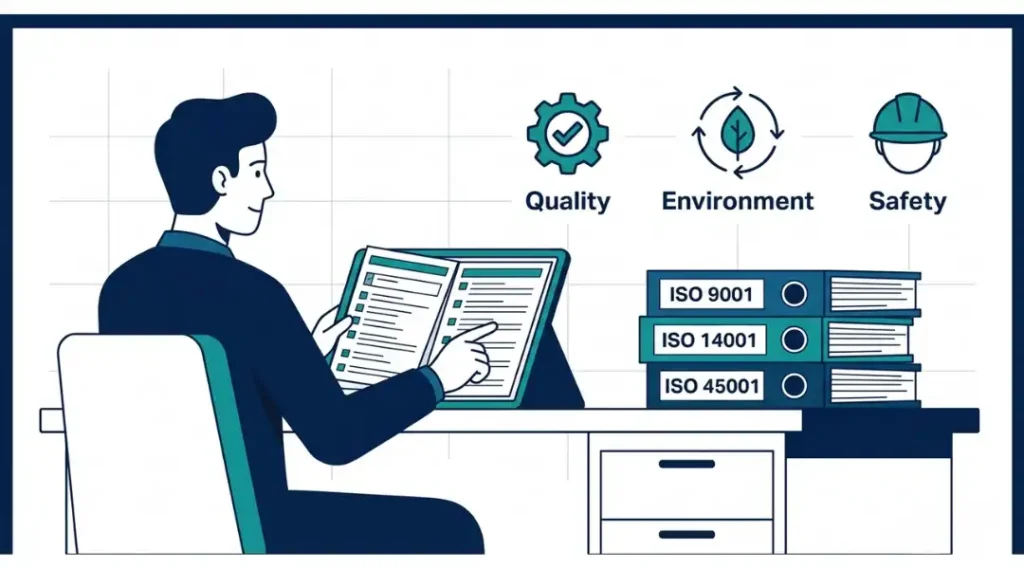
Organizations that take quality management seriously eventually reach a point where they need qualified lead auditors on their teams — people who can plan, conduct, and close internal or third-party audits with confidence and consistency. The path to that qualification runs through ISO 9001 lead auditor training, and increasingly, that path splits into two directions: a structured classroom program or a fully online learning experience. Both formats lead to the same certification. But they do not produce the same kind of auditor, and that difference matters when the certified professional is expected to operate in real audit environments where errors carry real consequences.
The conversation about format is not simply about convenience or cost, though those factors are real. It is about how auditors learn to think, how they develop judgment under pressure, and how well their training translates into competent performance once the course ends. Organizations investing in this qualification deserve a clear-eyed view of what each format actually delivers.
What ISO 9001 Lead Auditor Training Actually Involves
Before comparing formats, it is worth grounding the discussion in what this training actually requires of learners. An Iso 9001 Lead Auditor Training overview will typically show that the program covers the structure of ISO 9001:2015, audit planning and preparation, evidence collection techniques, nonconformity identification, reporting, and follow-up. Candidates are also expected to demonstrate understanding of audit principles as defined by ISO 19011, the international guidelines for auditing management systems.
The content itself is not light. Lead auditor programs generally run across five days in a structured setting, covering both theoretical knowledge and applied audit skills. The theoretical portion is manageable in almost any format. The applied portion — where candidates practice interviewing, document review, and audit communication — is where format starts to matter significantly.
The Role of Applied Practice in Auditor Development
Auditing is not a passive discipline. A lead auditor must be able to hold structured conversations with auditees, identify inconsistencies between stated processes and observed evidence, and communicate findings in a way that is factual, clear, and defensible. These are skills that develop through practice and feedback — not through reading or watching recorded material alone.
In classroom settings, this practice happens through role-play exercises, group case studies, and live feedback from a trainer who can observe how a candidate handles ambiguity, pushback from an auditee, or gaps in documented evidence. In online settings, these exercises must be simulated through written scenarios, recorded interactions, or virtual breakout activities, each of which carries its own limitations in terms of realism and immediacy of feedback.
The Classroom Format: Structure, Interaction, and Real-Time Calibration
Classroom-based ISO 9001 lead auditor training has been the standard for decades, and the reasons for its persistence are practical rather than traditional. When candidates learn in a shared physical environment, the quality of discussion is different. Questions are answered in real time. Misunderstandings surface immediately through body language, confused expressions, or follow-up questions that an online platform may not capture or encourage.
Trainers in a classroom can observe how candidates approach audit simulations, adjust instruction based on what the group is struggling with, and provide individual coaching moments that would be difficult to replicate asynchronously. The social dimension of the classroom — where candidates debate findings, challenge each other’s interpretations, and negotiate consensus — mirrors the team dynamics of an actual audit far more closely than solo online study.
Consistency of Assessment in Face-to-Face Settings
One concern that quality professionals raise about lead auditor certification is the consistency of competency assessment. A certified auditor who has passed an exam has demonstrated knowledge. But knowledge and competence are not the same thing. In classroom settings, examiners can observe behavior directly — they can see whether a candidate conducts an audit interview with appropriate structure, whether they probe effectively, and whether their verbal findings are accurate and well-supported.
This observational assessment is difficult to replicate online without significant investment in live virtual examination formats. Many online programs compensate with written assignments or recorded practice sessions, but these substitutes do not fully capture the real-time judgment and interpersonal navigation that auditing actually demands.
Group Diversity as a Learning Asset
In classroom settings, candidates often come from different industries, functions, and professional backgrounds. A participant from manufacturing sitting alongside someone from healthcare or financial services brings a form of contextual richness that enhances everyone’s understanding of how ISO 9001 principles apply across different operating environments. This cross-industry exposure is rarely available in self-paced online programs, where learning happens in isolation.
The Online Format: Flexibility, Access, and Its Real Limitations
Online ISO 9001 lead auditor training has expanded significantly over the past several years, driven both by technological capability and by the genuine logistical challenges many professionals face in attending week-long residential or classroom programs. For organizations with geographically dispersed teams, or for individuals whose work schedules cannot accommodate five consecutive days away from operations, online formats offer a meaningful pathway that would otherwise not exist.
Modern online programs have improved substantially in their design. Many now include live virtual sessions, interactive case studies, video demonstrations, and structured discussion forums. The better programs are not simply digitized workbooks — they involve real instructor contact time, scheduled cohort interactions, and assessed practical exercises. The gap between a well-designed online program and a poorly designed classroom session is sometimes smaller than assumed.
Where Self-Paced Learning Falls Short
The weakest version of online ISO 9001 lead auditor training is the fully self-paced model, where a candidate moves through recorded content at their own speed, completes written assessments, and sits an online exam at the end. This format can produce a certified auditor in terms of credential, but it does not reliably produce an auditor who is ready to function in a live audit environment without significant additional experience.
Audit skill requires repetition and correction. Without a trainer or peer group to push back on weak audit questions or poorly framed findings, candidates can complete their training without ever realizing the gaps in their applied technique. They may understand the standard thoroughly and still struggle when an auditee provides an unexpected answer or when the audit team disagrees on a finding classification.
Live Virtual Programs as a Middle Ground
Where online training performs most competently is in the live virtual model — structured sessions delivered in real time by an instructor, with cohort participation, live case studies, and interactive audit simulations conducted through breakout tools and shared documents. These programs maintain much of the interaction that classroom settings provide, while removing geographic and scheduling barriers.
According to the ISO 9000 family of standards, auditor competence encompasses knowledge, skills, and personal attributes — a combination that no single learning format can fully develop without deliberate, interactive practice built into the program design. Live virtual programs that take this seriously can produce competent auditors. Passive self-study programs, regardless of their content quality, are unlikely to do so consistently.
Factors That Should Actually Drive the Format Decision
Choosing between classroom and online ISO 9001 lead auditor training is not a matter of preference alone. It is a decision with operational consequences, particularly for organizations where certified auditors will be relied upon for internal audit programs, supplier audits, or certification preparation. Several factors deserve genuine consideration.
- The candidate’s prior audit experience matters significantly. Someone with an established background in process assessment or compliance work will extract more from self-directed content than a candidate who is new to auditing entirely and needs structured corrective feedback.
- The intended audit role should shape the format decision. A candidate who will lead third-party certification audits or complex supplier assessments needs the highest level of applied competency, which favors classroom or live virtual instruction over self-paced learning.
- The quality of the training provider is more important than the format itself. A well-structured online program from a credible provider with experienced instructors and substantive practical exercises will outperform a poorly run classroom session with limited interaction and minimal applied practice.
- Organizational timelines and resource constraints are legitimate inputs. If online training is the only realistic option for a particular individual or team, a well-chosen program is far preferable to delayed qualification.
- Post-training mentorship and supervised audit experience can compensate for format gaps. Organizations that pair new lead auditors with experienced practitioners during their initial audits often see stronger competency development regardless of training format.
Closing Observations
The question of which format produces better-certified auditors does not have a single universal answer, but it does have a practical one. Classroom and live virtual ISO 9001 lead auditor training programs tend to produce more immediately competent auditors — particularly for candidates who are new to audit practice — because they build applied skill through interaction, feedback, and simulated real-world conditions. Self-paced online programs serve an important access function but carry real competency risks when used as a standalone pathway for candidates without prior audit experience.
What matters most is not the delivery channel but the design of the program and the experience of the instruction. Organizations selecting a program for their teams should evaluate not just the content outline but the structure of practical exercises, the quality of instructor involvement, and the rigor of the final assessment. A credential issued after five days of passive video consumption is not the same as one earned through structured, interactive, assessor-observed audit practice — even if the paper certificate looks identical.
Format is a variable. Competence is the standard. The two should not be confused when the decision affects how well an auditor will perform when it counts.