
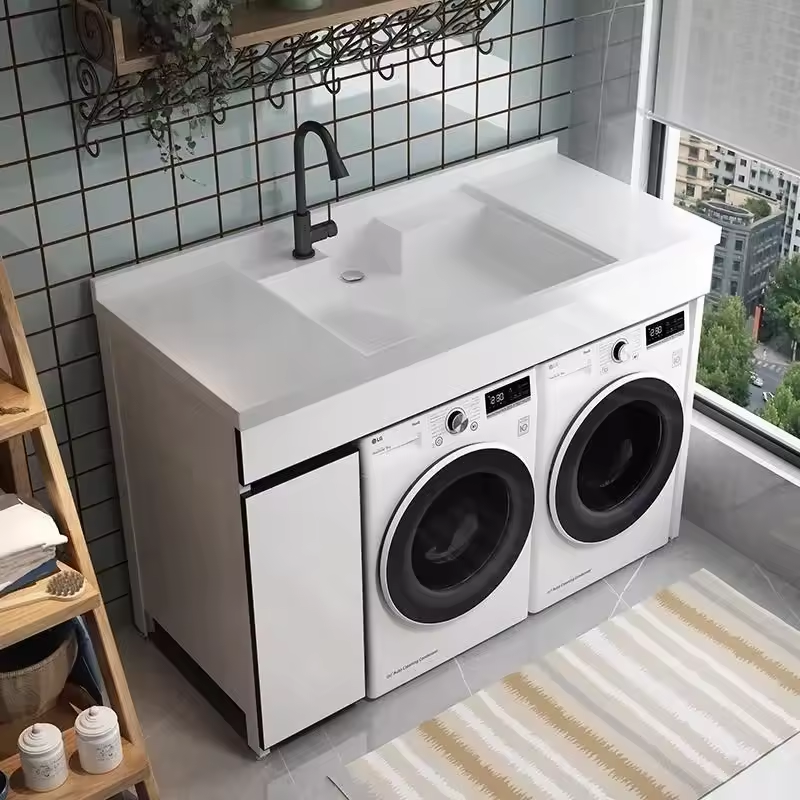
Most households manage laundry without ever thinking about the infrastructure behind it. A standard washing machine handles the bulk of the load, and that feels sufficient until it isn’t. Heavy-duty fabrics, work clothing soaked in grease or paint, muddy outdoor gear, or delicate items that cannot go through a machine cycle — these are the situations that expose the limits of a basic laundry setup. A laundry sink with a scrub board addresses exactly this gap. It extends the functional range of a laundry space without replacing what already works. For homeowners making a long-term investment in their utility or mudroom, understanding how these fixtures actually function — and what separates a practical choice from a frustrating one — determines whether the purchase holds up over years of real use.
What a Laundry Sink With a Scrub Board Actually Does in a Working Home
A laundry sink with a scrub board is a utility fixture designed to support hand-washing tasks that require friction, water control, and a stable surface. The scrub board — a ridged or textured panel integrated into the sink basin — provides resistance against which fabric can be worked by hand. This allows the user to remove embedded soil, stains, or debris from clothing without relying on machine agitation. For households with outdoor workers, children in sports, or anyone regularly handling heavily soiled items, this type of sink becomes part of a routine rather than an occasional tool.
If you are researching this category for the first time, the Laundry Sink With Scrub Board guide offers a useful starting framework for understanding the product options available and what distinguishes them from standard utility sinks.
The Role of the Scrub Board Within the Basin Design
The scrub board is not an accessory bolted onto an existing sink. In well-designed fixtures, it is integrated directly into the basin as a structural feature. The placement of the ridged surface — typically along one sloped side of the basin — determines how water flows during use. When a garment is pressed against the board and worked with water, the angle and texture together help release soil efficiently without requiring excessive physical effort. A poorly integrated scrub board, by contrast, can cause water to pool in unintended areas, reduce drainage efficiency, or simply provide so little texture that it offers no real advantage over scrubbing against a flat surface.
Understanding this relationship between the board and the basin shape is important before comparing products. The scrub surface alone does not define quality. How it connects to water movement, drainage, and the overall depth of the basin tells you whether the fixture will perform consistently under daily use.
Material Choices and Their Long-Term Implications
Laundry sinks with scrub boards are manufactured in several materials, and the differences are not cosmetic. Material selection directly affects how the sink handles temperature changes, cleaning chemicals, physical impact, and the sustained weight of saturated fabric over time. Each option carries trade-offs that become more relevant depending on where the sink is installed and how frequently it is used.
Cast Iron and Enameled Finishes
Cast iron sinks are among the heaviest utility fixtures available, and that weight serves a purpose. The density of the material absorbs vibration and resists movement during vigorous scrubbing. Enameled cast iron provides a smooth, non-porous surface that resists staining and is compatible with most household cleaning agents. However, the enamel coating is vulnerable to chipping under impact, and once the protective layer is compromised, the underlying iron can rust. Cast iron also requires reinforced cabinet or floor support due to its weight, which is a structural consideration that should not be overlooked during installation planning.
Fireclay and Vitreous China Options
Fireclay sinks are fired at high temperatures, producing a dense, glass-like surface that is highly resistant to scratching and chemical exposure. They are commonly used in farmhouse-style laundry rooms, and their durability under regular scrubbing is well established. Vitreous china, while visually similar, is generally less dense and more susceptible to cracking under heavy impact. Both materials provide excellent stain resistance, but fireclay holds up better in utility applications where the sink will be subjected to pressure and repeated contact with rough fabrics.
Acrylic and Composite Resin Alternatives
Lighter-weight materials like acrylic and composite resin have become more common in the laundry sink category. These materials are easier to install, less expensive, and available in a wider range of configurations. The trade-off is durability under sustained heat and chemical exposure. Acrylic can warp or discolor when exposed to very hot water repeatedly, and composite surfaces may show wear more quickly in high-use environments. For households where the laundry sink sees frequent, heavy use, these materials may require replacement sooner than cast iron or fireclay alternatives.
Installation Context: Where the Sink Is Placed Shapes How It Performs
A laundry sink does not perform in isolation. Its placement within a utility room, mudroom, or basement directly affects how useful it becomes in daily practice. Plumbing access, drainage slope, surrounding counter space, and proximity to the washing machine all factor into whether the fixture integrates smoothly or creates friction in the workflow. Before selecting a product, the physical environment should guide the decision as much as the fixture’s features.
Freestanding Versus Cabinet-Mounted Configurations
Freestanding laundry sinks sit on legs and require no cabinet infrastructure beneath them. This makes them easier to install in utility spaces that lack built-in cabinetry, and they typically allow better access to plumbing connections during installation and future maintenance. Cabinet-mounted sinks provide storage below the basin, which is useful in organized laundry rooms, but the cabinet must be rated for the weight of the sink material and the water it will hold. In finished spaces, cabinet-mounted configurations often look cleaner. In raw utility environments, freestanding options tend to offer more practical flexibility.
Plumbing Compatibility and Drainage Requirements
The drainage requirements of a laundry sink with a scrub board are more demanding than those of a standard hand sink. When used for pre-treating heavily soiled garments, the water discharged contains detergent, sediment, and debris at higher concentrations. According to guidance from the U.S. Environmental Protection Agency, household wastewater handling systems should be compatible with the volume and composition of what they receive. This is especially relevant for homes on septic systems, where high-frequency, high-volume laundry sink use can affect system performance if drainage is not properly sized and maintained. Ensuring that the sink’s drain connection matches the existing plumbing diameter and that the drain line has an adequate slope prevents slow drainage and backflow over time.
Evaluating Depth, Basin Size, and Scrub Board Geometry
The physical dimensions of a laundry sink determine what tasks it can actually accommodate. A basin that is too shallow limits the size of items that can be soaked or rinsed. One that is too deep may cause user fatigue during extended scrubbing sessions. The scrub board’s geometry — its angle, width, and texture pattern — determines how effectively it assists with different fabric types. These factors are interrelated, and prioritizing one without considering the others can result in a fixture that looks right but functions poorly in practice.
Matching Basin Depth to Intended Use
For general pre-treatment tasks — removing stains from shirts, rinsing muddy socks — a moderately deep basin provides enough room for water and fabric without requiring the user to lean uncomfortably. For larger items such as work pants, blankets, or outdoor gear, a deeper basin allows full submersion, which is often necessary before scrubbing. If the primary use case involves frequently handling bulky or oversized items, basin depth should be weighted heavily in the selection process.
Texture Pattern and Fabric Compatibility
Scrub boards are not uniform in their texture. Some feature wide, shallow ridges suited to heavy cotton fabrics, while others have finer patterns that work better with lighter textiles. Using a coarse texture on delicate fabric can cause damage, while a smooth or fine texture provides little benefit when working through thick, heavily soiled material. Homeowners who expect to use the sink across a wide range of fabric types should look for a moderate texture pattern that performs adequately across categories rather than excelling at one extreme.
Cost, Longevity, and the Real Value Calculation
Price is often the first filter applied when comparing laundry sinks, but it is rarely the most useful one. The upfront cost of a fixture tells you very little about what it will cost to own over a decade of use. Installation labor, replacement parts, potential damage from material failure, and the impact of a poorly draining or poorly designed sink on adjacent surfaces — these are the costs that accumulate invisibly and often exceed the initial savings of choosing a cheaper product.
A more useful approach is to evaluate cost in proportion to expected use frequency. A household that will use the laundry sink daily should treat it as a utility infrastructure investment and prioritize durability and drainage reliability. A household that anticipates occasional use has more flexibility to consider mid-range materials without accepting significant risk. The key is aligning the fixture’s construction quality with the actual demand placed on it, rather than buying up or down based on price alone.
Closing Considerations for a Long-Term Purchase Decision
Choosing a laundry sink with a scrub board is a practical infrastructure decision. It is not a cosmetic upgrade or a trend-driven purchase. The households that benefit most from this type of fixture are those with consistent, recurring needs that a washing machine alone cannot meet — regular exposure to heavily soiled clothing, the need to hand-treat specific fabrics, or a utility space that requires a durable, multi-function washing station.
The factors that determine whether a specific product delivers on that need come down to material durability, basin geometry, drainage compatibility, and installation environment. A fixture that performs well in all four areas will hold up across years of use without requiring early replacement or workaround solutions. One that falls short in any area will create friction in the very workflow it was purchased to support.
Before finalizing a selection, take time to assess the actual conditions of the installation space, the plumbing infrastructure already in place, and the full range of tasks the sink will be expected to handle. That ground-level assessment, more than any product specification, is what leads to a purchase that functions as intended from the first use through the last.