
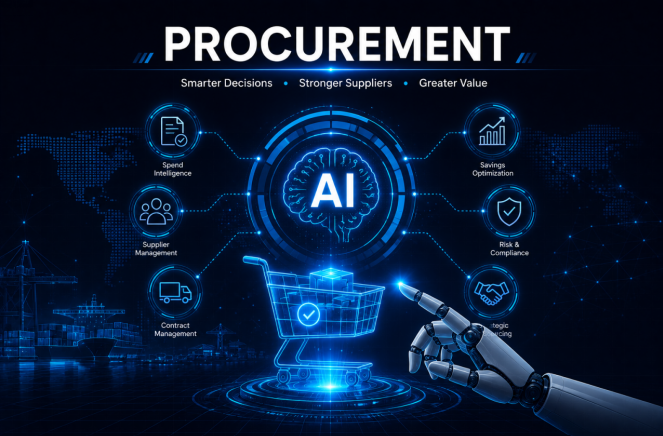
Procurement leaders are expected to control costs, manage supplier risk, strengthen resilience and create greater strategic value for the business. Yet fragmented data, manual processes and complex supplier networks can limit the function’s ability to respond quickly. AI in Procurement is changing this by enabling organizations to automate routine work, improve sourcing decisions and generate deeper insights from procurement data.
Implementing AI successfully, however, requires more than selecting new technology. AI Consultants can help organizations identify high-value opportunities, assess data and technology readiness, establish governance and develop a roadmap for scaling AI across procurement.
This article explores how AI in Procurement is transforming the function, the role of AI Consultants, key use cases, business benefits and priorities for successful implementation.
What is AI in Procurement?
AI in Procurement refers to the application of artificial intelligence technologies across procurement processes, including sourcing, spend analysis, supplier management, contracting, purchasing and risk management.
These capabilities can include machine learning, generative AI, predictive analytics, intelligent automation and AI agents. Together, they enable procurement teams to analyze large volumes of structured and unstructured information, automate repetitive activities and support more informed decisions.
Unlike traditional automation, which generally follows predefined rules, AI can identify patterns, interpret information and generate recommendations based on changing business conditions.
What do AI Consultants do?
AI Consultants help organizations determine how artificial intelligence can address specific business challenges and create sustainable value. Their role typically extends from strategy and opportunity identification through implementation, governance and performance measurement.
For procurement, AI Consultants can assess existing processes, technology architecture, data quality and workforce capabilities to determine where AI can have the greatest impact.
They can also help procurement leaders evaluate use cases based on business impact, implementation complexity, data readiness and expected return, helping prevent investment in disconnected initiatives with limited strategic value.
Why AI in Procurement matters
Procurement organizations manage extensive supplier networks, contracts, sourcing events and purchasing transactions. At the same time, leaders must respond to price volatility, supply disruptions, changing regulations and increasing expectations for business partnership.
AI in Procurement can help teams process this complexity more effectively. Machine learning can identify purchasing patterns, predictive analytics can highlight potential risks and generative AI can accelerate knowledge-intensive activities such as contract analysis and sourcing documentation.
The result is an opportunity to shift procurement capacity away from repetitive transactional work toward strategic sourcing, supplier collaboration and value creation.
Core technologies enabling intelligent procurement
Several technologies are expanding the capabilities of modern procurement.
Generative AI
Generative AI can summarize contracts, create supplier communications, prepare sourcing documents and help procurement professionals retrieve information using natural language.
Machine learning
Machine learning analyzes purchasing and supplier information to identify patterns, classify spend and support sourcing and supplier decisions.
Predictive analytics
Predictive models can help procurement teams anticipate supplier risks, demand changes, price movements and other factors that may affect purchasing decisions.
Intelligent automation
Automation can streamline purchase requisitions, approvals, supplier onboarding, invoice matching and other repetitive procurement activities.
AI agents
AI agents represent an emerging capability that can potentially coordinate multistep procurement workflows, interact with enterprise systems and escalate exceptions requiring human judgment.
AI Consultants can help organizations determine which technologies are appropriate for specific procurement challenges rather than applying AI indiscriminately.
Key use cases of AI in Procurement
Organizations can apply AI across multiple stages of the procurement lifecycle.
Spend analysis
AI can classify transactions, identify spending patterns and improve visibility across suppliers, categories and business units. Better spend intelligence can help procurement teams identify consolidation and sourcing opportunities.
Strategic sourcing
AI can analyze supplier information, previous sourcing events and market data to support supplier evaluation and sourcing decisions.
Contract management
Generative AI can summarize agreements, extract important clauses and identify obligations, renewal dates or other information requiring procurement attention.
Supplier risk management
AI can combine internal supplier performance information with external signals to help identify potential financial, operational or supply risks.
Supplier performance management
AI-supported analytics can help procurement teams evaluate delivery, quality, service and other supplier performance measures more consistently.
Procurement operations
AI can automate routine requisition, approval and purchasing activities while identifying exceptions that require specialist intervention.
These applications demonstrate how AI in Procurement can improve both transactional efficiency and strategic decision-making.
Business benefits of AI in Procurement
When applied to the right processes, AI can improve several dimensions of procurement performance.
Greater procurement productivity
Automation reduces time spent on repetitive administrative work, allowing procurement professionals to focus on sourcing, negotiations and supplier relationships.
Better spend visibility
AI can classify and analyze procurement information at scale, giving leaders a clearer understanding of where and how the organization is spending.
Stronger supplier decisions
Advanced analytics can provide a more comprehensive view of supplier performance, risk and commercial opportunities.
Faster procurement processes
Intelligent workflows can reduce manual handoffs and accelerate sourcing, approvals and other procurement activities.
Improved risk management
Predictive capabilities can help procurement teams identify emerging supplier and market risks earlier and respond proactively.
How AI Consultants support procurement transformation
Organizations often face a long list of potential AI use cases but limited investment capacity. AI Consultants can provide a structured approach for deciding where to begin.
This may include:
- Assessing current procurement performance and AI readiness.
- Identifying process-level AI opportunities.
- Prioritizing use cases based on value and implementation complexity.
- Evaluating data, integration and technology requirements.
- Establishing responsible AI and procurement governance.
- Redesigning workflows to incorporate intelligent automation.
- Defining metrics to track financial and operational outcomes.
This approach helps procurement leaders connect AI investment decisions with broader procurement transformation priorities.
Best practices for implementing AI in Procurement
Successful implementation requires organizations to address strategy, data, technology and people together.
- Start with clearly defined procurement problems rather than individual AI tools.
- Improve supplier, contract and spend data quality before scaling advanced capabilities.
- Prioritize use cases based on expected business impact, feasibility and time to value.
- Integrate AI with existing procurement, ERP and supplier management platforms.
- Establish governance for data security, model performance, compliance and human oversight.
- Maintain human accountability for negotiations, supplier selection and high-risk decisions.
- Measure outcomes through relevant procurement KPIs, including productivity, cycle time, supplier performance and spend management.
AI Consultants can help organizations apply these principles consistently as implementation expands.
Challenges organizations need to address
AI in Procurement depends heavily on the quality and accessibility of enterprise data. Fragmented supplier records, inconsistent category structures and incomplete contract information can reduce the effectiveness of AI-generated insights.
Integration with legacy procurement and ERP systems can create additional implementation challenges. Organizations also need clear governance for confidential supplier and commercial information.
Trust is equally important. Procurement professionals need to understand how recommendations are generated and when human judgment should override or validate AI outputs.
Addressing these foundations early can reduce implementation risk and improve long-term value.
The future of AI in Procurement
The next phase of AI in Procurement will increasingly involve AI agents capable of coordinating activities across sourcing, contracting, purchasing and supplier management.
For example, an agent could gather supplier information, analyze requirements, prepare sourcing materials and initiate approved workflows while escalating commercial decisions to procurement professionals. Multi-agent systems may eventually coordinate activities across procurement, finance and supply chain functions.
As these capabilities mature, AI Consultants will increasingly help organizations redesign operating models, establish agent governance and determine how work should be divided between employees and intelligent technologies.
Conclusion
AI in Procurement is expanding the function’s ability to automate work, analyze complex information and support more informed sourcing and supplier decisions. The opportunity extends beyond efficiency to improved risk management, procurement productivity and strategic business contribution.
AI Consultants can help organizations translate that potential into a practical transformation roadmap by identifying high-value opportunities, strengthening data and technology foundations and establishing appropriate governance. Organizations that combine procurement expertise with scalable AI capabilities will be better positioned to build agile, intelligent and future-ready procurement functions.