
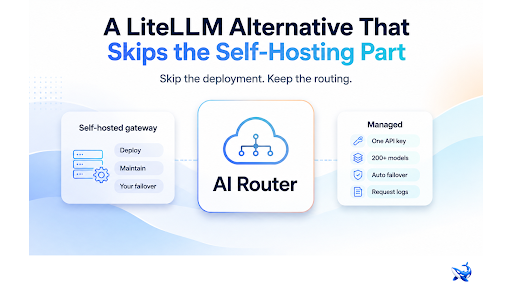
If you’re searching for a LiteLLM alternative, the question underneath the search is rarely “which gateway do I swap to?” — it’s whether you want to run a gateway at all. OrcaRouter is a managed AI router that gives you one API key for 200+ models, automatic failover and per-request logs with zero infrastructure to run — and the litellm alternative write-up puts that managed option side by side with self-hosted gateways, which is the fastest way to judge a LiteLLM alternative if you want the gateway benefits without owning the deployment.
The claim worth deflating up front is that open-source gateways are free. The software is free to clone; operating it is a job. LiteLLM’s real costs are the ones that never appear in a README: the container you keep patched, the failover logic you write yourself, the logging pipeline you assemble, and the on-call rotation that now covers a service your API depends on. This piece is the honest version of that trade — the control you actually gain, the operations you actually inherit, and how a managed alternative changes the math.
The alternative question is really managed versus self-hosted
“LiteLLM alternative” is a search, but it’s pointing at a category decision. LiteLLM is the popular open-source gateway teams self-host, and any honest alternative discussion has to start by admitting it’s a good piece of software — the reason you’re reading this article is probably not that it’s bad, but that running it became a project. The alternative to a self-hosted gateway isn’t necessarily another self-hosted gateway. It’s a managed one.
Here’s the mental model that helps: a gateway is a piece of infrastructure that sits between your application and every model provider. It holds your keys, routes each request to the right model, retries when a provider fails, and tells you what each call cost. Self-hosted, all of that is code that lives in your cloud and belongs to you — along with everything required to keep it alive. Managed, the same category of software is operated for you, and you consume it through one API key. The two options are not “free versus paid.” They are two different ways of paying: one in engineering hours, one in a subscription line item.
What self-hosting actually charges you
Start with the part self-hosting genuinely wins. Control. Your prompts stay in your network. Your keys live in your own key store. You can point the gateway at any provider you have a contract with and write routing rules as arbitrary as you like. If your compliance posture demands a data path you can draw on a diagram, a self-hosted gateway is the only option that satisfies it without paperwork.
Now the part nobody puts in the README: everything after deployment is yours. A self-hosted gateway is a single point of failure between your application and every model you call, so you inherit a DNS record, a TLS story, a capacity plan and a failover design for a service whose traffic is spiky by construction. Every provider outage becomes your incident, because your users only ever see that your endpoint timed out. Every new model you adopt is new integration code, new tests and a new entry in your key rotation schedule. And because all traffic flows through your own VPC, you pay egress on every token in and out of every long-context request — a real, recurring, hard-to-forecast line on your cloud bill.
The sharpest way to see the hidden tax is observability. To know which model answered which request, what it cost and why it was chosen, you build it yourself: log shipping, retention, a query layer and a dashboard — all before you can answer a single question from finance about why the bill went up. For a small team, that observability stack can cost more engineering time than the gateway itself ever will.
What a managed alternative takes off your plate
A managed alternative gives you the same capabilities without making you the operator. The provider maintains the connections, the model catalog, the key management and the failover logic; you use them through one API key. That one-key property matters more than it sounds, because it turns “add a model” from an integration project into a configuration change — no new SDK, no new deployment, no new credential rotation.
The failure mode that hurts most is a model your routing depends on starting to error or getting deprecated. Automatic failover re-routes the affected traffic to a model that still meets your criteria, so an outage becomes a routing decision instead of a pager alert [OrcaRouter]. The same logic covers quieter churn: list prices move and models retire, and a maintained catalog keeps itself current so you’re not chasing vendor changelogs.
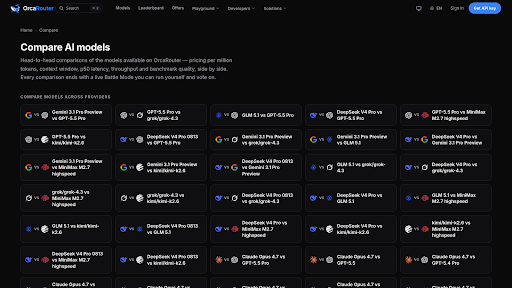
For the “200+ models” part, the numbers come straight from the product page: one API key reaches more than 200 models across OpenAI, Anthropic, Google, Meta, Mistral, xAI, DeepSeek, Qwen, GLM and MiniMax [OrcaRouter]. And the cost model matters just as much as the catalog: 0% markup, meaning provider list prices pass through exactly as published — no added fee, with glass-box receipts on every request [OrcaRouter]. That’s the pricing transparency self-hosting advertises but rarely delivers, because your own egress and observability bill quietly erases the “savings.”
The honest decision table
The question isn’t whether you can self-host a gateway — you can. It’s whether you should, given who you are.
| Factor | Self-hosted gateway | Managed alternative |
| Control | Total: keys, network, routing rules | High for routing; infra control delegated |
| Ops burden | You own deploy, patch, failover, capacity | Near zero; provider runs it |
| Observability | Build your own logging and dashboards | Per-request request logs out of the box |
| Uptime & failover | Your on-call rotation, your incidents | Automatic failover, provider-operated |
| Cost shape | Egress + headcount, lumpy and recurring | Transparent, 0% markup on list prices |
| When it wins | Compliance or data residency mandates | Everyone else, especially small teams |
The honest cases for self-hosting are mostly about control requirements — compliance, data residency, or a routing layer so bespoke no product would offer it. The managed column wins on everything else: no deployment, automatic failover, observability you don’t have to build, and a catalog that stays current. For teams under about twenty engineers who have never run an internal platform, the “savings” of self-hosting are usually an illusion once egress and engineering hours are priced.
How to decide
Compliance genuinely locks some teams into self-hosting — if your contract says data never leaves your network, the debate is over and no pricing model changes it. For everyone else, the decision collapses to one honest question: do you want to run a gateway, or build on one? If you have a named reason you need the network path — an air-gapped deployment, a regulatory mandate, a bespoke routing rule — self-hosting is defensible. If the reason is just “we like control,” cost it honestly first, because control has a payroll attached.
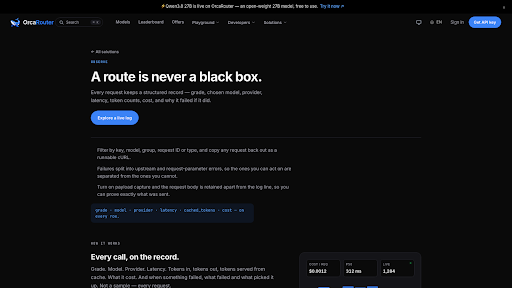
There’s a middle path worth naming explicitly: start managed and keep the receipts. Because a managed router logs every request [OrcaRouter], you get the observability you’d have built anyway — which model answered, at what price, with which routing decision — as a side effect, not a project. You can always migrate to self-hosting later if a concrete requirement appears. The reverse migration is harder, because you give up the built-in observability and the automatic failover you’d stopped thinking about.
The takeaway
Searching for a LiteLLM alternative is usually a signal that the self-hosted gateway project has outgrown the team. A managed alternative like OrcaRouter answers the real question — managed versus self-hosted — by keeping the parts that matter (one key, 200+ models, automatic failover, per-request logs, an OpenAI-compatible endpoint) and dropping the part that doesn’t (your infra team running it). Self-host when compliance or data residency demands it; go managed when what you actually want is to ship. Most teams, most of the time, are the second one.
Sourcing note: OrcaRouter product facts — one API key for 200-plus models, 0% markup pass-through of provider list prices, automatic failover, adaptive routing that grades each prompt in under 1ms, and per-request request logs — are OrcaRouter’s own published claims, verified on its official product pages August 22, 2026. No LiteLLM statistics, pricing or claims are cited; descriptions of self-hosting costs are general engineering reasoning, not vendor-reported figures.