
Handling performance issues or employee misconduct is one of the core duties of managers. Though managers do not enjoy calling employees out for not following the rules, it is their job to do so. Warming comes in many forms; it could be a quick hallway chat about a missed deadline, a gentle heads-up about attitude, or an offhand reminder about attendance.
These informal conversations feel natural, even kind. However, when the same issues persist, policies are disregarded, and performance suffers; it becomes necessary to take action. Knowing when and how to move from informal conversation to formal written notice is essential for clarity, fairness, and legal protection.
When performance or conduct issues go through the roof, most managers start searching for warning letter templates. However, editing old templates requires a lot of time and effort. Also, starting from a blank sheet is not a small task. To simplify the work of the manager, HR Docket designed a warning letter generator that helps you create clear warning letters.
What is a warning letter?
A warning letter is a formal written document used by HR teams to address an employee’s misconduct or performance issues. It documents the offense, establishes expectations for improvement, and outlines the consequences of failing to correct the behavior.
Warming letters are not a form of punishment but clarity tools. They help HR teams address recurring issues like lateness, absenteeism, disengagement, or policy violations in a consistent way.
Why the shift from verbal to written matters
Verbal conversations build rapport and allow immediate feedback, but memories fade quickly. The moment a conversation ends, details may disappear, and interpretations often diverge without documentation.
Without documentation, employees may claim they “never heard” about the issue. Managers may also struggle to track improvement patterns.
Written documentation creates a clear timeline, demonstrates due process, and supports progressive discipline policies. It protects the employee by providing specific expectations while allowing HR teams to monitor progress.
Written records create a shared, timestamped record that:
- Establishes a clear pattern of behaviour or performance issues over time
- Demonstrates procedural fairness
- Protects the organisation against wrongful termination claims, discrimination allegations, and regulatory scrutiny.
- Gives the employee a fair shot by clarifying expectations in a way a passing remark never can.
Modern HR documentation software like the HR Docket makes this process efficient, compliant, and collaborative, reducing administrative burden while maintaining professional standards. It also centralised the process with timestamps and stored it securely.
When should you move from conversation to formal notice?
Not every workplace issue requires a formal letter. Verbal conversation can fix some of these issues. These are some of the issues that require documentation:
- Performance issues that continue after verbal coaching
- Behavioural concerns such as repeated interpersonal conflicts, insubordination, or harassment complaints.
- Legal or compliance risks, like anything that could lead to protected-class claims or regulatory violations.
- Policy violations such as attendance problems, dress code breaches, or safety infractions.
- Patterns over time, like multiple instances of the same problem across weeks or months.
Common types of formal notices
Most organizations follow a progressive discipline framework in addressing workplace issues. This stepped approach is often from a verbal warning to a formal notice. Formal notices include:
- Written warning
- Final written warning
- Performance Improvement Plan (PIP) or suspension
- Termination
How to write an effective formal notice
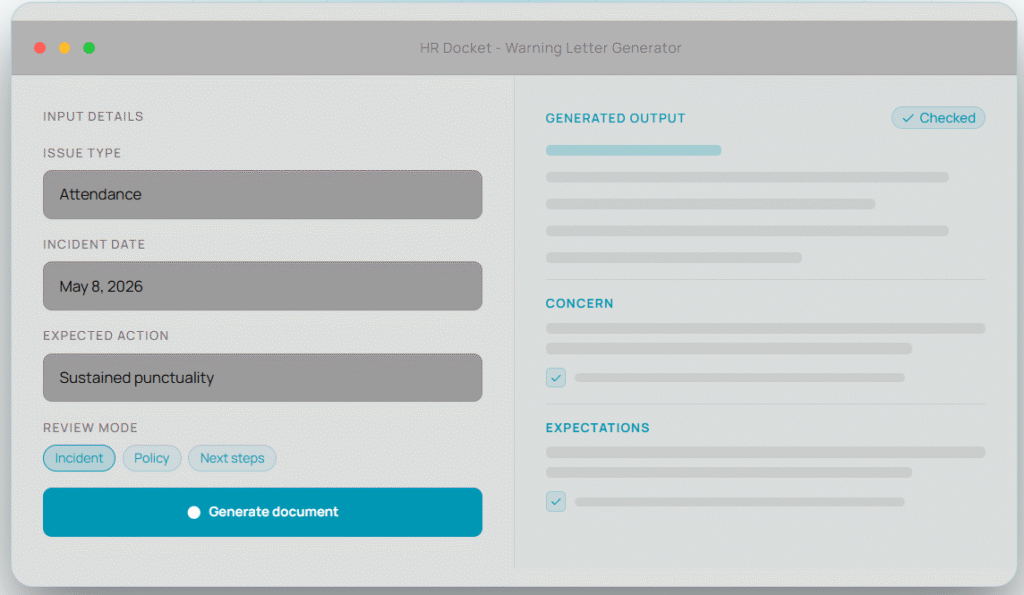
Writing a formal notice requires an objective, professional, and clear tone. The HR Docket’s warning letter generator helps managers write clear warning letters. The platform assists you in generating formal warning letters that state the issue, cite policy expectations, define next steps, and preserve a professional tone.
To ensure that your document is effective and professional, you will need to follow these steps:
- State the Facts Objectively. Avoid emotional language or subjective opinions.
- Reference previous documentation.
- Separate fact from interpretation. Describe what happened, not what you think it means about the person.
- Include the employee’s response. Note what the employee said, whether they accepted or disputed the feedback, and any mitigating circumstances they raised.
- State expectations clearly and measurably.
- Get acknowledgement by asking the employee to sign or acknowledge receipt of the document.
With the HR Docket’s warning letter generator, you just need to add the details for your warning letter and let HR Docket structure the first draft. The platform allows you to check for missing fields and keeps the output aligned to your workspace defaults.
The platform is designed for HR teams who care about quality, consistency, compliance, and speed all at once. It provides guided AI drafting that turns your inputs into a polished warning letter.
HR Docker features a risk-aware review that flags unclear clauses, missing dates, inconsistent terms, and sensitive language before the document is shared. It also provides reusable templates, and you can download the final file in Word or PDF.
The best part is that all generated drafts, saved versions, PDFs, and signatures are organised under the right employee profile.
Why consistency is everything
Manual templates and scattered emails lead to inconsistency and lost time. One of the common reasons why HR documentation fails is because of inconsistency. A good HR documentation software enforces consistent templates, tracks documentation history, and creates audit trails that are valuable not just for efficiency. This is also the basis for defensibility.
Purpose-built HR documentation software like the HR Docket centralises warnings, PIPs, acknowledgements, and performance notes in one secure platform. Special features like template libraries, e-signatures, and automated reminders help teams stay compliant and proactive.
Conclusion
Moving from informal conversation to formal notice is about setting clear expectations and supporting success. It often gives a relationship the structure it needs to survive. A well-crafted written communication protects your organisation, respects your people, and often leads to genuine performance turnarounds. It turns ambiguous conversations into shared understandings, and it ensures that if things do escalate, everyone can point to a fair and transparent process.
Don’t wait for a crisis to start documenting. You can start building formal HR documentation faster and more consistently with HR Docket.