
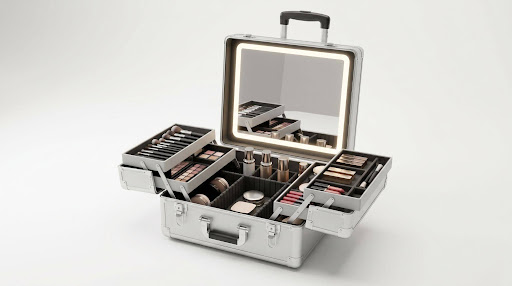
A professional makeup case is a working tool. For beauty brands supplying professional artists, or for artists sourcing their own equipment, the evaluation criteria are functional before they are aesthetic: Does the shell protect the contents under daily professional use? Does the latch stay closed under load? Do the wheels perform on varied surfaces? Can the interior be organized to match a professional workflow?
These questions separate professional-grade product from retail-grade product with a professional price tag.
What Separates Professional Grade from Consumer Grade
The distinction shows up in three areas: shell construction, hardware specification, and interior design.
A professional-grade shell is typically aluminum — not ABS or PC — because aluminum provides structural rigidity under the load conditions of professional use without deforming permanently. The corners are the highest-stress points in any hard-shell case and should be reinforced, not merely molded.
Hardware in a professional case is specified to a cycle rating: latches tested to a minimum number of open-close cycles, wheels rated to a load capacity and drag distance, handles tested to an extension cycle count. Consumer-grade cases carry no such ratings because the use intensity does not require them. Professional-grade cases that cannot provide hardware specification documentation are not professional-grade by any meaningful definition.
Shell Materials and Their Tradeoffs
When selecting a makeup case manufacturer, request samples that demonstrate interior customization flexibility — fixed layouts often indicate limited tooling capability. The interior of a professional makeup case is not decorative: it is a functional organization system, and its design should reflect how professional artists actually work.
Ask specifically: can dividers be repositioned or removed? What are the depth options for compartments? Can a mirror be integrated into the lid? What is the maximum weight the trolley wheel system is rated to carry? A manufacturer that cannot answer these questions in specifics has not designed the product for professional use.
Evaluating Samples Before Bulk Production
The sample stage is the quality gate. Do not proceed to bulk production without a physical sample that has been tested against functional criteria, not just inspected visually.
Test the latch or lock through repeated cycles and check for any loosening. Load the trolley to working weight and test wheel performance over a hard floor surface. Open and close the lid repeatedly while loaded and check for hinge flex or deformation. Verify that all interior dimensions match the specification exactly — a 5mm deviation in compartment depth can make a product unusable for specific tools.
Manufacturers like Aluvox produce aluminum and ABS makeup cases with configurable interiors, custom hardware, and MOQ programs suited to professional beauty brands. When evaluating any supplier at this level, the quality of their sample process — how they handle revision requests, how they document approval, how they manage the transition from sample to bulk — tells you as much about them as the sample itself.