
How American backyards became second kitchens
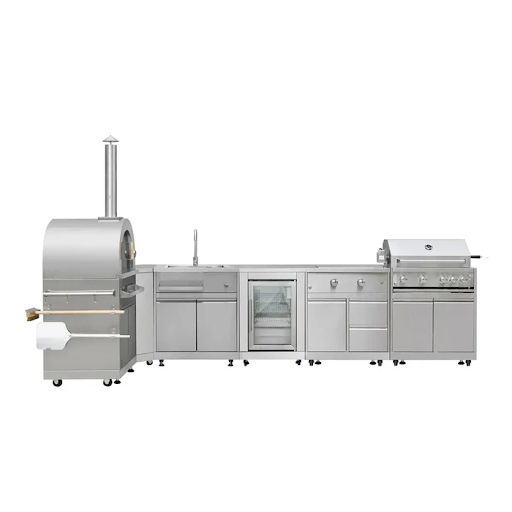
Over the past two decades the United States has steadily pushed daily living outward into the yard. Patios grew into rooms, gas lines reached the deck, and the grill stopped being a summer novelty and became a fixture used across seasons.
That demand on materials and layout is exactly why a modern outdoor kitchen is engineered the way it is, and the reasons trace back to one metal and one idea about building in blocks.
The self-healing skin that keeps stainless steel from rusting
Ordinary steel left outdoors corrodes because iron reacts with oxygen and moisture into flaking rust that never stops eating inward. Stainless steel resists this because it is alloyed with chromium, and chromium reacts with oxygen to form an extremely thin, transparent, tightly bonded layer of chromium oxide across the surface. This passive layer behaves like a coat of invisible glaze, except that it is not painted on; it grows from the metal itself.
The decisive property is that the layer repairs itself. Scratch a stainless surface with a grill brush and the freshly exposed metal meets the air and re-forms its oxide skin within moments, the way a still pond closes over after a stone breaks the surface. A coat of paint, once chipped, stays chipped and lets corrosion creep beneath it; the passive layer instead heals continuously, which is what allows the metal to face decades of weather swings outdoors. This is why an outdoor kitchen is built from stainless rather than painted steel: the surface is its own protection, renewing itself every time the weather or a cleaning tool wears it back.
Why the whole thing is assembled from standard blocks
The second design principle is modularity. Rather than one welded monolith, the station is built from standardized cabinet units of common widths that bolt and align together like construction blocks. A homeowner combines them to fit a straight run along a fence, an L-shape around a corner, or a U that wraps a seating area, and can add a unit years later without rebuilding the rest. The advantage is not only flexibility but repairability: if one module is damaged it can be replaced on its own, whereas a single fixed structure would have to be rebuilt entirely. A modular outdoor kitchen therefore ages gracefully as a household’s cooking habits change.
- Standard widths align and bolt together
- Layouts adapt to straight, L, or U runs
- Units can be added or rearranged later
Sorting the modules by the job each one does
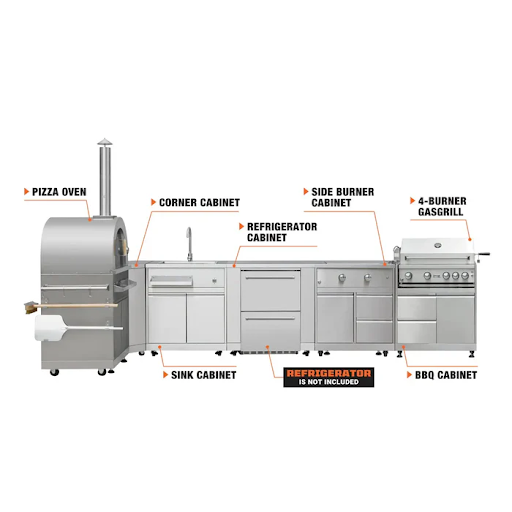
The clearest way to understand the system is to group modules by function rather than by appearance, because each role places different demands on the cabinet.
Cooking modules
These carry the heat sources: the grill, the side burner, and the pizza oven. They must shed intense radiant heat and channel grease safely, so they are vented and lined to keep high temperatures away from adjacent units and any stored fuel.
Preparation modules
Sink units and open counter runs form the wet and working zones. A sink brings water to the point of use so raw food handling and cleanup never force a trip indoors, and the surrounding counter gives the cook room to stage plates and tools.
Cold storage modules
An outdoor-rated refrigerator keeps drinks and ingredients chilled in ambient heat that would overwhelm an indoor unit. Its sealing and compressor are built to run against the same temperature swings the steel withstands.
Dry storage modules
Cabinets and drawers shelter tools, fuel, and utensils from rain and dust. Keeping these closed and dry protects what the cook needs between sessions and keeps the work surfaces clear.
Reading the design as a whole
Seen this way, the station is not a collection of appliances but a material strategy joined to a layout strategy. The stainless skin answers the weather; the modular blocks answer the space and the way a household actually cooks and gathers. Grouping the modules by role also guides safe planning, since cooking units with open flame and grease should sit apart from cold storage and from any stored fuel, and a sink should fall within easy reach of where raw food is handled. A thoughtfully arranged outdoor kitchen keeps these zones in a workable sequence so the cook moves naturally from preparation to heat to plating.
A well-planned outdoor kitchen therefore rewards the buyer who understands why its metal endures and why its modules are grouped by purpose, creating functional backyard cooking spaces long after any single feature has faded from memory.