
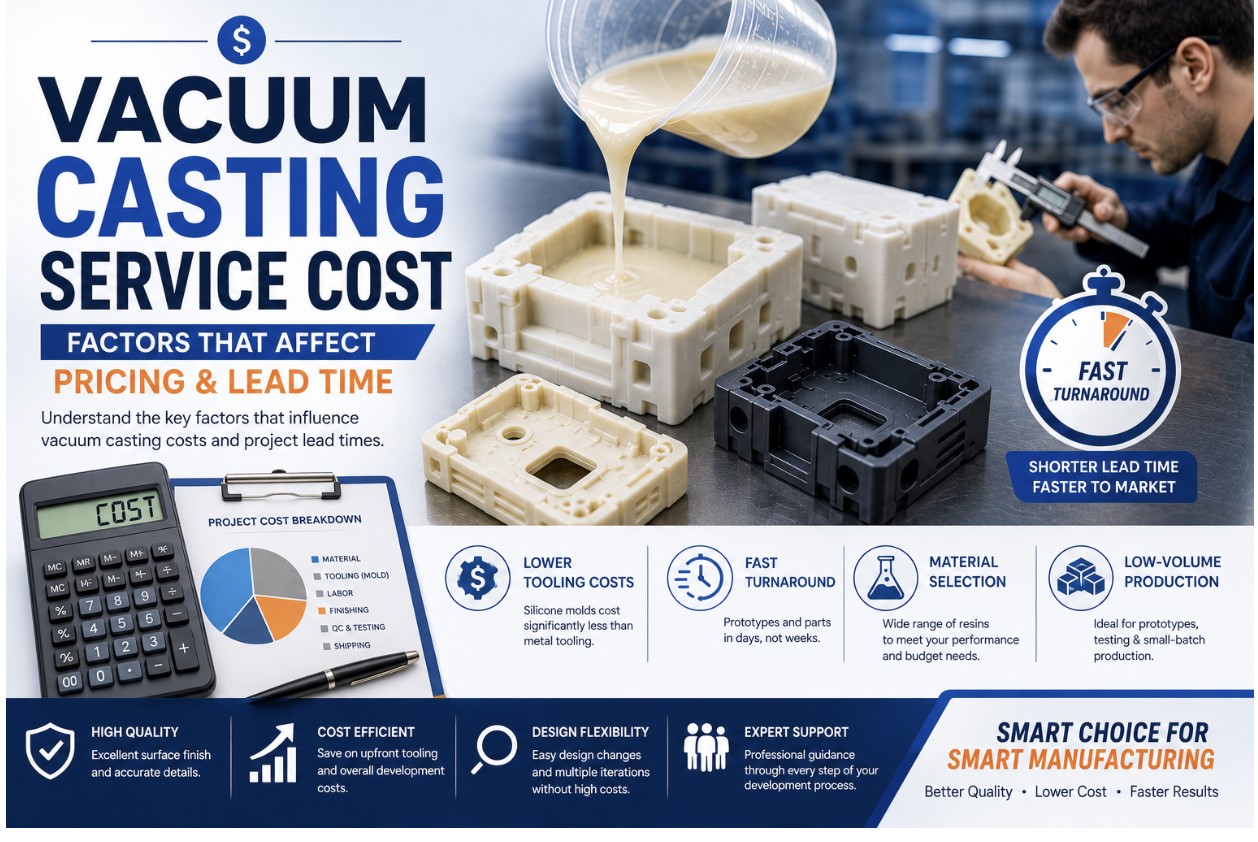
Introduction
When developing a new product, controlling manufacturing costs while maintaining quality is a top priority. This is one reason why a vacuum casting service has become a popular solution for prototyping and low-volume production. Vacuum casting offers an affordable way to produce high-quality parts without the significant tooling investment required for injection molding.
However, the cost of vacuum casting can vary considerably depending on several factors, including part complexity, material selection, production volume, and lead time requirements. Understanding these cost drivers can help businesses make informed decisions and optimize their manufacturing budgets.
In this article, we’ll explore the key factors that influence vacuum casting service costs and what businesses can do to improve cost efficiency.
Why Vacuum Casting Is a Cost-Effective Manufacturing Solution
Vacuum casting is commonly used for prototype development and low-volume production because it provides an excellent balance between quality, speed, and affordability.
Lower Tooling Costs
Unlike injection molding, which requires expensive metal molds, vacuum casting uses silicone molds that are much cheaper and faster to produce.
Faster Production Cycles
Vacuum-cast parts can often be produced within days, reducing development timelines and helping companies reach the market faster.
Ideal for Small Production Runs
For projects requiring anywhere from a few units to several dozen parts, vacuum casting is often significantly more economical than traditional manufacturing methods.
Factors That Affect Vacuum Casting Service Costs
Several variables contribute to the overall cost of a vacuum casting project.
Part Size
Larger parts require more material and larger molds, increasing both production and material costs.
Large components may also require longer curing times and additional processing steps, which can further affect pricing.
Part Complexity
Complex geometries often increase manufacturing costs because they require:
- More detailed mold designs
- Additional finishing work
- Longer production times
- Increased quality control requirements
Simple parts are generally less expensive to produce than highly detailed designs.
Quantity Required
Production volume plays a major role in determining overall costs.
Small Quantities
For a handful of prototype parts, the cost per unit is usually higher because mold creation costs are spread across fewer units.
Larger Production Runs
As production volume increases, the cost per part often decreases because tooling costs are distributed across more components.
Material Selection and Its Impact on Pricing
The type of resin selected can significantly influence project costs.
Standard Resin Materials
Common polyurethane resins designed to simulate ABS or polypropylene are generally more affordable.
Specialized Materials
Certain applications require premium materials such as:
- Transparent resins
- Heat-resistant materials
- Rubber-like materials
- Flame-retardant materials
These specialized options typically increase production costs.
Material Availability
Rare or custom materials may also affect pricing due to sourcing requirements and limited availability.
Mold Design and Tooling Costs
Every vacuum casting project begins with creating a silicone mold.
Master Pattern Requirements
The quality of the master model directly impacts mold quality. Master patterns are often produced using CNC machining or 3D printing.
More complex master patterns usually result in higher initial costs.
Silicone Mold Production
The number of molds required depends on:
- Production quantity
- Part complexity
- Desired lead times
Additional molds increase upfront tooling expenses but can accelerate production.
Surface Finish Requirements
Surface quality expectations can influence overall project pricing.
Standard Finishes
Basic production finishes generally require minimal post-processing.
Premium Cosmetic Finishes
Projects requiring high-end cosmetic appearances may involve:
- Additional polishing
- Painting
- Texture replication
- Surface treatments
These processes add both labor and material costs.
Quality Control and Inspection Costs
Quality assurance is essential for producing reliable parts.
Dimensional Inspection
Projects with strict tolerance requirements often require additional measurement and verification processes.
Functional Testing
Some components undergo testing to ensure performance requirements are met before delivery.
While quality control increases costs, it also helps prevent expensive manufacturing defects and rework.
How Lead Time Affects Vacuum Casting Costs
Delivery schedules can significantly impact project pricing.
Standard Production Timelines
Normal production schedules are usually the most cost-effective option.
Expedited Orders
Rush projects often require:
- Priority scheduling
- Additional labor
- Extended operating hours
- Faster material procurement
As a result, expedited production typically carries higher costs.
Businesses that plan projects can often achieve lower manufacturing expenses.
Hidden Costs Businesses Should Consider
Many companies focus only on production costs while overlooking additional expenses.
Design Modifications
Late-stage design changes can require:
- New molds
- Updated master patterns
- Additional testing
Shipping and Logistics
Transportation costs vary based on:
- Part size
- Order quantity
- Delivery location
- Packaging requirements
Post-Processing Services
Secondary operations such as painting, assembly, and finishing may increase total project costs.
Understanding these potential expenses helps businesses create more accurate budgets.
How to Reduce Vacuum Casting Costs
Companies can take several steps to improve cost efficiency.
Simplify Part Designs
Reducing unnecessary design complexity often lowers manufacturing costs.
Optimize Production Volumes
Producing multiple units from the same mold helps reduce per-unit expenses.
Choose Materials Carefully
Selecting materials that meet performance requirements without unnecessary specifications can improve cost-effectiveness.
Plan Production Early
Avoiding rush orders helps minimize expedited manufacturing charges.
Working with an experienced vacuum casting service provider can also help identify cost-saving opportunities throughout the development process.
Why Cost Shouldn’t Be the Only Consideration
While pricing is important, businesses should also evaluate:
- Product quality
- Manufacturing expertise
- Material options
- Lead times
- Technical support
The lowest-priced supplier may not always deliver the best long-term value.
A reliable vacuum casting service can often reduce overall project costs by improving quality, minimizing defects, and accelerating development timelines.
Conclusion
Vacuum casting remains one of the most cost-effective solutions for product prototyping and low-volume manufacturing. While pricing varies based on part size, complexity, materials, production volume, and lead times, understanding these factors can help businesses make smarter manufacturing decisions.
By planning projects carefully, optimizing designs, and partnering with an experienced vacuum casting provider, companies can achieve high-quality results while controlling costs and maintaining efficient development schedules.
FAQs
How much does a vacuum casting service typically cost?
The cost varies depending on part size, complexity, materials, production volume, and lead time requirements. Small prototype projects generally cost less than larger low-volume production runs.
Why is vacuum casting cheaper than injection molding?
Vacuum casting uses silicone molds instead of expensive metal tooling, significantly reducing upfront manufacturing costs.
What factors have the biggest impact on vacuum casting pricing?
The main cost factors include part complexity, material selection, production quantity, mold requirements, surface finish expectations, and delivery timelines.
Does faster delivery increase vacuum casting costs?
Yes. Expedited production often requires priority scheduling and additional resources, which can increase overall project costs.
How can businesses reduce vacuum casting expenses?
Companies can lower costs by simplifying designs, selecting appropriate materials, optimizing production volumes, and planning projects early to avoid rush orders.