
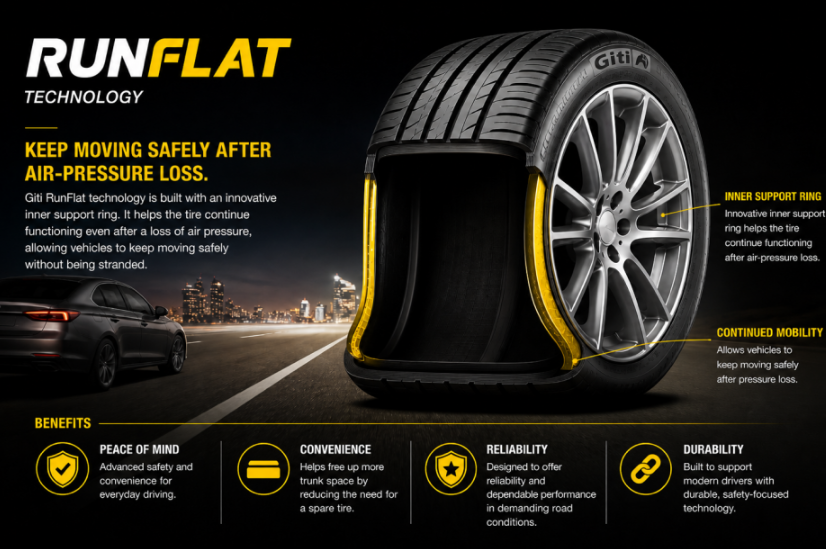
Run flat tires and regular tires serve the same basic function but use fundamentally different approaches to keep you driving safely. The choice between them affects everything from your safety during a roadside emergency to your ride comfort on daily commutes, from upfront tire costs to long-term repair expenses. Understanding what are run flat tires and how run flat tires work provides essential context, but this comparison examines the practical differences that matter when you’re deciding which types of run flat tires to consider versus staying with conventional options.
How They Work: The Core Difference
Regular tires depend entirely on air pressure to support vehicle weight and maintain structural integrity. When a conventional tire loses air from a puncture, the sidewalls collapse under the vehicle’s weight. The tire immediately loses load-bearing capacity and must be replaced or repaired before you can continue driving safely.
Run flat tires use reinforced construction that maintains structural support even at zero air pressure. Self-supporting run flat designs incorporate sidewalls engineered to be substantially thicker and stiffer than conventional tires. These reinforced sidewalls can support the vehicle’s full weight temporarily after complete air loss. Support ring systems use an internal ring structure beneath the tread that bears the load when pressure drops. Both approaches allow continued driving for limited distances at reduced speeds.
This fundamental construction difference cascades into every other aspect of performance, cost, and user experience.
Safety During Punctures
Regular tires create immediate hazard when punctured at highway speeds. The sudden pressure loss causes rapid deflation, which can trigger vehicle instability, steering pull, and loss of control if the driver doesn’t respond quickly and correctly. Changing a tire on a busy highway shoulder exposes drivers to traffic danger. AAA data shows roadside tire changes account for significant injuries annually, particularly on high-speed roadways where passing vehicles can strike stopped motorists.
Run flat tires eliminate the immediate roadside stop requirement. When punctured, the tire maintains its shape and continues supporting the vehicle. Steering remains responsive, braking stays predictable, and vehicle stability is preserved. Drivers can continue to a safe location or service facility rather than stopping immediately in potentially dangerous conditions. Most run flat tires allow driving up to 50 miles at speeds not exceeding 50 mph after complete pressure loss, though premium support ring systems may allow 80 to 100 miles.
For solo drivers, night commuters, and frequent highway travelers, this safety advantage represents the primary value proposition of run flat technology.
Ride Comfort and Handling
Regular tires deliver superior ride comfort through flexible sidewall construction. When the tire encounters road irregularities like potholes, expansion joints, or rough pavement, the relatively compliant sidewall flexes momentarily to absorb the impact energy before springing back. This cushioning effect isolates passengers from road harshness and contributes to the smooth, quiet ride modern drivers expect.
Run flat tires sacrifice some comfort for their safety capability. The reinforced sidewalls required to support vehicle weight at zero pressure are substantially stiffer than conventional construction. Self-supporting run flats use sidewalls approximately three to six times thicker than standard tires. This stiffness reduces the tire’s ability to absorb road impacts, transmitting more vibration and harshness directly through the suspension into the cabin.
Consumer Reports testing consistently shows run flat equipped vehicles scoring lower on ride comfort metrics compared to identical vehicles on conventional tires. The difference becomes most pronounced on poorly maintained roads, over expansion joints, and during pothole impacts.
Modern run flat designs have narrowed this comfort gap significantly. Technologies like Giti’s GitiSilent noise reduction system reduce cabin noise by 2 to 4 decibels compared to earlier run flat generations. Bridgestone’s DriveGuard Plus and Michelin’s latest ZP designs incorporate advanced rubber compounds and construction techniques that improve comfort while maintaining extended mobility capability. However, physics still imposes fundamental trade-offs between sidewall rigidity needed for deflated operation and the flexibility that creates comfortable ride quality.
Handling characteristics also differ. Run flat tires often provide improved cornering stability due to their stiffer sidewalls resisting flex during aggressive driving. However, this same stiffness reduces steering feedback and road feel that performance oriented drivers value. Conventional tires generally offer more natural, communicative handling.
Cost Comparison
Regular tires cost substantially less both initially and over the vehicle’s ownership lifecycle. Mid range conventional all season tires typically range from $100 to $150 per tire for passenger vehicles. Premium performance or specialty tires may cost more, but the category overall remains affordable with extensive competition among manufacturers.
Run flat tires command premium pricing. Self supporting run flat tires typically cost 35 to 100 percent more than comparable conventional tires, ranging from $150 to $250 per tire for mid range applications. Premium support ring systems and high performance run flats can exceed $300 to $400 per tire. This reflects genuinely higher manufacturing costs including specialized rubber compounds, additional reinforcement materials, more complex construction processes, and lower production volumes compared to mass market conventional tires.
The cost differential compounds over time. If conventional tires cost $500 for a complete set and run flats cost $800 to $1,200, the driver pays $300 to $700 more per tire purchase. Over typical vehicle ownership involving three or four tire replacements, this premium totals $900 to $2,800 in additional tire costs.
Tread Life and Wear
Regular tires generally deliver longer tread life under normal driving conditions. Industry research from J.D. Power indicates conventional tires typically last approximately 50,000 to 60,000 miles for quality all season designs, with some premium models exceeding 70,000 miles.
Run flat tires wear approximately 6,000 miles sooner than equivalent conventional tires according to J.D. Power data. Drivers should expect roughly 44,000 to 54,000 miles from run flat tires under similar conditions. The accelerated wear stems from several factors. The stiffer construction creates slightly higher rolling resistance, generating more friction and heat during operation. The reinforced sidewalls are heavier, which increases heat buildup. The reduced sidewall flex means the tire scrubs marginally more during cornering and acceleration.
This shorter lifespan represents real economic impact. If run flats cost 50 percent more initially and wear out 12 percent faster, the total cost of ownership increases substantially compared to conventional alternatives.
Repairability
Regular tires can often be repaired when damaged, significantly reducing ownership costs. A simple tread puncture in a conventional tire typically costs $20 to $40 to repair professionally. Many punctures are repairable if they meet basic criteria including tread area location, appropriate size, and no sidewall damage.
Run flat tires face severe repair limitations. Most manufacturers state run flat tires cannot be repaired if the tire has been driven while deflated, even briefly. The reason involves invisible internal damage. When you drive on a deflated run flat, the tire’s internal structure experiences loads and stresses beyond design parameters. This can cause heat damage to rubber compounds, layer separation between components, micro fractures in steel reinforcements, and bead deformation. This damage is invisible from external inspection but compromises tire integrity.
Manufacturer repair policies vary but remain restrictive. Pirelli explicitly prohibits any run flat tire repair under any circumstances. Continental and Bridgestone permit repair only under very specific conditions including tread area puncture only, confirmation the tire was not driven deflated, and professional inspection verifying no internal damage. Michelin maintains similar strict conditions.
Practically, most tire shops will not repair run flat tires due to liability concerns and the difficulty confirming the tire’s deflation driving history. Drivers should budget for replacement rather than repair after any run flat puncture.
Cargo Space and Weight
Regular tires require carrying a spare tire, jack, and lug wrench. These components typically consume 35 to 50 pounds of weight and 60 to 80 liters of cargo volume in the trunk or storage area.
Run flat tires eliminate spare tire requirements. Many run flat equipped vehicles from manufacturers like BMW, Mercedes, and Mini come from the factory without spare tires. This frees significant trunk space, particularly valuable in compact cars, sports cars, and electric vehicles where every liter matters.
The weight savings provides marginal fuel efficiency improvement, though this is partially offset because run flat tires themselves weigh 20 to 40 percent more than conventional tires due to their reinforced construction. The net weight impact varies by vehicle but typically still favors run flats slightly.
Availability and Selection
Regular tires offer extensive availability and selection. Virtually every tire retailer stocks conventional tires in common sizes. Drivers can choose from dozens of brands and hundreds of specific models spanning all season, summer, winter, touring, performance, and specialty categories. This competition keeps prices competitive and ensures replacement options exist even in smaller towns.
Run flat tires represent approximately 12 percent of the passenger tire market. Selection is substantially more limited, particularly outside major metropolitan areas. Rural tire shops may not stock run flats or may require special ordering with extended wait times. The variety of tire models available in run flat versions is considerably smaller than conventional offerings.
If you need a replacement while traveling, finding your specific run flat tire size and brand locally may be difficult or impossible, potentially requiring towing to a larger city with appropriate inventory.
Maintenance Requirements
Regular tires require standard maintenance including monthly pressure checks, periodic rotation, alignment monitoring, and tread depth inspection. Drivers should carry a functional spare tire and know how to change a tire safely or have roadside assistance coverage.
Run flat tires require identical maintenance with one critical addition. Because deflated run flats look identical to properly inflated tires, a functioning Tire Pressure Monitoring System becomes absolutely essential rather than merely helpful. TPMS is federally mandated on all vehicles sold after September 1, 2007, but for run flat owners, maintaining TPMS in working condition is non-negotiable. Dead TPMS sensors must be replaced promptly. The system malfunction light requires immediate diagnosis and repair.
Which Tire Type Is Right for You?
Choose run flat tires if:
Your vehicle came factory equipped with run flats (BMW, Mini, Mercedes, Lexus). Switching to conventional tires requires adding spare tire equipment.
You prioritize safety and convenience over cost and comfort. The ability to continue driving after puncture justifies the premium and firmer ride.
You frequently drive alone, at night, or on highways where roadside stops would be dangerous. Solo commuters and frequent travelers benefit most.
Trunk space is valuable to you. Compact cars, sports cars, and electric vehicles where cargo volume matters.
You live within 50 miles of tire service facilities. The limited extended mobility range works for your geography.
Choose regular tires if:
Ride comfort is your top priority. You want the smoothest, quietest ride possible and will accept roadside tire change inconvenience.
You are budget conscious. Lower purchase price, longer tread life, and repairability reduce total ownership cost.
You drive in rural areas far from service facilities. The 50 mile limit may not reach help in remote regions.
You already have comprehensive roadside assistance. The safety advantage of run flats becomes less compelling with reliable towing coverage.
You want maximum tire selection and availability. The broader conventional tire market offers more choices at every price point.
Frequently Asked Questions
Can you switch from run flat tires to regular tires?
Yes, but you must replace all four tires simultaneously and arrange for spare tire equipment. Many vehicles equipped with run flats from the factory lack the jack, lug wrench, and spare tire mounting hardware conventional tire users need. You will need to purchase these items and find secure storage in your vehicle. Never mix run flat and conventional tires on the same vehicle as the handling differences create safety hazards.
Do run flat tires last as long as regular tires?
No. Industry research shows run flat tires typically wear out approximately 6,000 miles sooner than comparable conventional tires. Expect roughly 44,000 to 54,000 miles from run flats compared to 50,000 to 60,000 miles for conventional tires under similar driving conditions. The stiffer construction and higher rolling resistance contribute to accelerated wear.
Are run flat tires more expensive than regular tires?
Yes, significantly. Run flat tires cost 35 to 100 percent more than comparable conventional tires initially, ranging from $150 to $400+ per tire compared to $100 to $150 for conventional options. They also cannot usually be repaired after puncture, requiring expensive replacement. Over vehicle ownership, total tire costs can be $900 to $2,800 higher with run flats.
Why do run flat tires ride rougher than regular tires?
The reinforced sidewalls required to support vehicle weight at zero pressure are substantially stiffer than conventional tire construction. This stiffness reduces the tire’s ability to flex and absorb road impacts, transmitting more vibration and harshness into the cabin. Modern run flat designs have improved comfort considerably but cannot fully eliminate the physics trade off between rigidity and cushioning.
Can regular tires be used on vehicles designed for run flats?
Yes technically, but practical considerations apply. The vehicle will function normally on conventional tires. However, you must install spare tire equipment the vehicle lacks if it came with run flats from the factory. Additionally, the vehicle’s suspension tuning may have been calibrated for stiffer run flat characteristics, potentially affecting ride and handling slightly when switching to more compliant conventional tires.
Key Takeaways: Run Flat vs. Regular Tires
Safety and Convenience: Run flats allow 50 to 100 miles of driving after puncture, eliminating dangerous roadside stops. Regular tires require immediate replacement when flat, potentially stranding drivers.
Ride Comfort: Regular tires deliver smoother, quieter ride through flexible sidewall construction. Run flats transmit more road harshness due to reinforced sidewalls, though modern designs have narrowed this gap.
Cost: Regular tires cost $100 to $150 per tire with repair options available. Run flats cost $150 to $400+ per tire and typically require replacement rather than repair. Total ownership cost strongly favors conventional tires.
Tread Life: Conventional tires last approximately 6,000 miles longer than run flats under similar conditions, averaging 50,000 to 60,000 miles versus 44,000 to 54,000 miles.
Cargo Space: Run flats eliminate spare tire, freeing 60 to 80 liters of trunk space and saving 35 to 50 pounds weight. Regular tires require carrying spare equipment.
Availability: Conventional tires offer extensive selection with wide availability. Run flats represent only 12 percent of market with limited options, particularly outside major cities.
The Bottom Line
Neither run flat tires nor regular tires are universally superior. Each optimizes for different priorities. Run flats excel at emergency mobility and driver convenience, preventing dangerous roadside stops after punctures. This safety and peace of mind comes at measurable cost in purchase price, ride comfort, tread life, and repair flexibility.
Regular tires prioritize comfort, value, and practicality for drivers who accept the traditional puncture management approach using spare tires or roadside assistance. The substantially lower costs, smoother ride, longer lifespan, and repairability make conventional tires the economically rational choice for many drivers.
The decision should reflect your specific driving patterns, budget, safety priorities, and geographic context. Highway commuters traveling alone value run flat safety differently than occasional drivers in urban areas with comprehensive roadside coverage. Drivers in remote regions weigh the 50 mile extended mobility limit against different considerations than city dwellers always within service facility range.
Modern run flat technology has addressed many traditional complaints about ride quality and performance. Premium systems like Giti Tire‘s GitiControl P10 RunFlat with support ring technology and GitiSilent noise reduction deliver extended 80 to 100 mile mobility range with substantially improved comfort compared to earlier run flat generations. These advances are closing the experience gap while maintaining the core safety advantage.
