
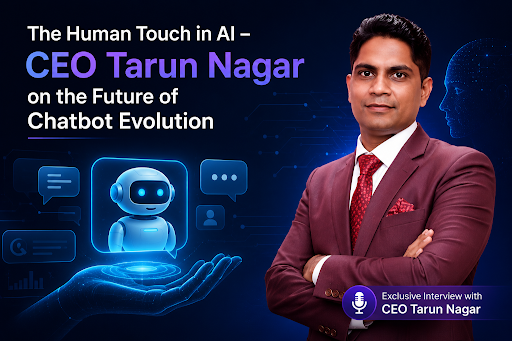
Artificial Intelligence is redefining the future of digital communication. From customer support automation to intelligent virtual assistants, AI chatbots are transforming how businesses interact with users across industries. But as technology advances, one important question remains: can AI truly replicate human connection?
In this exclusive Q&A interview, Tarun Nagar shares his insights on the evolution of chatbot technology, the importance of personalization in AI, and how businesses are preparing for the future of intelligent communication systems.
As the CEO of Dev Technosys, Tarun Nagar has witnessed the rapid transformation of AI-driven platforms and their growing impact on modern businesses worldwide.
Q1. How has chatbot technology evolved over the last few years?
A: Chatbot technology has changed dramatically in a very short period of time. Earlier chatbots were mainly rule-based systems that could only respond to predefined commands or scripted conversations. They lacked flexibility and often failed when users asked unexpected questions.
Today, AI-powered chatbots are far more advanced. Modern conversational systems use machine learning, natural language processing, and behavioral analytics to understand context, user intent, and communication patterns. Instead of simply answering questions, chatbots can now hold intelligent conversations, provide personalized recommendations, and automate complex tasks.
Businesses are no longer using chatbots only for customer support. They are becoming essential tools for sales, marketing, onboarding, engagement, and operational automation.
Q2. Why is the “human touch” still important in AI conversations?
A: Technology should make communication easier, but it should never remove the emotional aspect of human interaction. Customers still want empathy, understanding, and personalization when they engage with businesses online.
The biggest challenge in AI development is creating systems that feel natural instead of robotic. Users expect instant responses, but they also want meaningful interactions.
The future of conversational AI is not about replacing humans completely. It’s about combining automation with emotional intelligence. Businesses that understand this balance will create stronger customer relationships and better digital experiences, which is why partnering with an experienced AI Chatbot App Development Company has become increasingly important for modern enterprises.
Q3. What industries are benefiting the most from AI chatbot technology?
A: Almost every industry is adopting AI chatbots in some form today. However, sectors like healthcare, e-commerce, finance, education, travel, and real estate are experiencing especially rapid growth.
In healthcare, AI chatbots assist patients with appointment scheduling, health queries, and support services. E-commerce businesses use conversational AI for product recommendations and customer engagement. Financial institutions use AI to improve fraud detection and automate customer support operations.
We are also seeing increasing adoption in logistics, hospitality, and fintech industries where automation can significantly improve efficiency.
Q4. What should businesses look for when choosing an AI Chatbot App Development Company?
A: Businesses should focus on long-term scalability and technology expertise instead of only looking at pricing. A chatbot platform should be secure, flexible, and capable of evolving alongside future AI innovations.
Before choosing a development partner, companies should evaluate:
- AI and machine learning expertise
- Natural language processing capabilities
- Security standards
- Integration experience
- User experience design
- Scalability infrastructure
- Post-launch technical support
A chatbot is no longer just a customer support tool. It has become a core part of digital transformation strategies for many businesses.
Q5. AI agents are becoming a major trend. How are they different from traditional chatbots?
A: Traditional chatbots are usually task-specific and operate within predefined workflows. AI agents are much more advanced because they can perform autonomous actions, analyze data, and adapt continuously based on user behavior.
Businesses looking to Build an AI Agent are now focusing on intelligent systems capable of handling complex operations with minimal human involvement.
AI agents can:
- Automate workflows
- Analyze user behavior
- Make predictions
- Manage tasks independently
- Learn from interactions
This next generation of AI systems will significantly improve business productivity and operational efficiency.
Q6. How important is personalization in modern chatbot experiences?
A: Personalization is one of the most important factors driving customer engagement today. Users expect businesses to understand their preferences and provide customized experiences.
Modern AI chatbots analyze user interactions in real time to deliver:
- Personalized recommendations
- Context-aware conversations
- Customized notifications
- Behavioral insights
- Intelligent customer support
Personalized communication improves user satisfaction and helps businesses build stronger customer loyalty.
Q7. What role do artificial intelligence development services play in business growth?
A: Today, businesses are using artificial intelligence development services to improve efficiency, automate repetitive tasks, and enhance decision-making processes.
AI technologies are helping organizations:
- Reduce operational costs
- Increase productivity
- Improve customer experiences
- Analyze large datasets
- Strengthen cybersecurity
- Automate business operations
Companies that invest in AI early are gaining competitive advantages because they can adapt faster to changing customer expectations and market demands.
Q8. What factors influence the Cost To Develop A Chatbot?
A: Several factors affect chatbot development costs, including:
- Complexity of features
- AI and NLP integration
- Platform compatibility
- Third-party APIs
- Security requirements
- UI/UX design
- Cloud infrastructure
- Scalability needs
The Cost To Develop A Chatbot depends on several factors, including complexity, AI capabilities, integrations, and scalability requirements. A simple chatbot with limited automation features may require a smaller investment, while enterprise-level conversational AI platforms with advanced machine learning capabilities can involve much larger development budgets.
Businesses should focus on long-term business value instead of just short-term costs.Q9. How do you view the growing competition in the global chatbot industry?
A: The increasing competition in the AI industry is actually accelerating innovation globally. Companies around the world are investing heavily in conversational AI, automation, and intelligent systems.
This competition is helping businesses access more advanced technologies and better AI solutions than ever before.
At the same time, customer expectations are growing rapidly. Businesses now need AI systems that are faster, smarter, more secure, and capable of delivering highly human-like interactions.
The companies that prioritize innovation, user experience, and ethical AI development will lead the future of this industry.
Q10. What future trends do you expect in chatbot and AI technology?
A: The future of chatbot technology will focus heavily on emotional intelligence, voice-based interaction, and autonomous AI systems.
Some major trends we expect to see include:
- Voice-enabled AI assistants
- Emotion-aware conversations
- Hyper-personalized experiences
- AI-powered virtual employees
- Multi-language conversational systems
- IoT-connected AI assistants
- Predictive communication systems
AI will continue evolving from simple automation tools into intelligent digital companions capable of understanding human behavior more naturally.
Conclusion
The evolution of AI chatbots is transforming the future of digital communication by combining automation with more personalized and human-centered experiences. As businesses continue investing in conversational AI, the focus is shifting toward intelligent systems that can understand emotions, analyze behavior, and deliver meaningful interactions. The rise of Top Chatbot Development Companies In USA and other global technology firms is further accelerating innovation in AI-driven communication, helping businesses create smarter, faster, and more engaging customer experiences.
In this insightful interview, Tarun Nagar explains how AI is becoming far more than a support tool — it is now a key driver of digital transformation, customer engagement, and business growth. As chatbot technology continues advancing, businesses that embrace human-focused AI innovation will be best positioned to lead the future of intelligent communication.