
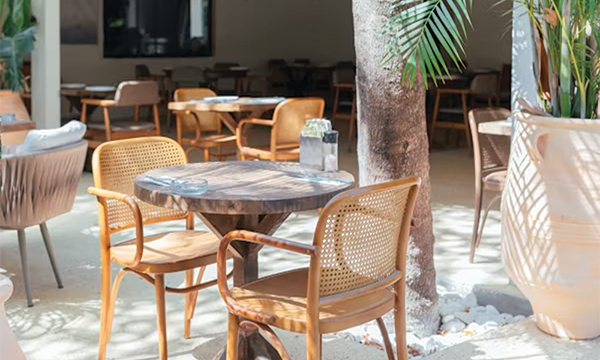
The patio was the business. The patio was twenty-four seats, one live oak, and about $310 on a decent Saturday. Then a ring of shelf fungus appeared at the base of that oak, the pavers around it started lifting, and a 1,400-square-foot cafe in Seminole Heights was suddenly facing a bill nobody had budgeted for. The owner could have closed the seating and waited for someone to tell her what to do, and instead she called a tree service tampa fl operators usually find by asking the shop next door, then paid for an assessment before she paid for any cutting. Reading the tree first cost her less than closing the patio would have, and a fraction of what an emergency callout runs. That is the whole argument of this piece, and her arithmetic is what makes it.
Fungus At The Base Started The Whole Problem
Conks, the shelf-shaped brackets that push out through bark, are decay announcing itself. They do not cause the rot. They show up after a fungus has already been eating through the trunk or the root flare, sometimes for years, which is why finding one is a timing problem rather than a discovery. What usually turns up on a call like this is a tree that looks fine from the sidewalk: full canopy, green leaves, no dead limbs a customer would ever notice, and a base telling a completely different story to anyone who bothers to crouch down and look at it. The lifting pavers were the second signal. Roots pushing upward can mean the root plate is moving, and a moving plate is a stability question, not a landscaping one.
Florida stacks the odds badly here. Storm season piles wind load onto whatever decay is already inside the wood, and a July 2026 safety advisory from a tree crew, written up in the Aspen Daily News, said the weeks right after a strong storm are when trees carrying hidden cracks, split trunks or root damage fail most suddenly. A cafe patio gets no grace period for that. She found the conks in early summer, which meant twenty-four chairs were sitting under an open question for the busiest storm stretch of the year.
An Arborist Read The Tree Before Anyone Cut
The assessment took under an hour. A certified arborist sounded the trunk with a mallet listening for the hollow note, checked the root flare where the conks had emerged, probed for soft wood, looked up for the crown dieback that tends to mirror internal decay, and estimated how much sound cross-section was left holding the thing up. The finding was not the one she braced for. Decay was real but localized, concentrated on one side of the flare, with enough solid wood remaining to carry the tree provided the load above that side came down. So the work order was small: a crown reduction on the heavy limb hanging over the seating, deadwood removal through the rest of the canopy, and a mulched root zone with the pavers pulled back off the flare instead of reset hard against it.
There is a rule of thumb in that worth keeping. If the fungus is out on a limb, taking that limb usually settles the question and the tree carries on. If it is at the base or on the root flare, assume the structural wood is already compromised and get a professional under it before anyone sits there again (waiting to see what happens is not a plan, it is just a slower way of finding out).
The Math Of Pruning Now Versus Closing Later
Run it the way an owner-operator runs everything, which is on the back of a receipt. Call the assessment $250 and the pruning, deadwood removal and root-zone work roughly $1,400, and the preservation route lands at about $1,650 all in, comfortably inside a repairs budget that stops at $3,000 a month. The other path prices out very differently: 24 seats dark at around $310 a day, and even a tidy nine-day closure while a removal crew, a stump grinder and a paver contractor each take their turn comes to $2,790 in lost patio revenue, before a single invoice for the removal itself has been opened. Those are illustrative figures rather than a quote, and yours will differ, but the shape of it holds at almost any scale, because the revenue clock keeps running whether or not the work is happening.
Removal also deletes an asset. That oak had been paying its way for twenty years, holding the afternoon patio temperature down far enough that August seating stayed usable, and no umbrella does that job. Replanting means a two-inch caliper tree in the same hole and a decade of waiting behind it. Preservation is not sentiment in a case like this. It is the cheaper line, right up until the wood is too far gone to trust, and the only person who can locate that line is someone qualified to read what is left inside the trunk.
Shade Is An Asset Worth Inspecting Every Year
Suppose the assessment had gone the other way. Visible decay at the base, conks on the root flare, or a root plate that is lifting means you rope off the seating under the entire canopy and keep people out from under it until a qualified arborist has been there, and if any part of that tree is close to a power line, that is a call to the utility and never a job for staff with a ladder. The International Society of Arboriculture recommends that judging how serious a tree’s defects really are be left to a professional arborist, who should assess the tree before anyone works or gathers beneath it, which is the standard her assessment was measured against. An umbrella blows over and everybody laughs. A limb the thickness of your arm does not.
The patio stayed open through the season, and the pavers were reset with room around the flare. She has the same crew back once a year now for a look at the base and the crown, which costs less than one slow Saturday and replaces guesswork with a record of what actually changed since the last visit. Any tree service tampa fl business owners keep on file will tell you the same thing about the trees over their seating: the expensive one is almost never the tree somebody inspected, it is the tree nobody looked at until a storm made the decision instead.