
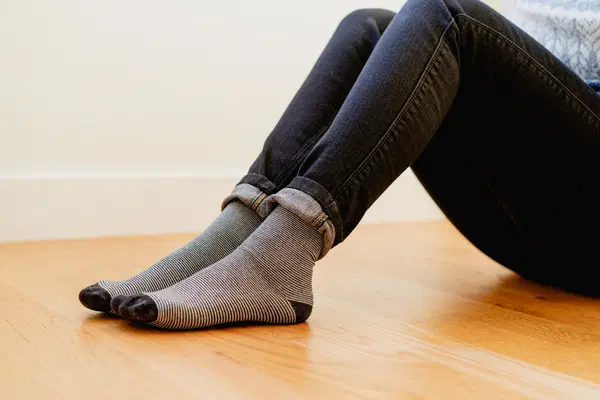
Long-distance travel — whether by train or road — places demands on the body that most people underestimate until they’re halfway through a twelve-hour journey with aching feet, poor circulation, and the quiet regret of having packed the wrong socks. Footwear comfort is one of the most consistently overlooked aspects of travel preparation, particularly for women who spend extended hours seated, walking through stations, or standing on platforms in variable temperatures.
The problem is rarely dramatic. It builds slowly. Feet swell during long sits. Temperature shifts between heated train cars and cold outdoor platforms create a cycle of overheating and chill. Synthetic materials trap moisture, which leads to discomfort, odor, and in colder conditions, genuine cold. By the time the discomfort becomes noticeable enough to act on, you are already hours from any practical solution.
Wool socks address most of these issues in a straightforward way — not because they are marketed as a premium product, but because the material properties of wool align well with the actual conditions of extended travel. This guide is written for women who want to make an informed choice, not one based on brand claims or vague comfort language.
Why Wool Performs Differently Than Other Materials During Extended Travel
When evaluating wool socks for women as a travel option, it helps to understand what wool actually does at a material level, rather than taking comfort claims at face value. Wool fiber has a natural crimp structure that traps air between fibers. This air acts as insulation in cold conditions and allows heat to escape when temperatures rise. The result is a fiber that self-regulates to some degree — not perfectly, but meaningfully better than cotton or most synthetic blends under fluctuating conditions.
This matters on a train or in a vehicle because the temperature environment is rarely consistent. You move from a cold platform into a heated car, then step off again at a stop. Outdoor conditions may change entirely over the course of a journey. A synthetic sock retains heat when it’s hot and provides little insulation when it’s cold, because it has no inherent thermostatic behavior. Cotton absorbs moisture readily but dries slowly, which creates a damp environment against the skin that compounds both cold and friction-related discomfort.
Moisture Management and Why It Matters Over Long Periods
Wool is a naturally hygroscopic fiber, meaning it can absorb moisture vapor — including perspiration — without feeling wet to the touch. According to the Woolmark Company’s published fiber research, wool can absorb a substantial percentage of its weight in moisture while still maintaining a dry surface feel. For travelers, this translates directly into extended comfort without the need to change socks mid-journey.
During long seated periods, feet perspire at a low but continuous rate. Over several hours, even light moisture accumulation in a non-wicking sock creates friction, softens the skin, and in colder environments, accelerates heat loss. Wool’s ability to manage this moisture passively — without relying on synthetic wicking channels that can become saturated — keeps conditions at the foot more stable across the duration of a trip.
Odor Resistance as a Functional Property, Not a Marketing Claim
Odor in socks is primarily caused by bacterial activity, which accelerates in warm, moist environments. Because wool manages moisture more effectively than synthetic or cotton alternatives, the conditions for bacterial growth are less favorable. Wool also contains lanolin and natural protein compounds that have inherent antimicrobial properties, which further reduce odor development over extended wear periods.
For a traveler on a multi-day trip with limited luggage, this is practically significant. A quality wool sock worn on the first day of travel is likely to remain comfortable and odor-neutral enough for a second wear without laundering — something that is not reliably true of synthetic or cotton options. This is not a hygiene compromise; it is a material reality that experienced travelers often discover through direct comparison.
Understanding Wool Weight and Construction for Travel Conditions
Not all wool socks are built for the same purpose, and the differences in weight and construction have real consequences for comfort during travel. Wool sock weight — often described loosely as lightweight, midweight, or heavyweight — refers to the density of the knit and the thickness of the finished sock. Each serves a different set of conditions, and selecting the wrong weight is one of the most common mistakes travelers make.
Lightweight Wool for Warm Environments and Mixed Indoor Use
Lightweight wool socks use a finer, less densely knitted construction that provides the core benefits of wool — moisture management, temperature moderation, odor resistance — with minimal bulk. These are well-suited for women who spend most of their travel time in climate-controlled environments: train cars with consistent heating, long road trips in modern vehicles, or airport transitions into warm destinations.
The reduced bulk also matters for women who wear fitted shoes or ankle boots, where a thicker sock would change the fit of the footwear enough to create pressure points or reduce comfort. Lightweight options sit close to the foot and behave more like a refined everyday sock than a hiking or outdoor product.
Midweight Wool for Variable Conditions and Longer Outdoor Exposure
Midweight wool socks provide more cushioning underfoot and retain more warmth, making them appropriate for travel that involves genuine outdoor exposure — walking between vehicles, waiting on open platforms, or moving through cold-weather destinations on foot. They work well for women who travel in transitional seasons or to destinations where temperatures can shift significantly between morning and afternoon.
The added cushioning also reduces fatigue during extended walking — a factor that matters more than most travelers anticipate when moving through large train stations, airports, or urban areas on foot. A midweight wool sock absorbs more impact energy than a thin sock, which reduces the cumulative strain on the soles of the feet over the course of a long travel day.
Fit and Construction Details That Affect Long-Haul Comfort
Material choice matters, but construction quality determines how well that material actually performs in practice. A poorly constructed sock — even one made from quality wool — will bunch, slip, create pressure ridges, or wear out at the heel before the material delivers its promised benefits. For travel specifically, construction details that might be irrelevant during a short commute become meaningful over eight to twelve hours of wear.
Seam Placement and Its Effect on Prolonged Wear
The toe seam is one of the most common sources of irritation during extended travel. A raised or poorly positioned seam creates a pressure point that becomes increasingly noticeable as the hours pass — especially in closed footwear where there is no way to adjust the fit. Women’s wool socks designed for travel often feature flat-knit or hand-linked toe seams that lie flush against the fabric, eliminating the ridge that causes friction.
This is worth checking explicitly when evaluating options, because seam construction is rarely advertised prominently but has an outsized effect on actual travel comfort. If you are purchasing socks online, looking at construction details rather than material descriptions alone will give you a more accurate picture of how the product will perform.
Elastic Construction and the Risk of Restriction During Sitting
Extended sitting — which defines most train and road travel — causes moderate swelling in the lower legs and feet. A sock with overly aggressive elastic at the cuff can create a tourniquet effect that compounds this swelling and reduces circulation over time. This is more than a comfort issue; reduced circulation during long sedentary periods is associated with fatigue, leg discomfort, and in susceptible individuals, more serious vascular concerns.
Wool socks designed specifically for travel or everyday extended wear tend to use lighter elastic constructions that hold the sock in place without constricting. The difference between a sock designed for athletic use — which often has a tighter elastic to prevent slipping during movement — and one designed for extended sedentary or mixed-use travel is relevant and worth attention when choosing.
Practical Considerations for Packing and Multi-Day Travel
Women who travel frequently, particularly for work or extended personal trips, make packing decisions that balance weight, volume, and versatility. Wool socks for women offer practical advantages in this area that go beyond material performance during wear.
- Wool socks compress well without losing their shape, making them efficient for luggage packing compared to thicker synthetic alternatives that retain more volume under compression.
- Because wool manages odor and moisture effectively, fewer pairs are needed for trips of equivalent length compared to cotton or synthetic options, reducing overall sock volume in the bag.
- Wool dries relatively quickly after hand washing and can be refreshed overnight when access to full laundry facilities is limited — a practical reality of multi-day travel in hotels or on extended rail journeys.
- Wool maintains its shape and elasticity through repeated hand washing better than many synthetic performance fabrics, which can degrade or pill after frequent laundering.
- A single pair of midweight wool socks can serve across varied conditions in the same trip — train travel, outdoor walking, cooler evenings — reducing the need to pack condition-specific footwear.
What to Avoid When Selecting Wool Socks for Travel
Understanding what to avoid is as useful as understanding what to look for. Several common choices reduce the practical performance of wool socks in travel contexts, and these are worth being explicit about.
Socks labeled as wool blends with high synthetic content — sometimes listed as containing as little as twenty percent wool — do not deliver the same temperature regulation or moisture management as higher-content wool options. The wool properties are diluted to a point where the blend behaves more like a synthetic sock with marginal wool benefit. If moisture management and temperature moderation are the primary reasons for choosing wool, the actual wool content in the fabric matters.
Heavily cushioned socks designed for hiking or cold-weather outdoor activity are often inappropriate for travel in footwear not designed for that level of insulation. The added bulk creates heat buildup in warm environments and changes the fit of regular footwear enough to cause pressure or instability. Travel-specific or everyday-wear wool socks are a more appropriate category than outdoor performance socks for most train and road travel contexts.
Conclusion: Making a Decision That Holds Up Across the Whole Journey
Choosing wool socks for travel is not a complicated decision, but it is one worth making deliberately rather than by default. The conditions of extended train or road travel — variable temperatures, prolonged sitting, limited opportunity to change clothing, and the cumulative effect of hours in enclosed footwear — create a specific set of demands that wool addresses more consistently than alternatives.
The practical guidance is straightforward: select a weight appropriate for your expected environment, prioritize construction quality and seam placement over brand presentation, verify actual wool content in the fabric, and choose a sock designed for extended everyday wear rather than specialized outdoor activity. These decisions, made before a trip, determine whether your footwear supports the journey or quietly undermines it.
For women who travel regularly by train or road, investing in two or three quality wool sock pairs is a small, durable change that compounds in comfort across every trip that follows.