
If you have ever tried to work out whether a UK online pharmacy is genuine, you have probably come across the same piece of advice again and again: look for the little green logo. It sat in the footer of the site, said “Registered Pharmacy” above a number, and clicked through to an official record.
That advice is now out of date, and it is worth knowing why before you buy anything.
The General Pharmaceutical Council ran that badge as a voluntary scheme. It closed to new applications in June 2025 and was discontinued, and from 31 December 2025, the GPhC disabled it from their online register. The older European logo went even earlier: Great Britain-based online sellers stopped being required to display it on 1 January 2021.
So if you are still hunting for a badge, you are looking for something that no longer proves anything. Worse, a fake site can simply copy the image. The real check takes about ninety seconds, and it is completely free.
Why this is worth ninety seconds of your time
Buying medicine online has become normal. Repeat prescriptions, hay fever treatment, contraception, hair loss treatment, travel jabs, and weight management support. A lot of it now starts with a form rather than a waiting room. That convenience is genuine, and pharmacies have handled it well.
The problem is that demand has pulled in sellers who are not pharmacies at all.
The consequences are not theoretical. The GPhC’s public warning on this is blunt: fake pharmacies often sell medicines with the wrong ingredients or the wrong dose, and fake medicines have been found to contain impurities, including mercury, arsenic, rat poison and cement. Using one can also expose you to card fraud and identity theft.
You are also handing over your medical history, your address and your card details. Even if the tablets that arrive are harmless, the data is not.
The check that actually settles it
There is one authoritative answer, and it is the pharmacy register. Every legitimate pharmacy operating in Great Britain has to be on the General Pharmaceutical Council’s register, and the GPhC describes it as the only way to confirm a pharmacy is legally operating and meeting standards. If a pharmacy is not listed, do not use it.
Here is how to do it.
Step 1: Find the registration number on the site.
The GPhC registration number is usually in the “About us” section or at the bottom of the homepage. It is a seven-digit number beginning with a 9.
If you cannot find one anywhere on the site, stop there. That is your answer.
Step 2: Search the register.
Go to pharmacyregulation.org and open the pharmacy register. You can search by the pharmacy’s name or by the registration number.
Use the number rather than the name. Names get copied. Numbers are harder to fake convincingly, because the number has to return a record that matches everything else you are looking at.
Step 3: Compare the details, not just the fact of a match.
This is the step people skip, and it is the one that catches the cleverest fakes.
A dishonest site can lift a real pharmacy’s registration number and put it in their footer. The number will check out. What will not check out is the rest of it. Look at the register entry and confirm that the trading name, the owner and the premises address all match what the website tells you. If the site says it operates from Manchester and the register says the premises are in Croydon, something is wrong.
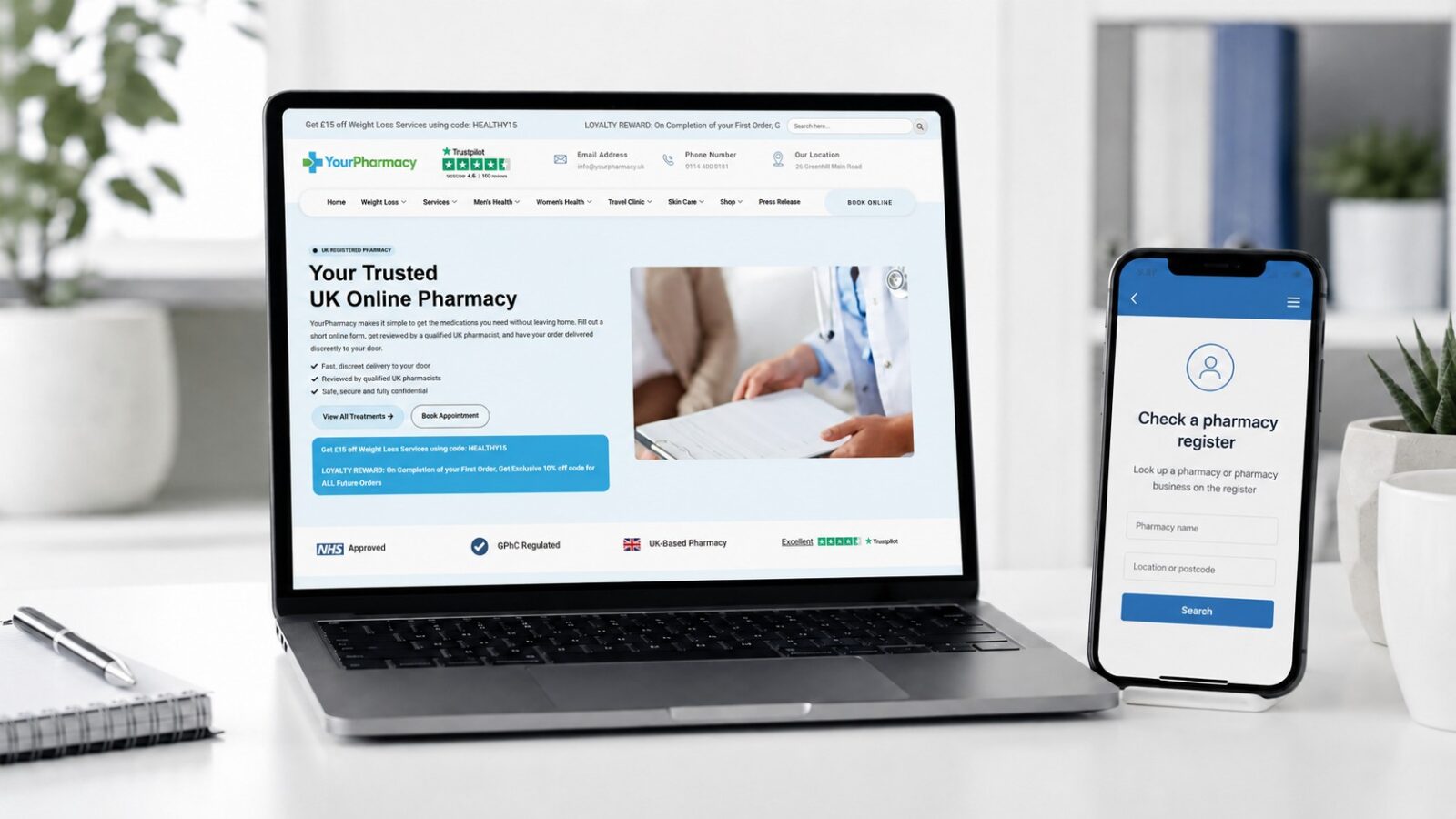
Take a real example. If you look at the footer of YourPharmacy, a pharmacy based in Sheffield, it lists premises number 9012029, a company registration number, a street address on Greenhill Main Road, and the name and individual registration number of the superintendent pharmacist. Every one of those can be checked independently, and the superintendent’s number can be searched on the separate pharmacist register. That is what a site with nothing to hide looks like. Use it as your benchmark when you assess anyone else.
If you are in Northern Ireland, the register is different
The GPhC covers England, Scotland and Wales. Pharmacies in Northern Ireland are regulated by the Pharmaceutical Society of Northern Ireland instead, so a Northern Irish pharmacy will not appear on the GPhC register, and that absence is not a red flag.
There is one more wrinkle. Because of the Northern Ireland Protocol, anyone in Northern Ireland selling medicines to the public through a website must still register with the MHRA and display the Distance Selling Logo on every page that offers medicines for sale. So in Northern Ireland, the logo still means something. In the rest of the UK, it does not.
What a UK-registered pharmacy always shows you
Registration is the hard test. These are the softer signals that tend to travel with it.
A named superintendent pharmacist. Every registered pharmacy has one, and they are personally accountable. A real pharmacy names them and gives their registration number. A fake one talks vaguely about “our team of experts”.
A physical address. Not a PO box, not just an email form. An actual premises address that matches the register.
A way to speak to a human. A phone number that a pharmacist actually answers, and ideally the opening hours to go with it.
Clarity about who owns it. A company name and company’s house number, usually in the footer or terms.
A proper clinical process for prescription items. More on that below, because it matters most.
Nine signs you should walk away
The MHRA and the GPhC publish a list of tell-tale signs. These are the ones worth committing to memory, in plain terms.
- You can add a prescription medicine to a basket and check out. ‘No prescription required for prescription medicines’ is a headline warning sign. If nobody assesses you, nobody is protecting you.
- Prescription-only medicines and their prices are splashed across the homepage. Advertising prescription-only medicines and prices to the public is illegal in the UK, so a site doing it openly is either ignorant of the rules or indifferent to them. Neither is reassuring.
- The web address contains a product name. Legitimate retailers do not build a URL around a medicine name.
- Guarantees that no medicine can honestly make. Claims like “100% safe”, “no side effects” or “quick results” are a recognised warning sign. Every effective medicine has side effects. A pharmacy that pretends otherwise is selling, not advising.
- The site feels rushed. Spelling and grammar mistakes, weak design and pop-up ads all point the same way. Real pharmacies are inspected. It shows.
- Payment in cryptocurrency. This appears on the official warning list, and for good reason. Crypto payments are close to unrecoverable.
- You are asked to disguise the transaction. Being told not to name the medicine or the website in your banking reference is not discretion. It is a seller avoiding scrutiny.
- No street address anywhere. A missing physical address appears on the official warning list too, and it is one of the easiest things to check.
- Aggressive delivery promises. A heavy emphasis on next-day delivery can be a sign that shortcuts are being taken, particularly when it sits alongside a consultation that takes thirty seconds.
None of these on its own is proof. Two or three together, with no register entry, is more than enough to close the tab.
The consultation test
For anything prescription-only, this is the part I would pay most attention to.
A real consultation is designed to find reasons not to prescribe. It asks about your other medicines, your medical history, allergies, and whether you are pregnant or breastfeeding. It sometimes asks for your GP’s details so the prescriber can share information. Occasionally it comes back and says no or asks you to see your GP first.
A fake consultation is a formality. Every answer leads to the same place: checkout. There is no follow-up, no monitoring and no named prescriber.
If a questionnaire feels like it exists to be passed rather than to assess you, that tells you what the service is for.
What to do if you think you have already used a fake pharmacy
Do not take anything that has arrived. Keep the packaging and the order confirmation.
You can report a suspicious online seller of medicines or medical devices to the MHRA and report a problem with a medicine itself through the Yellow Card scheme. Then contact your bank, because card details given to an illegal seller should be treated as compromised.
If you have already taken something and you feel unwell, contact NHS 111 or 999 if it is serious. Tell them what you took and where it came from. Nobody will judge you for it, and it helps them treat you properly.
Frequently asked questions
Is it legal to buy prescription medicine online in the UK?
Yes, as long as it comes from a registered pharmacy and a UK-registered prescriber has assessed you first. The illegal part is supplying prescription medicine without a valid prescription, not the internet.
Does the green “Registered Pharmacy” logo still mean anything?
Not in Great Britain. The GPhC discontinued the voluntary internet pharmacy logo scheme and disabled it from the register at the end of December 2025. Some sites still display the image out of habit. Check the register instead.
Do online pharmacies still have to show a registration number?
Yes. Online pharmacies must continue to display their GPhC registration number on their website.
Is a cheaper price a red flag on its own?
Not necessarily, since private prices vary a lot between pharmacies. It becomes a red flag when a very low price sits next to no prescription requirement, no address and no register entry.
What if the pharmacy is registered but I still had a bad experience?
Registration means the pharmacy is accountable, so use it. Complain to the pharmacy first, then to the GPhC if it is not resolved.
The short version
Finding a trusted UK online pharmacy has nothing to do with spotting a badge any more. Find the registration number, search the GPhC register, and check that the name, owner and address on the register match the site in front of you. Then look at how the site handles a prescription request, because a service that never says no is not a clinical service.
Two minutes of checking is a small price for knowing that what arrives is what it says on the box.
This article is general information, not medical advice. If you have questions about a specific medicine or your own health, speak to a pharmacist or your GP.