
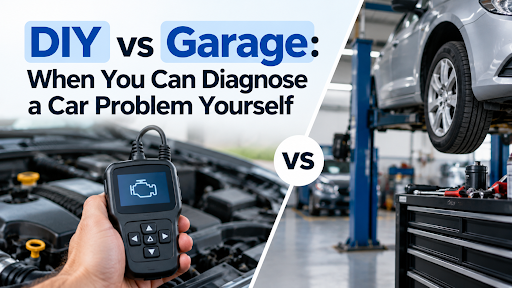
Something’s not right with the car. Maybe it’s a warning light, an odd noise, or it just doesn’t feel like it’s running quite the way it should. The question that follows is nearly always the same: Will you give it a try and attempt to figure it out, or will you book it straight into a garage and let others take care of it?
There isn’t one definitive right answer, as it really depends on the fault, your experience working with tools, and the amount of time you are willing to invest. What’s changed in the last few years is that DIY diagnosis has become a lot more realistic for ordinary drivers, not just people who grew up tinkering with engines. The tools and information that once resided in a dealer’s shop are now stored inside a lot of glove boxes.
Why More Drivers Are Trying DIY First
The obvious motivator is cost. An RAC survey of 2,000 UK motorists found that almost a quarter (23%) are either putting off servicing or undertaking some maintenance themselves, rather than booking it straight into a garage, with around 10% servicing their own car or getting assistance from a friend or family member. It is a trend that has become noticeable in the wake of rising running costs.
The RAC’s own take on this is worth bearing in mind before you get too enthusiastic: skipping proper maintenance altogether is “a false economy,” since problems left unchecked tend to snowball into more expensive repairs, and the RAC has warned that costs “are likely to snowball when things start to go wrong.” That’s not an argument against DIY diagnosis itself, though. It’s an argument for doing it right, which is to find out exactly what’s wrong before deciding your next step, rather than ignoring the issue and hoping it will get better, or spending money on a repair that may not be the right one.
There’s also a simple practical shift behind the trend. Over the past decade or so, cars have been increasingly transparent to their owners. The same OBD2 system that a dealer’s tech uses to plug in is available with a handheld scanner that costs less than a call-out to a garage, and the fault codes are written everywhere on the internet, including forums. None of that makes it easier to actually repair the car, but it makes it a whole lot easier to understand what is going on before you sign on to anything.
What You Can Reasonably Diagnose Yourself
A decent chunk of everyday car problems fall well within reach of a driver with a bit of patience and the right basic kit:
- Reading a warning light’s fault code. Any car built since the early 2000s has an OBD2 port, and a simple scan tool will tell you precisely which sensor or system triggered the light, rather than leaving you to guess.
- Battery health and charging issues. A failing battery, a loose battery terminal or a battery failure caused by a failing alternator will typically present fairly noticeable symptoms, such as slow starts, dim lights and a battery warning (which can be verified with a multimeter or simple battery testing device).
- Tyre-related problems. Examining the tread depth, tyre pressures and identifying any irregular wear patterns that may indicate alignment or suspension problems.
- Fluid levels and leaks. Determining what is under the car under the patch, whether it’s oil, coolant, or something less serious, as well as if levels are low.
- Basic bulb and fuse checks. Straightforward to diagnose and often just as straightforward to fix.
- Worn brake pads (by sight). Many cars display the thickness of the pad through the window of the wheel, providing a general indication of when the pad will need attention.
Where DIY Diagnosis Reaches Its Limit
There’s a real distinction between reading a fault code and figuring out what it means for the vehicle, and that’s typically where the DIY diagnosis gets stuck:
- Anything involving the airbag or SRS system. Get this wrong and you risk a safety system either not deploying when it should, or deploying when it shouldn’t.
- Transmission and gearbox faults. These typically require live data and expertise to determine if a sensor fault or a mechanical issue exists.
- Intermittent electrical faults. The kind that show up for two miles and then vanish. They can take a trained technician hours to trace and are a true test of patience even with the right equipment.
- Anything under warranty. Trying to do it yourself, including diagnosis in some cases, can make a warranty claim more complex, depending on the terms of your warranty provider.
- Faults you can’t confidently explain. If you’ve read the code, looked it up, and you still don’t know what it is telling you, that’s useful information too. It signifies that the task is meant to be done by a qualified individual.
The Middle Ground: Diagnose Yourself, Let a Garage Fix It
This is where most sensible drivers end up settling, and it’s arguably the smartest approach for anyone without a fully equipped home workshop. You don’t need to choose between “I’ll fix this entirely myself” and “I know nothing, take my money.” There’s a genuinely useful middle step.
Plugging in a scanner and reading the fault code before you book the car in means you walk into the garage with information instead of a vague description of a warning light. A set of iCarsoft diagnostic tools UK drivers commonly use for this covers most makes and models, so you can find out whether you’re dealing with a straightforward sensor fault or something that points to a bigger underlying issue, before a single spanner comes out.
This is important for two reasons. First, it can save you a diagnostic fee at the garage, because some will charge just to plug in and read the code you can read yourself in the driveway. Second, and more importantly, it protects you from a rogue quote. If you know the fault code is for a fairly minor and inexpensive sensor, a five-figure sounding repair estimate should raise an eyebrow, and you’re in a much stronger position to ask questions.
Getting Started: What You Actually Need
You don’t need a fully stocked garage to diagnose most common faults. A basic setup covers the vast majority of what an everyday driver will ever need:
- A code scanner. This is the single most useful piece of kit for turning a mystery warning light into a specific answer, and prices have come down enough that owning one no longer feels like overkill.
- A tyre pressure gauge and tread depth gauge. Cheap, small, and genuinely useful more often than most drivers expect.
- A basic multimeter. Handy for battery and electrical checks once you’re past the beginner stage.
- A torch and a set of ramps or axle stands, if you plan on getting a proper look underneath.
Beyond the kit itself, the other half of the equation is knowing where to look things up. Manufacturer forums, owners’ groups, and the fault code lists that come with most scanners will usually tell you whether a code is a five-minute fix or something that needs a second opinion. Read a couple of threads about your specific code before assuming you’ve got the full picture.
A Few Ground Rules If You’re Going the DIY Route
- Don’t disconnect the battery just to clear a light. It might switch the light off temporarily, but you’ve lost the fault code, and the underlying problem hasn’t gone anywhere.
- Cross-check what you find. A fault code points you in a direction; it doesn’t always confirm the exact cause on its own. It’s worth reading around the specific code for your make and model before assuming you know the fix.
- Know your own limits, and be honest about them. There’s a real difference between confidently swapping a sensor you’ve identified and improvising a fix for something you don’t fully understand.
- Keep a record. If you’ve read a code, noted symptoms, or tried a fix, that information is genuinely useful for a garage later, even if you don’t end up sorting the problem yourself.
So, DIY or Garage?
If the issue is something you can identify with a scan tool, look up, and understand with reasonable confidence, there’s nothing wrong with having a go, particularly for the kind of common, well-documented faults that make up most warning lights. If it involves safety systems, intermittent faults, or anything you can’t fully explain even after reading the code, that’s the point to hand it over to someone qualified.
Either way, the smartest habit any driver can build is finding out what’s actually wrong before deciding what to do about it. Whether that’s the end of the story or just the first step before a trip to the garage, it beats guessing every time.