
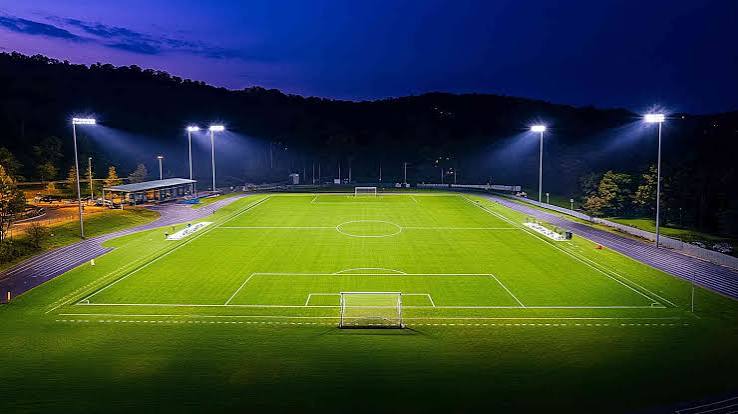
Soccer fields need light that is bright, even, and glare-free. Players track a fast-moving ball at night. Referees need to spot fouls from a distance. Spectators need clear sightlines. LED Soccer Field Lights meet these needs better than older metal halide systems.
Why LED Soccer Field Lights Replace Metal Halide
Metal halide fixtures take several minutes to reach full brightness. They also need a cool-down period before they can restart. LED Soccer Field Lights turn on instantly at full output. This matters during storm delays or scheduling changes.
LEDs also cut energy use. A metal halide fixture often runs 1,000 to 1,500 watts per unit. A comparable LED fixture can deliver the same or higher light output at 600 to 1,000 watts. Lower wattage means lower monthly bills.
Color quality is another factor. Metal halide light shifts color as the bulb ages, often turning greenish or dim well before it fully fails. LED output stays consistent across its full rated lifespan, so field color and brightness don’t drift year to year.
- Instant-on and instant-restrike, no warm-up delay
- 40-60% lower energy draw than metal halide for equal brightness
- Rated lifespan of 50,000-100,000 hours versus 10,000-15,000 for metal halide
- No mercury or hazardous gas inside the fixture
- Directional light output, so less light is wasted skyward
Foot-Candle Standards by Level of Play
Lighting requirements change based on who is playing and who is watching. The Illuminating Engineering Society sets the reference standard, known as IES RP-6. Foot-candle (fc) levels rise as the level of competition rises.
Recreational and youth fields need the least light. Professional and broadcast fields need the most, because television cameras require higher, more even illumination than the human eye alone.
- Recreational play: 20-30 foot-candles
- High school competition: 30-50 foot-candles
- College-level fields: 50-75 foot-candles
- Professional and broadcast fields: 75-100+ foot-candles
- Class IV low-spectator fields: minimum 20 foot-candles per IES RP-6
Uniformity Ratios Matter More Than Brightness Alone
A field can hit the right average foot-candle level and still play poorly under lights. The reason is uneven distribution. Dark patches and bright hot spots make the ball hard to track.
IES defines this with two ratios: U1 (max-to-min) and U2 (average-to-min). Lower ratios mean more even light. Professional fields require tighter control than recreational ones.
- U1 target for professional play: below 2.0
- U2 target for professional play: near 1.5
- Recreational field uniformity: up to 3:1 max-to-min is acceptable
- Uniformity is measured on a grid, typically 30×30 feet, at 3 feet off the ground
- Poor uniformity causes shadow gaps that slow player reaction time
Pole Height and Placement
Pole height controls both beam spread and glare. Short poles with wide beams work for small training fields. Tall poles with narrow beams work for large, high-level fields.
Most soccer fields use poles between 40 and 100 feet. Recreational and youth fields sit at the lower end. Professional and stadium fields sit at the higher end, since taller poles reduce glare for players looking upward during high balls.
- Recreational/training fields: 40-60 feet
- High school and club fields: 60-80 feet
- College and professional fields: 70-100+ feet
- Standard layout uses 4 to 8 poles along the sidelines
- Fixture aiming angle affects glare more than pole height alone
Fixture Specs to Check Before Buying
Wattage and lumen numbers on a spec sheet don’t tell the whole story. Two fixtures with the same wattage can produce very different field results. Check these details before you compare price.
Buy from a spec sheet, not a marketing headline. Ask for third-party photometric test data (LM-79) whenever possible.
- Lumen output: match to field size and required foot-candle level, not a flat number
- Beam angle: narrow (10-30°) for distance throw, wide (60°+) for close-range fill
- CRI (Color Rendering Index): 70+ for general play, 80+ for broadcast or livestreamed games
- IP rating: IP65 minimum for outdoor exposure to rain and dust
- Glare shields or louvers: reduce spill onto neighboring roads or homes
- Surge protection: 10kV minimum to handle grid spikes and storm surges
Energy and Maintenance Savings
The biggest cost in field lighting isn’t the fixture. It’s the electricity and labor over 10-15 years of use. LED fixtures reduce both.
Metal halide bulbs typically need replacement every 2-3 years under regular use. LED drivers and chips run far longer, so labor and bucket-truck costs drop sharply. Many utilities also offer rebates for switching to DLC-listed LED fixtures.
- Lower kWh usage cuts monthly utility costs directly
- Fewer bulb replacements means fewer service calls
- No ballast to fail or replace, unlike metal halide systems
- DLC or ENERGY STAR listing may qualify a project for utility rebates
- Typical payback period: 2-5 years depending on run hours and local rates
Installation Checklist
A photometric layout should come before any fixture purchase. This shows exactly how many fixtures, what wattage, and what pole height your specific field needs. Skipping this step often leads to under-lit or over-lit fields.
Local rules also matter. Some municipalities cap allowable light spill onto neighboring property. Confirm this before finalizing pole locations.
- Request a photometric study specific to your field dimensions
- Confirm electrical service can handle total fixture load
- Check local light trespass or glare ordinances
- Plan pole placement for even coverage across goal areas and sidelines
- Include access planning for future maintenance, such as raise/lower pole systems
Choosing a Supplier
Fixture quality varies widely between manufacturers. A low upfront price often means a shorter warranty and weaker driver components. Compare warranty terms directly, not just sticker price.
LED Light Expert provides fixtures built for soccer field applications, along with layout support for facilities upgrading from metal halide or planning a new installation.
- Compare warranty length on chips, drivers, and full fixtures separately
- Confirm DLC or ENERGY STAR certification for rebate eligibility
- Ask for a free photometric layout before purchase
- Request references from completed sports field installations
- Verify replacement parts are available long-term
Bottom Line
LED Soccer Field Lights deliver instant-on brightness, lower energy costs, and longer service life than metal halide systems. Match your fixture choice to IES RP-6 foot-candle and uniformity standards for your level of play. Get a photometric layout before you buy. This single step prevents the most common and costly lighting mistakes on soccer fields.