
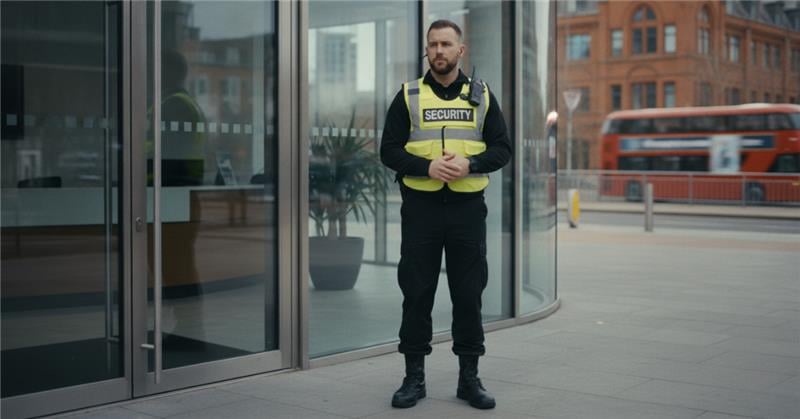
Whilst the record-breaking vertical growth of businesses and residents boosts the local economy in Birmingham, does it also not invite certain crime opportunities? Keypads and cameras hold value; yet can a lens stop an uninvited guest tailgating your staff?
Manned guarding services by Innovative Security provides a thinking, physical presence on your site. Professionals read about the atmosphere and redirect unwelcome visitors before conflict occurs, delivering a level of human intuition that passive IT systems lack.
This guide provides an in-depth look at manned guarding security Birmingham businesses can rely on, exploring current market trends, core responsibilities and the strict standards to become one.
Statistics on the Need for Manned Guards
According to the latest data from Grand View Research (2026), the international manned security market is estimated at $24.60 billion in 2025. It is projected to climb to an impressive $67.36 billion by 2033, expanding at a compound annual growth rate (CAGR) of 13.4%.
Parallel studies by Market Research Future (2026) value the baseline 2025 sector even higher at $30.12 billion. Within this landscape, standard security guards command the lion’s share of the market, accounting for over 69% of global revenue.
This trend is equally apparent across Europe, which represents around 30% of the global market. The United Kingdom remains a major contributor, supported by rigorous regulatory requirements and a strong emphasis on operational resilience.
Consequently, security personnel continue to play a central role in protecting people, property and business operations.
This prioritisation of physical security is evident in recent corporate decisions. In April 2025, the Bank of England awarded a major contract to secure its Threadneedle Street headquarters in London and its high-security printing facility in Essex.
When the nation’s core financial infrastructure chooses physical guards over digital alternatives, can a forward-thinking business afford to rely on silent screens alone or is it time to deploy the on-site security guards.
Why Manned Guarding Outperforms Tech
AI-powered observation depends on continuous power supply and stable connectivity. Businesses must therefore consider the impact of a system failure or local power interruption. A digital security perimeter can be compromised right away, leaving premises exposed to unauthorised access.
Beyond this, digital sensors operate without human discretion or situational understanding. They can generate false alerts triggered by harmless wildlife or changing environmental conditions. Without trained personnel on-site to evaluate and respond to these notifications, businesses may face unnecessary call-outs, avoidable costs and workflow interruption.
Contextual Judgement and Complex Decision-Making
Artificial intelligence is powerful at processing vast streams of data, yet its strength to interpret circumstances remains limited. A surveillance camera may identify an individual’s lingering near a restricted entrance, but it cannot distinguish between a genuine security concern and a visitor waiting for taxi.
Professional guards master these uncertain situations. By applying experience, situational awareness and informed decision-making, they help resolve misunderstandings before they escalate into unnecessary incidents.
The Unmatched Deterrent of Physical Presence
We must also consider the profound psychological influence of human observation. Individuals exhibit far less antisocial behaviour when they are aware of an active, watchful presence.
Recent studies suggest that property-related friction decreases by up to 31% in areas patrolled by marked security personnel. A visible, uniformed officer discourages an uninvited entry from ever taking place, whereas an active-deterrence camera wards off intruders by sounding alarms and flashing lights.
Core Duties of a Security Officer
The modern manned guarding carries responsibilities that extend far beyond roaming a building. Today’s manned guarding services merge quiet observation with high-level incidents and conflict management. When stationed on your premises, officers handle a distinct set of operational tasks:
- Checking credentials, issuing passes and, in a polite manner, preventing uninvited individuals from crossing the threshold, whilst maintaining detailed entry logs.
- Conduct regular sweeps of buildings, car parks and perimeters to spot potential vulnerabilities before they develop into real problems.
- Monitoring camera systems to investigate suspicious activity and coordinate an immediate physical response on the ground.
- Stepping in to de-escalate aggressive behaviour with grace, manage disputes and respond to sudden alarms or accidents.
- Safeguarding valuable inventory, heavy machinery and fleet vehicles from unexpected loss.
- Identifying physical hazards, reporting concerns and supporting strict compliance with your internal site regulations.
- Securing the premises at the close of business and executing strict locking protocols and out-of-hours guarding.
- Producing clear records of all shift activities and guiding evacuations alongside the emergency services when required.
Common Manned Guarding Deployment Approaches
Since different commercial environments present unique operations, businesses prefer to deploy personnel in specific ways to match the premises of infrastructure, operations uniqueness and the level of severity.
1. Static Guarding
Manned guards maintain a constant, immovable presence at a fixed point, such as a reception desk or a busy loading bay. They act as the primary point of contact for contractors and visitors, keeping strict control over who enters commercial offices and industrial facilities.
2. Mobile Patrol Security
Roving officers use uniformed deployed SIA-licenced officers in marked vehicles to inspect multiple areas at unpredictable times. This movement discourages opportunists who might otherwise attempt to study a static guard’s daily routine.
3. Night and Out-of-Hours Protection
Defenselessness, by itself, increases the moment your regular staff head home. Night security officers or 24/7 security guards service are deployed to protect buildings, assets and infrastructure during evenings, weekends, bank holidays and other periods of low occupancy.
For example, a warehouse storing high-value inventory may rely on overnight security personnel to perform perimeter checks, monitor vehicle movements, investigate unusual activity and coordinate responses to alarm activations.
4. Keyholding and Alarm Response
Assigning late-night responsibilities removes the risk of sending your own employees to investigate triggered alarms in the dark. The security guards hold your building keys. If a system activates, a trained officer travels to the site to resolve the situation and secure the building.
5. K9 Security
Expert, trained to use controlled aggression, work alongside trained security dogs such as the Belgian Malinois and German Shepherd to sweep vast areas that might otherwise is too complex for human senses alone.
As dogs possess olfactory capability, they can track human scent through wind currents (“air scenting”) and locate hidden individuals.
Trained dogs can work in pitch-black conditions, poor weather and alongside heavy machinery without losing focus on their patrol routines
What Skills Do Professional Guards Possess?
The modern security professional relies on far more than a basic physical presence. When you place an officer on your site, you integrate a multi-skilled professional into your daily operations.
1. Situational Awareness
Before a threat ever occurs, trained officers sense the environment. They notice subtle shifts in behaviour and spot quiet vulnerabilities that an untrained eye misses, allowing them to stop problems at its earliest.
2. Conflict Resolution and De-escalation
When conflict arises, physical intervention always remains the last resort. Professional guards use tactical communication and polite authority to defuse aggressive behaviour with grace, guiding tense situations back to a calm state without drawing unwanted attention.
3. First Aid and Crisis Management
During sudden medical incidents or emergencies, time becomes critical. Licenced personnel hold essential first aid qualifications, allowing them to stabilise injured individuals and safely manage the immediate scene whilst waiting for paramedics to arrive.
4. Technological Awareness
Physical security is no more than about locks and guards; it’s now a high-tech operation. Officers, on a regular basis, use complex digital ecosystems, manage advanced camera networks, electronic access controls and digital incident reporting tools alongside their traditional duties.
Uniforms and Equipment
When outfitting a guarding team to maintain order, providers rely on several distinct categories of uniforms and equipment.
- Operatives wear recognisable clothing featuring clear company branding and SIA-compliant badging. Corporate concierge staff wear formal blazers and ties to blend into lobbies, whilst retail officers rely on durable formal trousers and rugged shirts.
- Bright coloured vests and jackets make personnel to be recognisable during crowded gatherings, low-light conditions or sudden emergency evacuations.
- Officers spend long hours conducting foot patrols. Slip-resistant, steel-toed safety boots act as a standard issue, protecting against workplace hazards whilst providing necessary comfort.
- In higher-risk environments, personnel wear stab-resistant and ballistic armour, either beneath their clothing or as part of a tactical rig. This layer protects against sharp objects, mitigating the fear of life-threatening injuries.
- Many Manned officers also waers base layers like kevlar designed to prevent cuts during unexpected physical altercations.
- In the UK, carrying rigid bars or chain handcuffs requires specific training. Officers may only apply these restraints in strict accordance with legal guidelines surrounding reasonable force.
- Security personnel act as immediate first responders. Carrying trauma kits, complete with bandages, CPR masks and tourniquets, allows them to stabilise injured individuals and save lives before paramedics arrive.
- Portable push-to-talk devices remain the industry standard for instant coordination. They connect officers to central command rooms and team leaders. Earpieces allow for discreet conversations when passing sensitive information.
- These compact recorders sit on an officer’s chest. The simple presence of a recording device discourages anti-social behaviour. If a situation does escalate, the camera captures clear, court-ready digital evidence.
- Beyond providing illumination during dark patrols, a robust, weighty torch serves as a deterrent, offering a practical defensive tool should a late-night encounter escalate.
The Standards and Compliance Behind the Uniform
The Security Industry Authority (SIA) dictates clear legal requirements for anyone performing these duties.
Which Licence Does an Officer Need?
The specific commercial environment and the required duties dictate the licence an individual must hold.
- Security Guard Licence:This covers traditional physical protection, including static guarding, retail security and regular site patrols where alcohol is not served or crowd control is not the primary focus.
- Door Supervisor Licence:This holds a much broader operational scope. It allows an individual to perform standard guarding duties, but it also legally permits them to manage crowds and control access at licenced premises, events or nightlife venues.
The mandatory background check now looks far deeper into an applicant’s history whilst applying for SIA licence. The expanded vetting process scrutinises overseas records for anyone who has lived abroad and reviews historical patterns of violent behaviour or disciplinary issues, keeping individuals of unfavourable character out of the industry.