
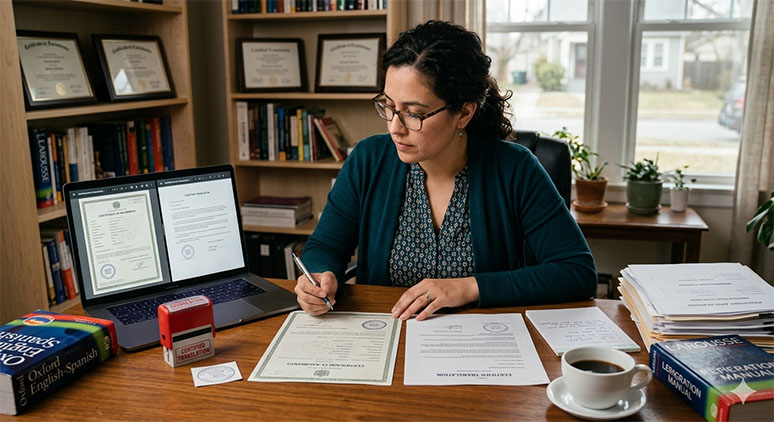
Whether you are applying for a visa, want Australian citizenship, or enrolling in a university, the quality and validity of your translated document can make or break your application.
There are strict requirements in Australia around certified translations, and it is essential that there are no errors or omissions, as otherwise you may find that your translation is not accepted and you may not get it back in time.
It is important to understand what renders a certified translation invalid in order to avoid using an invalid document when it is required in an official Australian proceeding.
What Is a Certified Translation in Australia?
A certified translation in Australia is a translation created by a certified translator, accredited by the National Accreditation Authority for Translators and Interpreters (NAATI).
NAATI is the nationwide regulating authority for the translation and interpretation profession. NAATI-certified translations are generally needed for documents in a language other than English when submitted to government agencies, courts, immigration authorities, or educational institutions.
A certified translation is not just a translation by a bilingual individual; it’s a formal, legally recognised document that bears the translator’s signature and certificate and their credentials.
These are the key constituents that are important to the document being accepted by any Australian government body.
Common Reasons a Certified Translation Is Rejected
-
Translator is not NAATI Certified
The most frequent reason why a translation is rejected is that the person who creates the translation does not have an active NAATI credential. A common error a number of applicants make is using a friend, family member, or even an uncertified interpreter to translate their documents.
-
Missing Translator Statement or Declaration
A certified translation should contain a declaration by the translator. This statement will generally confirm that the translation is accurate to their best knowledge, that they are a qualified NAATI Translators and that it is complete. If this statement is not included, the translation cannot be accepted for official submission.
-
Unfinished Translation of the Original Document
A certified translation should be a translation of the source document that is complete and accurate. Translators may not leave out parts of a document, summarise, or only translate parts. In the case of a stamp, a seal, or even a handwritten note included in the Birth Certificate, this part should be translated or precisely indicated in the translation
-
Wrong Format
Australia’s government departments typically require translations to be as close to the original layout as possible. If the original document is in a specific format (including tables, column headings, numbered fields, etc.), then the translation should be in the same format.
A translation that is a plain text block, as opposed to a structured form, could be marked as incomplete or misleading. Also, a copy of the original document should accompany the certified translation. Another frequent cause of rejection is the submission of just the translated text and the omission of the original text.
-
Changes or Corrections Without Attestation
The translator must initial and date any corrections made to a certified translation that are written over a word, crossed out, or made using correction fluid. If a document is not signed and sealed, a corrected copy may cause doubts about the integrity of the document, and can cast doubt on the validity of the document. It is invariably best to make a new, clean translation and not modify an existing one.
Police Report Translation: Special Considerations
In Australia, one of the most sensitive documents that may require translation for government submission is police reports. Police Report Translation is often needed for visa applications (especially character assessment), protection orders for domestic violence, lawsuits, and claims for insurance and compensation.
Australian police authorities pay special attention to the accuracy of police reports, which have legal consequences. A police report can be very legalistic in nature, and may contain specific codes, acronyms, legal terms, and local references that don’t necessarily translate well into other languages.
A translator who is not well-versed in legal or law enforcement matters may translate a charge category, type of offence, or the result of an investigation incorrectly, which could cause significant issues for the applicant.
Tips for Ensuring that Your Certified Translation is Accepted
When providing certified translations to Australian government authorities, be mindful of some important considerations to prevent delays and rejections:
- Always consult a current NAATI-certified translator and record their NAATI certification number.
- Provide a formal, signed statement from the translator that contains the translator’s complete identification.
- Please include the original document with a certified translation. The certified translation shall not be written on, folded in excess, or otherwise altered.
- If the police report or legal documents are to be translated, ask for a translator who has experience with legal translation.
- Make sure to retain copies of all documents, originals, translations, and declarations.
Final Thoughts
Submitting to the Australian government can be stressful, especially if there is a language barrier. Failure to obtain a certified translation that is acceptable for Australia can be time-consuming, expensive, and ultimately, can make an application fail.
When it comes to certified document translation, knowing what invalidates a translation and paying extra attention to sensitive documents like police reports will ensure your paperwork is proper the first time. Always ask directly of the relevant authority for their particular translation needs; pick your NAATI-certified translator wisely.