
Introduction
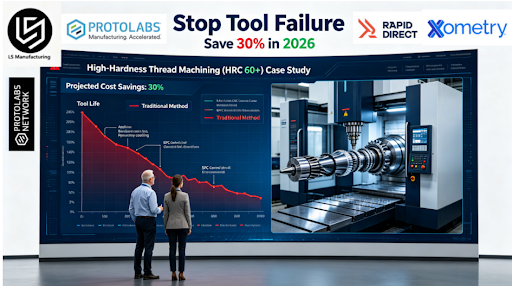
In today’s competitive environment where manufacturers are tasked with producing intricate parts, the issue of machining threads on highly hard material like HRC 60+ is a consistent problem that proves to be quite expensive. Manufacturers are constantly facing issues related to rapid tool wear, poor thread quality, and increasing costs, affecting project completion and overall profits.
This challenge emanates from the traditional techniques that fail to control cutting heat and tool deflections, thus producing micro defects and inaccuracies. This paper provides the readers with a detailed approach when choosing a precision CNC milling service, with a comprehensive review of service providers in the market up until 2026.
Understanding High Hardness CNC Milling and its Importance for Threading
High hardness CNC milling is a machining operation involving the precise machining of metals such as tool steel, powder metallurgy steel, and certain superalloys, which have been heat treated to obtain extraordinary toughness and wear resistance properties, usually above HRC 60. Such alloys are critical in fields like aviation, medical instruments, and automobile for parts that need to bear excessive load, temperature, and wear.
Threading operations like manufacturing of thread cutting taps using these metals bring forth difficulties, owing to the hardness of material, leading to accelerated wear and concentrated cutting forces, along with inadequate thermal conductivity. As a result, there are chances of thermally induced deformations, such as softening or micro cracking and geometric errors. Thus, precision CNC milling for thread cutting taps becomes crucial to tackle these issues. The machining of thread cutting taps utilizes modern techniques like trochoidal toolpaths and adaptive control to overcome these difficulties.
What are the Major Criteria of Choosing High-Level CNC Machining Precision Service Providers in 2026?
To choose a suitable provider for critical machined parts, it is necessary to go further than their fundamental qualities. The leading companies in 2026 can be identified through an excellence model involving three main aspects: technological strength, system quality, and compliance. Evaluation should be strict and based on certain criteria that can be verified.
l State-of-the-Art Technology and Machinery: The first criterion relates to core technical capability. Leading machining providers will have high-quality 5-axis simultaneous milling centers able to perform highly precise contours and micro-milling processes. In addition to technology, skills in CAD/CAM programming to perform difficult geometries and knowledge of optimal parameter values to use for different materials determine the reliability of a company. The above-mentioned technologies allow producing very complicated parts such as variable helix flutes in taps that cannot be manufactured using 3-axis milling.
l Full-Quality and Certified Quality Control Systems: But equipment alone is not sufficient, a good system to yield costumer quality result has to be implemented. For high class service it is perform a quality control plan with in process inspection, in process measurement in process and final measurement on CMM machine. Also all these works and measures are covered by official international certifications such as ISO 9001, IATF 16949 and AS9100D about respectively quality management, car industry production and aerospace production.. For instance, LS could be a partner with these qualities which show its capacity to be traceable and in process control along the chain.
l Full-Spectrum of Engineering Assistance: True cooperation implies teamwork. Top-notch suppliers have comprehensive assistance in DFM (design for manufacture) and will help you find the best possible design of your parts considering their cost, performance, and manufacturability. In addition, these partners’ capabilities include engineering and material science knowledge that is necessary for selecting the proper substrate, coating, and parameters for machining, particularly in the context of thread cutting tap milling.
What Are the Methods for Assessing a CNC Milling Company’s Competence in High Hardness Thread Machining?
The assessment of the company’s competence in the particular field of high hardness thread machining involves analyzing the company’s unique expertise and practical achievements. It should be noted that it is necessary to ensure the company’s competence regarding the complete physics of the process, and not only the equipment used.
1. Control over Complex Tool Geometry and Micro Precision
The demonstration of expertise lies in the proficiency to machine complicated flute geometries with micrometer precision. It involves designing varying helical and rake angles for efficient chip removal and minimized cutting pressure. A provider needs to show their competency in maintaining accuracies of thread profiles up to 2 microns, which demands not only a high level of precision machining equipment but also strict process control measures to counteract any heat-related changes, as discussed by CNC thread cutting factory specialists.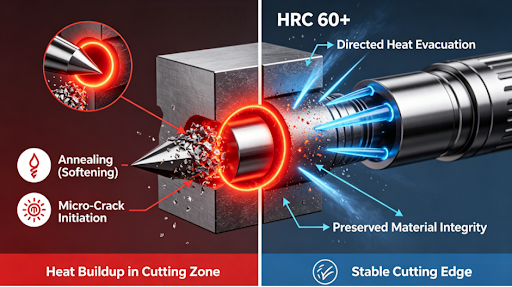
2. Strategic Mitigation of Thermal and Deflection Risks
What sets one apart from another is the strategy employed to battle the dual foes of temperature rise and deflection. Seek any indicators of innovative proprietary cooling methods for lowering temperatures and smart toolpath planning techniques such as trochoidal milling that reduce contact time between the tool and workpiece. In the context of slender taps, ask how they address the issue of deflection through advanced techniques like tailstock synchronization or toolpath offsetting in sub-micron precision levels.
3. Verification Through Case Studies and Process Transparency
Solicit real examples through case studies, datasheets on the hard tooling solutions. A reliable company should be able to provide concrete figures for the improvement (percent of increased tool life,100% scrap reduction rate, or even Ra values<0. 2m for Medical tools). Another way to test their expertise is asking about their closed-loop machining process and in process metrology procedures.
What Is the Relation Between Precision in Thread Milling and Service Life/Quality of the Part?
The relationship between milling precision and performance is very strong. The best CNC tap milling services don’t simply manufacture a part – they build its performance. From the mechanics of tool engagement through coolant delivery, each element becomes a control mechanism for the tool service life and part quality. Perfecting this chain brings dramatic benefits to productivity and profitability.
1. Improving Tool Life Through Improved Cutting Mechanics
High-tech toolpath technology transforms the cutting mechanics. By ensuring steady chip loading and proper tool engagement, these technologies minimize violent interruptions that result in micro-chipping and rapid flank wear. In addition, effective heat management through tools with coolant channels efficiently removes the heat through the chip flow, as opposed to concentrating it in the cutting tool itself. This precise approach increases the tap life by up to 200%.
2. Assuring Dimensional Accuracy and Thread Flank Surface Finish
The precision machining of threads assures dimensional accuracy and the required surface finish for the threads. A process with good stability and no chatter and deflection will produce highly accurate and precise threads with respect to their lead accuracy. More importantly, this process guarantees an excellent surface finish of the thread flanks. The surface finish of the thread flanks will minimize friction during the tapping process and ensure minimum drive torque, preventing seizing and providing high-quality, durable thread holes.
3. Predictable Tool Performance in Mass Production
Consistency is paramount in mass manufacturing processes. Precision machining using CNC milling controlled by SPC provides for consistent performance of all the taps used in one batch. Such consistent performance provides uniformity in production and allows for the reduction in the inspection cost, and most importantly, the avoidance of reworking and scrapping the products produced due to variability in production performance.
Beyond Price, Which Other Considerations Are Important When Selecting an Outsourcing Partner for CNC Milling Services?
Although price plays a role, focusing solely on price in relation to high-hardness, highly precise operations can be considered an extremely risky strategy. Price here is defined not just in terms of the actual price but in the context of total cost of ownership, which includes quality, timely delivery, and process stability. The perfect partner is one that offers total value from the start.
- Importance of Certification and Quality Infrastructure: Certification is more than a badge or plaque hung up in one’s establishment because it implies a systematic commitment towards quality. Certifications such as ISO 9000 or AS9100D have strict requirements regarding supplier management and APQP that are important for automotive and aerospace projects. When the provider has invested in a robust quality infrastructure, including things like CMMs, optical comparators, and even material labs, the same benefits you in terms of lowering your risks. This can be seen, for example, through the large CNC milling services provided by the provider.
- Technical Collaboration and Supply Chain Reliability: Check how cooperative your provider is regarding technical collaboration during the DFM phase. It can be very helpful if your potential partner suggests design improvements for better manufacturability and savings. In addition, consider the reliability of the supply chain of materials and communication transparency. Frequent feedback, proper documentation, and an engineering contact person will save you from a lot of problems and miscommunication, despite being slightly pricier.
- Scalability, Flexibility, and the Platform Provider Factor: Look at the scope of your project and the entire product life cycle. Does the provider give you the ability to scale up and down quickly? Does the company provide flexible orders? Although platforms such as RapidDirect, Protolabs, Xometry, and Hubs have extensive networks, fast processing, and streamlined procedures, they could also work as brokers. If you need extremely hard and precise custom tooling, it could be wise to go directly to the specialist manufacturer.
Conclusion
The choice of the right CNC milling outsourcing company is a decision that can impact on your company performance strongly Mainly on “hard” cases as machining threads of hardened materials for example. The success is the result of a mix of technical and quality management system with the right certification and the right mind-set for an engineering collaboration.
FAQs
Q1: What are the challenges connected to high hardness cnc milling?
A: The biggest problems to theCAMwill be controlling the cut temperature to prevent annealing and overheating andtool deflection in order to maintain the shape. This will require novel cooling methods, accurate toolpaths and extremely rigid machinery.
Q2: What does ISO 9001 and IATF 16949 certifications mean to a CNC milling service provider?
A: ISO 9001 certifies that the provider has a general quality management system for consistent processes. The latter, IATF 16949, certifies the service provider in a more stringent manner with emphasis on the need for continuous improvements, defect prevention, and strict audits of suppliers to guarantee high dependability of the automotive parts supplied.
Q3: How does 5 axis CNC milling make an impact on threads?
A: With simultaneous machining using the 5-axis system, the tool gets access to the workpiece from an ideal angle, thus enabling the machining of complex shapes with one single setup only. This makes it possible to produce taps with such designs as varied helix angles.
Q4: How to know a suitable CNC milling service provider for low-volume prototyping?
A: One will have to consider the quick turn-around ability, proficiency in a wide range of materials, and availability of DFM analysis services. One that engages actively throughout the entire prototyping stage usually turns out to be better in handling design issues.
Q5: Apart from the machine tool, which other aspects affect the final outcome in terms of CNC milling quality?
A: Some important aspects include tooling choices and management, fixture design, coolant choice and application, in-process metrology methods, and process knowledge of the operator. Overall process control becomes more important than the machine tool itself.
Author Bio
The author has extensive experience of over 15 years in the field of precision manufacturing and uses sophisticated CNC machining technologies in his work. As an experienced solution provider to many world-renowned companies working in the aerospace and medical devices sector, the author has vast knowledge about solving production problems effectively. The author is linked to LS Manufacturing, which provides comprehensive manufacturing solutions.