
The Improvised Era
We all remember it, even those of us who prefer not to. The dining chair pulled up to the kitchen table. The spare bedroom reimagined as an office at forty-eight hours notice. The laptop propped on a stack of books because the screen height was wrong and no one had a monitor stand and the shops were closed. The video call backdrop — invariably a bookcase, a wall, a closed door — that became the strange new face of professional life.
In the spring of 2020, most British households set up a home office the way you set up a field hospital: with whatever was to hand, as fast as possible, without any expectation that the arrangement would need to last. A kitchen table was fine for two weeks. A spare dining chair was fine for a month. The temporary setup was, of its nature, not worth investing in — because the situation was temporary, and investing in it would mean accepting that it was not.
Five years on, we can be honest about what happened next. The situation was not temporary. The temporary setup became permanent. The dining chair became the permanent chair. The kitchen table corner became the permanent desk. The room that was not designed to be an office became, by default and inertia, the room that most of us work in every day. And most of us — even those of us who care deeply about how the rest of our homes look and feel — have never quite got around to properly fixing it.
Five Years On: What Has Changed
What has changed, definitively, is the expectation. In 2020, a laptop on a kitchen table was a reasonable response to an emergency. In 2025, it is a choice — and increasingly, it is a choice that people are questioning.
Forty-four per cent of UK workers are now hybrid, a figure that has stabilised rather than continued to fall. The home office is not a temporary arrangement waiting to end. It is a permanent domestic space — as permanent as the kitchen, as deserving of considered design as the sitting room. The improvised setup that was excusable in an emergency is no longer excusable in a settled working pattern that shows every sign of continuing indefinitely.
What has also changed is the home office furniture UK market itself. In 2020, the options were limited, the lead times were long, and the aesthetic range was narrow. The standing desks that were available looked like they had been relocated from a corporate office rather than designed for a domestic room. The task chairs looked like they belonged in an open-plan floor rather than a Victorian spare bedroom. The home office furniture available was, almost without exception, furniture designed for the office that happened to be small enough to fit in a home.
That has shifted. Not uniformly, not dramatically, but meaningfully. A small number of products have begun to understand that the home office is a domestic room and to design accordingly — with the material quality, the visual register, and the sense of permanence that a domestic room deserves.
The Objects That Mark the Transition
There is a particular satisfaction in replacing an object that was decided under pressure with one that was genuinely chosen. The kitchen table corner replaced by a proper desk. The spare dining chair replaced by something that supports the back through a working day. The cable running along the skirting finally managed. These are not large changes. They are the kind of changes that compound — that make a room feel, cumulatively, as though it was designed rather than assembled from necessity.
The desk is the anchor of these changes, and it is the decision that determines the quality of everything else in the room. A desk that was ordered under pressure in 2020 — functional, forgettable, chosen for availability rather than quality — will be the visual centre of a room for as long as it remains in it. Replacing it with something chosen is not a luxury. It is the decision that makes every other investment in the room worthwhile.
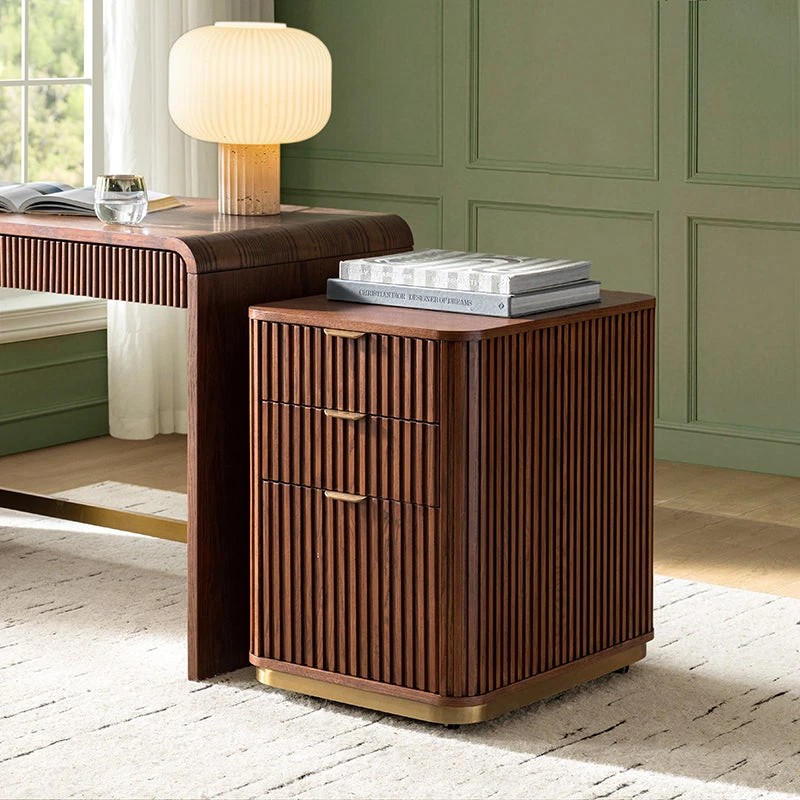
The Julia standing desk from Hulala Home is one of the objects that marks this transition from improvised to intentional. A motorised, height-adjustable workstation with a solid wood surface, clean square edges, built-in drawer, and built-in cable management — available in Cocoa Walnut and Light Oak. It is not office furniture relocated into a home. It is domestic furniture designed for the room it will live in: for the wooden floor it will stand on, for the light that falls on it in the morning, for the quality it maintains when the laptop is closed and the room returns to itself.
What a Grown-Up Home Office Looks Like
A grown-up home office is not a corporate showroom installed in a spare room. It is not a curated Instagram backdrop or a productivity influencer’s perfectly lit desk setup. It is something quieter and more durable than either of those things: a room that functions fully as a workspace during working hours and fully as a room outside them.
That means a desk that reads as furniture when the screen is off — something with the material quality to belong in a room rather than to occupy it. It means a chair that was chosen for the back, not inherited from the dining table. It means light that serves both the working day and the evening. It means storage that closes, cables that are not visible, a surface that stays clear because the desk itself has a drawer rather than because you have decided to be tidier than you historically are.
It means, in short, a room that was designed — even if simply, even if gradually, even if one considered choice at a time. The home office that began as crisis infrastructure in 2020 deserves, five years on, to be the room you chose. Not the room you ended up in.
The Choice That Matters Most
People upgrading their home offices in 2025 are asking the same question in different forms: where do I start? The answer, consistently, is the desk. Not because the desk is the most emotionally resonant object in the room — that is usually the chair — but because it is the most visually dominant one. The desk sets the material register of everything around it. Choose a desk with a laminate surface and an aluminium frame, and every subsequent choice in the room will be pulled toward the visual grammar of the corporate office. Choose a desk with a solid wood surface and a warm base, and the room has permission to be domestic.
The most important decision in a home office is not the monitor size, not the broadband speed, not the ergonomic chair specification. It is the desk. Everything in the room radiates from it — the lamp position, the storage solution, the anti-fatigue mat, the wall behind it. Get the desk right and the rest of the room has a foundation to build from. Get it wrong and no subsequent investment will quite fix the room.
The home office has grown up. Five years of hybrid working have given us the time, the stability, and the reason to stop accepting the improvised arrangement and start making the considered one. The room you work in every day deserves the same attention you would give to any other permanent room in your home. The desk is where that attention starts. Choose it accordingly.